
| Reference: | S50316 |
| Author | Bernard PICART |
| Year: | 1722 |
| Measures: | 215 x 330 mm |
| Reference: | S50316 |
| Author | Bernard PICART |
| Year: | 1722 |
| Measures: | 215 x 330 mm |
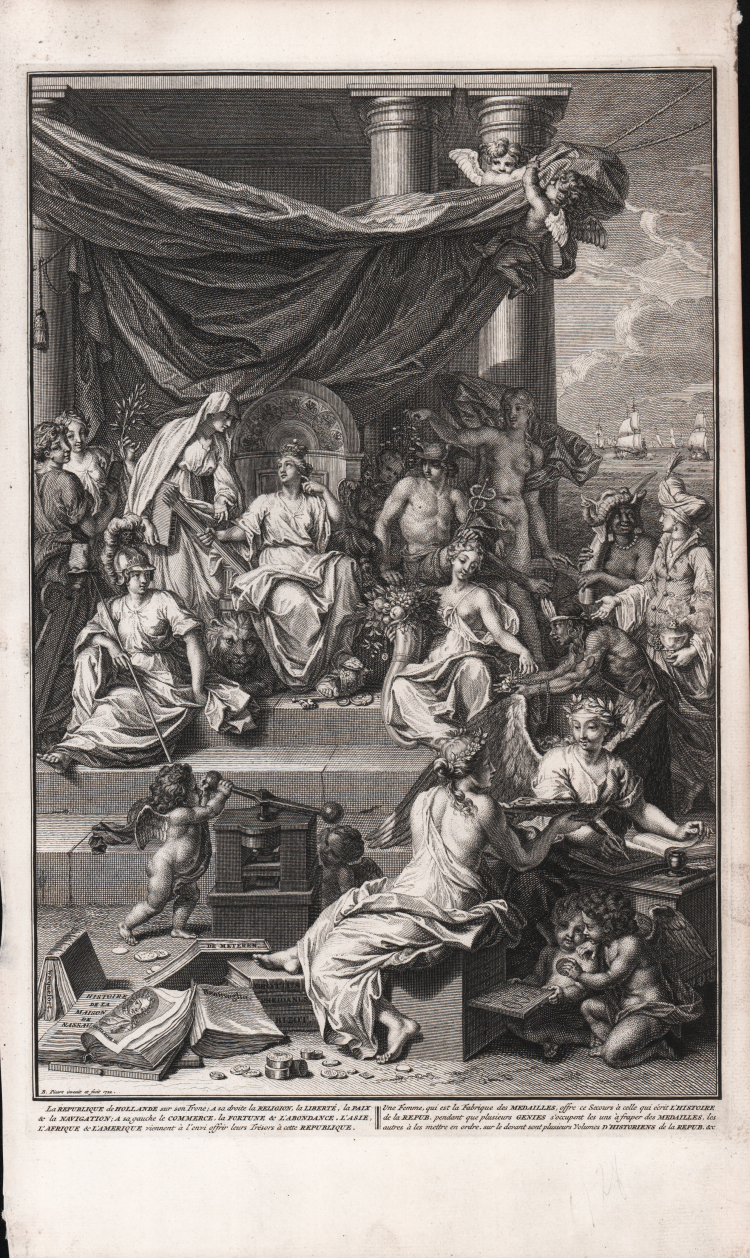
The glorification of the Dutch Republic, also identified as a naval power by the large sailing ships in the background, depicts a crowned female figure on a throne, surrounded by allegorical figures representing freedom, peace, fertility, science, and artistic achievement, and honored by foreign peoples.
Allegorical plate used as the frontispiece of the Histoire des Provinces-Uniés des Pays Bas ... avec les principales médailles et leur explication, published in Amsterdam by Zacharias Châtelain from 1723 to 1728.
The French engraver Bernard Picart, who initially worked in Paris and moved to Amsterdam in 1710, was one of the most creative book illustrators and a highly regarded artist for allegorical depictions such as this one, as well as for ornamental engravings.
Etching, 1722, signed and dated on the plate lower left. A beautiful work on contemporary laid paper, with margins, in excellent condition.
Bernard PICART (Parigi 1673 - Amsterdam 1733)
|
Bernard Picart (Paris, June 11, 1673 - Amsterdam, May 8, 1733) was a French engraver. His father Etienne (1632-1721), known as the Roman, was well known for the excellence of his drawing and was his first teacher along with renowned artists of the time such as Sébastien Leclerc. In the brief biographical sketch compiled by his second wife, Anna Vincent, and published in Amsterdam soon after the artist's death, it is mentioned that the famous court painter Charles Le Brun paid attention to the artist, then 18 years old, when he received the prize of the Academy of Fine Arts. He moved to Antwerp in 1696, and spent a year in Amsterdam before returning to France in 1698 because of his mother's death and his father's ailments. After the death of his wife in 1708, he moved permanently to the Dutch capital in 1711, where he converted to Protestantism and married again. During this time Picart lent his happy hand to illustrate the books of authors who came to him. He depicted physiognomies, architecture, episodes and anecdotes told in the written pages, historical subjects, numismatics, portraits, costume scenes, gallant pastimes and chivalric activities that so appealed to the French, Dutch, Belgians and Swedes. Most of his works were collected in a kind of illustrated book, which included the Bible and Ovid. His most important work is Cérémonies et coutumes religieuses de tous les peuples du monde, edited by Jean-Frédéric Bernard between 1723 and 1743.
|
Bernard PICART (Parigi 1673 - Amsterdam 1733)
|
Bernard Picart (Paris, June 11, 1673 - Amsterdam, May 8, 1733) was a French engraver. His father Etienne (1632-1721), known as the Roman, was well known for the excellence of his drawing and was his first teacher along with renowned artists of the time such as Sébastien Leclerc. In the brief biographical sketch compiled by his second wife, Anna Vincent, and published in Amsterdam soon after the artist's death, it is mentioned that the famous court painter Charles Le Brun paid attention to the artist, then 18 years old, when he received the prize of the Academy of Fine Arts. He moved to Antwerp in 1696, and spent a year in Amsterdam before returning to France in 1698 because of his mother's death and his father's ailments. After the death of his wife in 1708, he moved permanently to the Dutch capital in 1711, where he converted to Protestantism and married again. During this time Picart lent his happy hand to illustrate the books of authors who came to him. He depicted physiognomies, architecture, episodes and anecdotes told in the written pages, historical subjects, numismatics, portraits, costume scenes, gallant pastimes and chivalric activities that so appealed to the French, Dutch, Belgians and Swedes. Most of his works were collected in a kind of illustrated book, which included the Bible and Ovid. His most important work is Cérémonies et coutumes religieuses de tous les peuples du monde, edited by Jean-Frédéric Bernard between 1723 and 1743.
|