
| Reference: | S50774 |
| Author | Benjamin Wright |
| Year: | 1613 ca. |
| Measures: | 277 x 220 mm |
| Reference: | S50774 |
| Author | Benjamin Wright |
| Year: | 1613 ca. |
| Measures: | 277 x 220 mm |
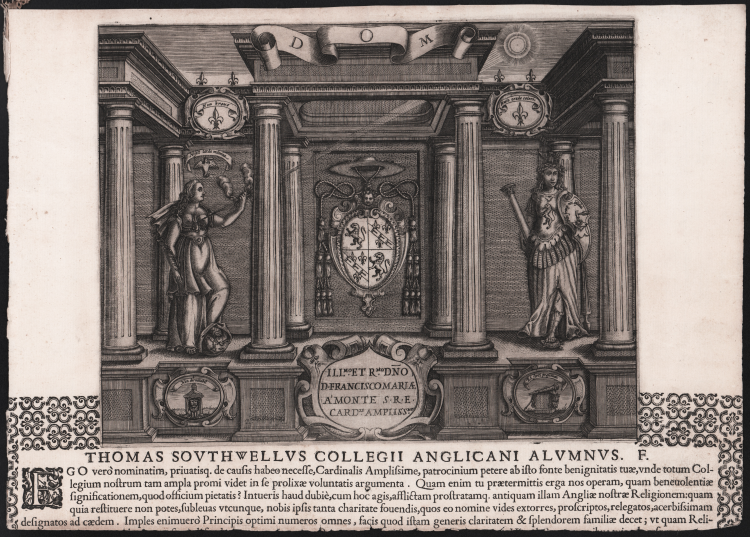
Allegorical print for the thesis defense of Thomas Soutwell (Thomas Bacon) discussed at the English College in Rome around 1613, and dedicated to Cardinal Francesco Maria Bourbon del Monte Santa Maria, whose coat of arms appears in the center of the composition.
Engraving, around 1613, without signature and editorial indications, which we attribute for stylistic reasons to Matthaeus Greuter.
Magnificent work, rich in tones, printed on contemporary laid paper, with margins, in good condition.
Through to the work of reformers such as Ignatius of Loyola, by 1600 Rome had become a city of schools. The University of Rome, founded in the early 14th century, was joined by the Collegio Romano, founded by the Jesuits in 1551, the Seminario Romano, various national schools (including the Germanic College, the Greek College, and the English College) - dedicated to the education of young Catholics from non-Catholic countries - the Collegio Clementino, and many other minor colleges and academies. These institutions represented important new markets for printing. Professors published books that required title pages, while students celebrated their academic achievements by publishing flyers and brochures richly decorated with engravings. The impact of all this on the printing industry was considerable. At the beginning of the 17th century, Rome's educational institutions were among the city's most important consumers of printed matter. The academic year was punctuated by thesis discussions, events of fundamental importance within the system, which allowed the most gifted and talented students to showcase their eloquence and erudition before an elite audience. Thesis discussions generated a large amount of printed material, as well as the most elaborate. The broadsheets (a term used to describe individual printed publications that do not belong to a book or collection) listing the ‘conclusions’, or theses, that the student would discuss became essential accessories, which, over time, were embellished with engravings rich in artistic and iconographic virtuosity, giving rise to a fashion that would last more than a hundred years.
Prints designed and produced specifically to decorate the broadsheets first appeared in the mid-1580s, and by 1590 it was common practice for students to commission large and impressive heraldic-allegorical compositions to accompany their defenses. From the outset, these prints were not only decorative but also had a celebratory function. The Jesuits encouraged their students to dedicate their theses to important and influential figures, knowing that an elegant and well-received dedication had the potential to promote not only the defender's career prospects but also the reputation of the college. The conclusion thus served the same purpose as the dedication: both were designed to oil the mechanisms of patronage.
Among the leading artists/engravers who specialized in this new graphic market were Matthaeus and his son Johann Friedrich Greuter, who clearly enjoyed a special relationship with the Jesuits, judging by the number of prints they made for them and their students. Matthaeus may have established a connection with the Society even before leaving France; and among the Jesuits based in Rome were influential Germans who may have given him a helping hand when he first arrived there in 1603. This would explain how he managed to get off to a good start, completing several large conclusions for students at the Roman College and the Germanic College before the end of 1604. After gaining a foothold in the college market, he quickly established himself as one of the leading producers of conclusions in Rome. Fifty-eight prints of Matthaeus' theses are listed in The New Hollstein, but he certainly engraved more. At least a dozen unlisted ones exist, and since he did not always sign his plates, there are probably many more yet to be identified.
These theses, although probably printed in large numbers, are now very rare, and only a few copies are recorded in institutional collections around the world. Not described by Hollstein.
Bibliografia
Louise Rice, Matthaeus Greuter and the Conclusion Industry in Seventeenth-Century Rome, in “Ein Priviilegiertes Medium und die Bildkulturen Europas, Deutsche, Franzosische und Niederlandische Kupferstecher und Graphikvetleger in Rom von 1590 bis 1630” Ròmische Studien der Bibliotheca Hertziana b.de 32, pp. 221-238; cfr, Jorg Diefembacher, The Greuter Family part I, Matthaeus Greuter, in “The New Hollstein”.
Benjamin Wright(1575-1613)
Benjamin Wright(1575-1613)