
| Reference: | A53187 |
| Author | Christoffel JEGHER |
| Year: | 1630 ca. |
| Measures: | 330 x 420 mm |
| Reference: | A53187 |
| Author | Christoffel JEGHER |
| Year: | 1630 ca. |
| Measures: | 330 x 420 mm |
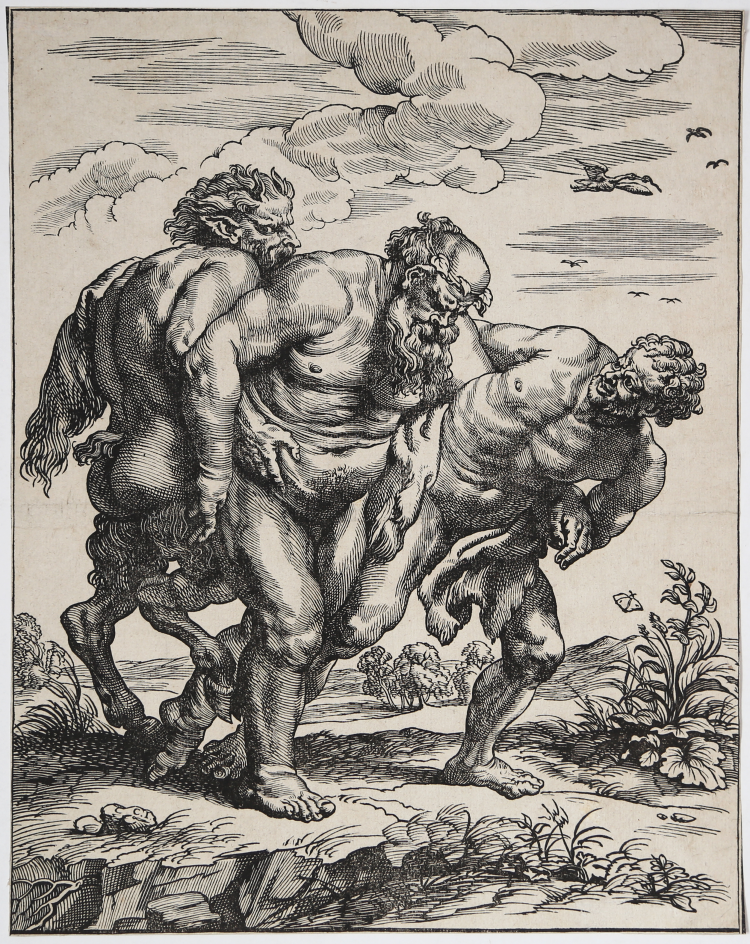
The drunken Silenus supported by a satyr and a faun, walking to right.
Woodcut, circa 1630, after Peter Paul Rubens (Siegen 1577–1640 Antwerp). Lettered in lower margin with production details: "P.P. Rub. delineau. / et excud." and "CVM PRIVILEGIIS" and "Christoffel Iegher sculp.". Signed on the stone at lower left “C. I.”.
Probably after a design by Rubens and made under his supervision. The satyr and the faun are after a painting by Rubens ('Drunken Bacchus') today at the Alte Pinakothek of Munich, of which a copy by Rubens' circle is in the Musée des Beaux-Arts, Angers. A preparatory drawn modello is in the Cabinet de dessins, Musée du Louvre, Paris.
In addition to publishing engravings of his work, Rubens also issued a series of large woodcuts (cut by Christoffel Jegher) which were the last great woodcuts to be made for a period of almost two hundred years. This woodcut of the "Drunken Silenus" from around 1630, designed by Peter Paul Rubens and engraved by Christoffel Jegher, exemplifies how Baroque artists continued to find powerful expressive possibilities in classical mythological subjects. Depicting Silenus—the Greek god of wine and companion to Dionysus/Bacchus—in a state of intoxication surrounded by satyrs and nymphs, the print demonstrates how mythological narratives provided frameworks for exploring aspects of human experience that might otherwise be difficult to address directly.
The collaborative nature of this work—with Rubens providing the design and Jegher executing the engraving—exemplifies how printmaking facilitated broader circulation of mythological imagery, allowing compositions originally accessible only to elite audiences to reach wider publics. This democratisation of mythological imagery played an important role in maintaining the cultural relevance of classical references even as European society underwent profound religious and social transformations.
Silenus himself represents a complex mythological figure whose drunkenness was associated not just with physical intoxication but with philosophical insight and prophetic wisdom. This ambiguity made him a particularly suitable subject for exploring tensions between physical indulgence and spiritual/intellectual transcendence that preoccupied Baroque culture. Rubens' characteristic style, with its emphasis on dynamic, sensual figures, was particularly well-suited to capturing this paradoxical aspect of Silenus' nature.
The print's connection to related works in Munich and the Louvre's Cabinet des Dessins demonstrates how mythological subjects circulated across media and national boundaries, creating complex networks of visual reference that maintained the cultural currency of classical themes throughout Europe.
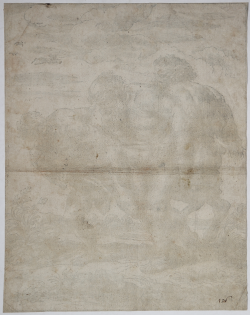
A fine impression, printed with tone on contemporary laid paper with “number 4 over letters IB” watermark (Bodart n. 10), trimmed to the borderline and missing the lower margin, trace of central fold on the back, otherwise perfect condition.
Example of the first state of two, before Rubens' address is removed. Although this example lacks the lower white margin, in which the production details are placed, the high quality of the impression and his watermarks suggest that this is the first state of the woodcut.
Bibliografia
Hollstein, Dutch and Flemish etchings, engravings and woodcuts c.1450-1700, p. 188, n. 16 I/II; Schneevoogt, Catalogue des estampes gravées d'après P.P.Rubens (135.139); D. Bodart, Rubens e l’incisione, pp. 83-84, n. 156.
Christoffel JEGHER (Anversa 1596 - 1652/53)
|
Christoffel Jegher or Christophe Jegher, born around 1596 and died around 1652, was a Flemish engraver, whose family originated from the province of Silesia, and who was active in Antwerp in the 17th century.
From 1625 on, Christoffel Jegher worked as an xylographer in the printing house run by Christophe Plantin in Antwerp. He produced book illustrations, ornaments and woodcuts with Christian religious themes.
In 1627-1628 Jegher was admitted to the Antwerp Guild of St. Luke as a wood engraver. It is assumed that he imitated the style of Christoffel van Sichem the Elder. In 1630, he was present in the workshop of Peter Paul Rubens as a wood engraver and from 1633 onwards, the collaboration between Rubens and Jegher intensified, and Jegher's style of wood engraving several important works that the Flemish master intended to publish changed profoundly. Done under the watchful eye of the latter, they are executed with great virtuosity and create the illusion of pen-and-ink drawing.
From 1630 on, Christoffel Jegher also produced a series of woodcuts based on drawings by Erasmus Quellinus and Frans Francken I. His son Jan Christoffel Jegher continued the tradition and engraved works by Antoine Sallaert.
|
Christoffel JEGHER (Anversa 1596 - 1652/53)
|
Christoffel Jegher or Christophe Jegher, born around 1596 and died around 1652, was a Flemish engraver, whose family originated from the province of Silesia, and who was active in Antwerp in the 17th century.
From 1625 on, Christoffel Jegher worked as an xylographer in the printing house run by Christophe Plantin in Antwerp. He produced book illustrations, ornaments and woodcuts with Christian religious themes.
In 1627-1628 Jegher was admitted to the Antwerp Guild of St. Luke as a wood engraver. It is assumed that he imitated the style of Christoffel van Sichem the Elder. In 1630, he was present in the workshop of Peter Paul Rubens as a wood engraver and from 1633 onwards, the collaboration between Rubens and Jegher intensified, and Jegher's style of wood engraving several important works that the Flemish master intended to publish changed profoundly. Done under the watchful eye of the latter, they are executed with great virtuosity and create the illusion of pen-and-ink drawing.
From 1630 on, Christoffel Jegher also produced a series of woodcuts based on drawings by Erasmus Quellinus and Frans Francken I. His son Jan Christoffel Jegher continued the tradition and engraved works by Antoine Sallaert.
|