

| Reference: | A53200 |
| Author | Laurent de La Hyre |
| Year: | 1639 |
| Measures: | 220 x 285 mm |
| Reference: | A53200 |
| Author | Laurent de La Hyre |
| Year: | 1639 |
| Measures: | 220 x 285 mm |
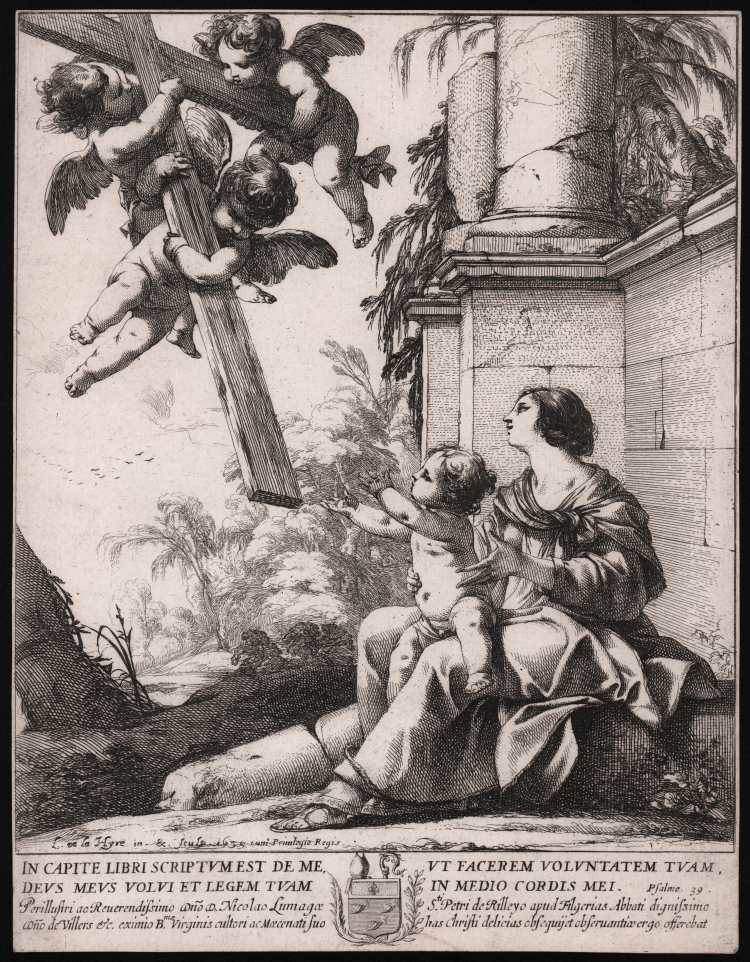
Three cherubs presenting the Cross to Child seated on Virgin's lap.
Etching, 1639, dated and signed on plate: 'L. De la Hyre in. & Scul.'; inscription in Latin and dedication to Abbott Nicolas Lumague.
After a drawing by the artist, now at Albertina, Vienna (Inv. 11.558).
Example of the second state of three.
Laurent de La Hyre made a name for himself in his native Paris in the first half of the 17th century above all as a painter of religious and mythological scenes, although he also took an interest early on in printmaking and left an exquisite oeuvre of high-quality etchings. After studying in Fontainebleau he was active for a while in Paris in the flourishing studio run by Georges Lallemand.
A fine impression, printed on contemporary laid paper without watermark, trimmed to the platemark, in good condition.
Bibliografia
Robert-Dumesnil, Le Peintre-Graveur Français, I.81.8.II; Rosenberg & Thuillier, Laurent de la Hyre, 155.II.
Laurent de La Hyre (Parigi, 27 febbraio 1606 – Parigi, 28 dicembre 1656)
|
La Hyre was certainly a pupil of Georges Lallemant, just as he certainly studied and was influenced by the work of Francesco Primaticcio at the Château de Fontainebleau. However, there is no evidence that he ever traveled to Italy, as was the custom of French painters at the time, who traveled to Rome to study the models of Antiquity and the Renaissance before returning home.
La Hyre was perhaps the most perfect example of the restrained and moderate expressiveness known as "Parisian Atticism," which contrasted with the Baroque tendencies of Simon Vouet, who returned from Italy in 1627 and dominated the French painting scene in the 1630s and 1640s.
In his early years, La Hyre, like his teacher Lallemant, was a typical exponent of the late Mannerism still in vogue in France. For the young La Hyre, the 1630s, a period of effervescence in French painting following Vouet's return, were a time of experimentation: after some brief attempts to escape in the wake of Caravaggio, his work falls within that transitional phase that, from post-Renaissance mannered painting, opens the door to the Baroque experience, and finally stabilizes, in the late 1630s, towards a classicism inspired by the example of Nicolas Poussin, who spent two years in Paris between 1640 and 1642.
A cultured painter, interested in mathematics, La Hyre loved to treat mythological subjects that were usually rarely depicted by other painters. However, it was precisely in the field of landscape painting that La Hire was unsurpassed in the 1640s and 1650s. Alongside Claude Lorrain, La Hyre was one of the finest landscape painters of his time, creating balanced scenes with clear, harmonious colors and a particular attention to the depiction of the ancient ruins that populate his imaginative views. His interest in geometry, architectural proportions, and the mathematical harmony of forms are also evident in his drawings and prints.
From the mid-1630s, he became one of the most sought-after Parisian painters, creating large altarpieces for the capital's major churches, including two so-called "Mays" for Notre-Dame Cathedral. He also created models for a large series of tapestries for the Royal Gobelins Manufactory. Proof of his fame is that in 1648, he was one of the twelve founding members of the Académie Royale de Peinture et de Sculpture, the highest institution governing the Fine Arts in France.
He fell ill and died in Paris at the age of 50, in December 1656.
|
Laurent de La Hyre (Parigi, 27 febbraio 1606 – Parigi, 28 dicembre 1656)
|
La Hyre was certainly a pupil of Georges Lallemant, just as he certainly studied and was influenced by the work of Francesco Primaticcio at the Château de Fontainebleau. However, there is no evidence that he ever traveled to Italy, as was the custom of French painters at the time, who traveled to Rome to study the models of Antiquity and the Renaissance before returning home.
La Hyre was perhaps the most perfect example of the restrained and moderate expressiveness known as "Parisian Atticism," which contrasted with the Baroque tendencies of Simon Vouet, who returned from Italy in 1627 and dominated the French painting scene in the 1630s and 1640s.
In his early years, La Hyre, like his teacher Lallemant, was a typical exponent of the late Mannerism still in vogue in France. For the young La Hyre, the 1630s, a period of effervescence in French painting following Vouet's return, were a time of experimentation: after some brief attempts to escape in the wake of Caravaggio, his work falls within that transitional phase that, from post-Renaissance mannered painting, opens the door to the Baroque experience, and finally stabilizes, in the late 1630s, towards a classicism inspired by the example of Nicolas Poussin, who spent two years in Paris between 1640 and 1642.
A cultured painter, interested in mathematics, La Hyre loved to treat mythological subjects that were usually rarely depicted by other painters. However, it was precisely in the field of landscape painting that La Hire was unsurpassed in the 1640s and 1650s. Alongside Claude Lorrain, La Hyre was one of the finest landscape painters of his time, creating balanced scenes with clear, harmonious colors and a particular attention to the depiction of the ancient ruins that populate his imaginative views. His interest in geometry, architectural proportions, and the mathematical harmony of forms are also evident in his drawings and prints.
From the mid-1630s, he became one of the most sought-after Parisian painters, creating large altarpieces for the capital's major churches, including two so-called "Mays" for Notre-Dame Cathedral. He also created models for a large series of tapestries for the Royal Gobelins Manufactory. Proof of his fame is that in 1648, he was one of the twelve founding members of the Académie Royale de Peinture et de Sculpture, the highest institution governing the Fine Arts in France.
He fell ill and died in Paris at the age of 50, in December 1656.
|