

| Reference: | S48730 |
| Author | Frans Crabbe van Espleghem |
| Year: | 1575 ca. |
| Measures: | 240 x 240 mm |
| Reference: | S48730 |
| Author | Frans Crabbe van Espleghem |
| Year: | 1575 ca. |
| Measures: | 240 x 240 mm |
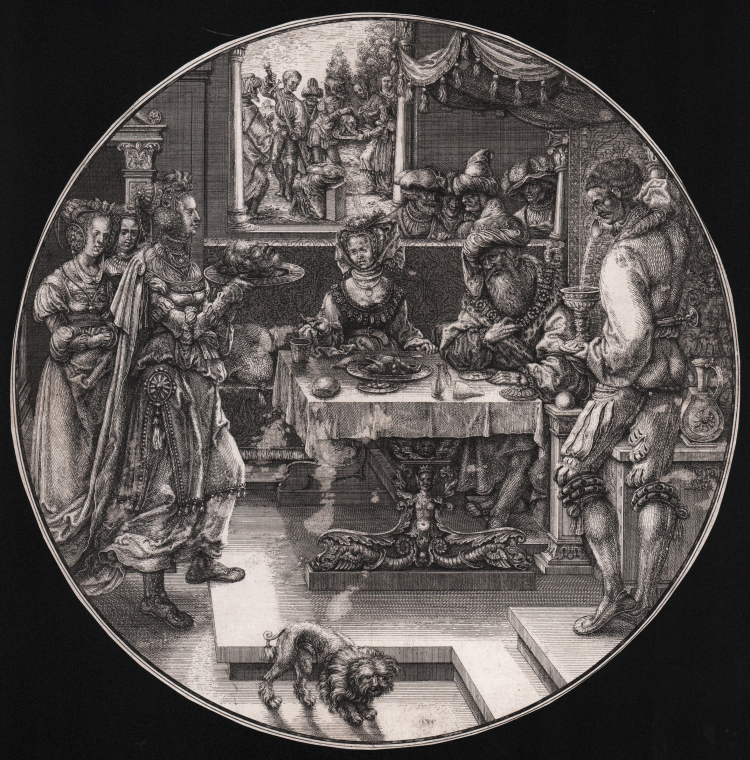
The Death of Saint John the Baptist; Salome enters a room on the left accompanied by two maids, proudly holding a plate with the Baptist's head. Her mother, Herodias, and her uncle Herod sit at the table, while a servant pours wine into a glass for him. In the background, a window depicts the beheading of Saint John.
Etching in roundel, diameter approximately 240 mm, circa 1575/1625.
First-state example, before the addition of the monogram 'GWL' at the bottom and numerous engraving retouches throughout the floor.
The print is derived from a similar subject painted on glass by Jan Gossaert, known as Mabuse (1478–1532), by an anonymous, unidentified artist, probably a pupil of Frans Crabbe (1480–1553), whose style he imitated.
The composition refers to the biblical episode of Salome carrying the head of Saint John the Baptist on a platter to the table where Herod Antipas and Herodias, Salome's mother, are seated. Herodias, having abandoned her husband, went to live with her brother-in-law, King Herod Antipas. John the Baptist publicly condemned their conduct. The king then first imprisoned him and then, to please Herodias's beautiful daughter, who hated the Baptist, had him beheaded.
Frans Crabbe van Espleghem, Flemish printmaker. Friedländer first identified the Master of the Crayfish Frans Crabbe in 1921. It seems likely that Crabbe met and was influenced by Albrecht Dürer during the latter's visit to Mechelen in June 1521. In 1539 Crabbe acquired the workshop of Nicolaas Hogenberg, he is recorded in Mechelen as a master in the Guild of St Luke and head of the Brotherhood of Our Lady. His work is transitional, combining late northern medieval subjects and compositions with a style and technique showing the influence of the Italian Renaissance. He was especially indebted to Lucas van Leyden in his concern for atmosphere and depth in landscape, and to Jan Gossart for Italianate figure types. Crabbe worked as an engraver, woodcutter and etcher but is noted for etching because of his unusual success in a medium considered by his contemporaries to be limited. His achievement lies in his ability to create graphic equivalents for a painterly style in this experimental medium and in his ambitious compositions, which show his ability to depict striking lighting and atmospheric conditions. Surviving examples of his work are rare.
A magnificent work, rich in tone, printed on laid paper without watermark, trimmed to the platemark, in excellent condition.
A very rare work, not described in literature.
A first and a second state of this work are held in the British Museum collection.
https://www.britishmuseum.org/collection/object/P_1865-0708-96
https://www.britishmuseum.org/collection/object/P_1931-0119-3
Frans Crabbe van Espleghem (Mechelen 1480 circa - 1553 circa)
|
Flemish printmaker. Friedländer first identified the Master of the Crayfish Frans Crabbe in 1921. It seems likely that Crabbe met and was influenced by Albrecht Dürer during the latter's visit to Mechelen in June 1521. In 1539 Crabbe acquired the workshop of Nicolaas Hogenberg, he is recorded in Mechelen as a master in the Guild of St Luke and head of the Brotherhood of Our Lady. His work is transitional, combining late northern medieval subjects and compositions with a style and technique showing the influence of the Italian Renaissance. He was especially indebted to Lucas van Leyden in his concern for atmosphere and depth in landscape, and to Jan Gossart for Italianate figure types. Crabbe worked as an engraver, woodcutter and etcher but is noted for etching because of his unusual success in a medium considered by his contemporaries to be limited. His achievement lies in his ability to create graphic equivalents for a painterly style in this experimental medium and in his ambitious compositions, which show his ability to depict striking lighting and atmospheric conditions. Surviving examples of his work are rare.
|
Frans Crabbe van Espleghem (Mechelen 1480 circa - 1553 circa)
|
Flemish printmaker. Friedländer first identified the Master of the Crayfish Frans Crabbe in 1921. It seems likely that Crabbe met and was influenced by Albrecht Dürer during the latter's visit to Mechelen in June 1521. In 1539 Crabbe acquired the workshop of Nicolaas Hogenberg, he is recorded in Mechelen as a master in the Guild of St Luke and head of the Brotherhood of Our Lady. His work is transitional, combining late northern medieval subjects and compositions with a style and technique showing the influence of the Italian Renaissance. He was especially indebted to Lucas van Leyden in his concern for atmosphere and depth in landscape, and to Jan Gossart for Italianate figure types. Crabbe worked as an engraver, woodcutter and etcher but is noted for etching because of his unusual success in a medium considered by his contemporaries to be limited. His achievement lies in his ability to create graphic equivalents for a painterly style in this experimental medium and in his ambitious compositions, which show his ability to depict striking lighting and atmospheric conditions. Surviving examples of his work are rare.
|