
| Reference: | S47011 |
| Author | Agostino de Musi detto VENEZIANO |
| Year: | 1528 |
| Measures: | 85 x 130 mm |
| Reference: | S47011 |
| Author | Agostino de Musi detto VENEZIANO |
| Year: | 1528 |
| Measures: | 85 x 130 mm |
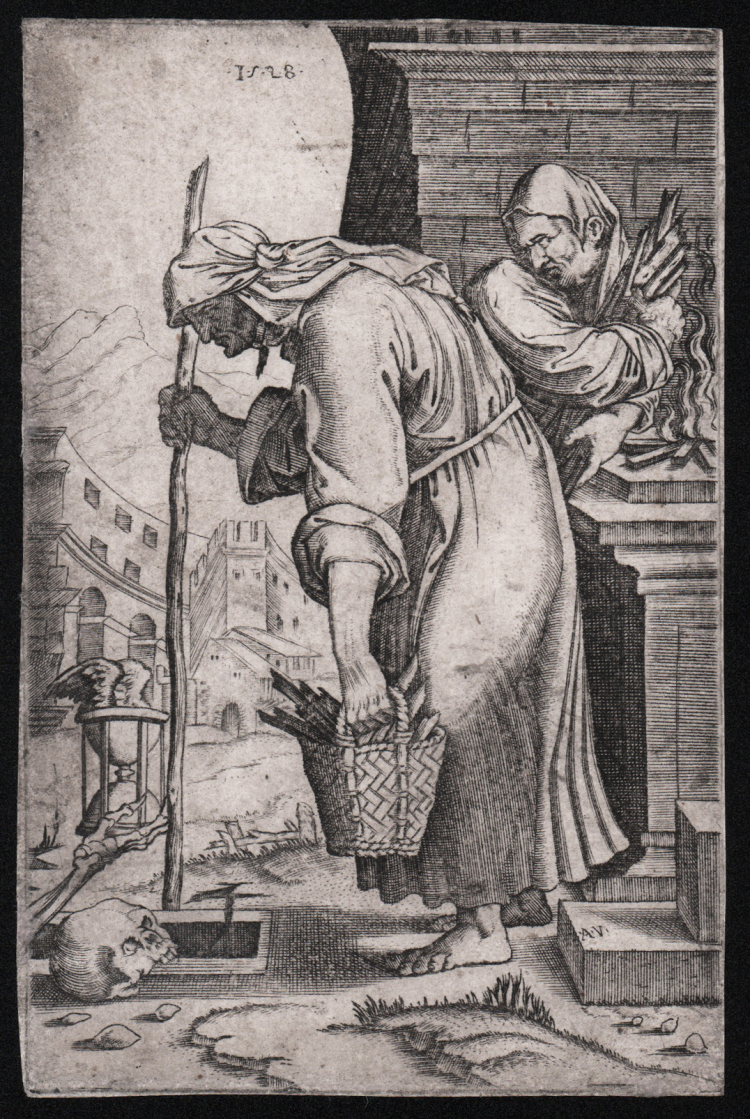
Engraving, 1528, monogrammed and dated on the plate.
From a drawing by the workshop of Raphael Sanzio.
The engraving by Agostino Veneziano, known as "The Old Woman Going to the Grave" depicts an elderly woman walking toward a tomb, symbolizing the theme of memento mori. The work was likely created following the Sack of Rome in 1527, as evidenced by the cityscape in the background. On the left, near the tomb, are a skull and a winged hourglass held by a skeleton's arm; on the right, a second woman is burning wood on a sacrificial altar. All these macabre elements contribute to giving the composition a strong connotation regarding the theme of mortality and the emptiness of earthly life.
A beautiful, clear and brilliant work, in its only known state, printed on contemporary laid paper without watermark but date back to the first half of the sixteenth century, trimmed to copperplate or with very thin margins, in good condition.
Bibliografia
Bartsch, n. 457; Delaborde, pp. 41, 290; Passavant, n. 104; Ferrara-D'Amico, n. 67
Agostino de Musi detto VENEZIANO (Venezia 1490 ca. - Roma 1536/38)
|
Heir of the great tradition of the Raimondi’s, Agostino Musi, from the family de Masyus or dè Musis, also known as the Veneziano, derives his nick name from the city where he studied the “giorgionesco” style of Giulio Campagnola, di Jacopo dè Barbari and Dürer.
For a while, Agostino lived in Florence translating works from Andrea del Sarto. After that, he moved to Rome where he started working in the workshop of Bavero di Carrocci (aka Baviera) from 1516 till the Sack (Sacco) of the City.
After the Sack, he very likely went back to Florence and maybe Mantua, where he worked on Giulio Romano’s production. Between 1530 and 1531 Agostino went back to Rome and engraved the marvellous Vasi antichi e moderni, with the coats of arms of Clemente VII de Medici; in this work it can be seen his own, peculiar, ornamental style, which he used to realize splendid works for the first, great Roman publisher, Antonio Salamanca.
Bartsch ascribes to him 181 prints, dated between 1509 and 1536; Passavant then added other seven subjects (VI, pp. 49-68).
|
Agostino de Musi detto VENEZIANO (Venezia 1490 ca. - Roma 1536/38)
|
Heir of the great tradition of the Raimondi’s, Agostino Musi, from the family de Masyus or dè Musis, also known as the Veneziano, derives his nick name from the city where he studied the “giorgionesco” style of Giulio Campagnola, di Jacopo dè Barbari and Dürer.
For a while, Agostino lived in Florence translating works from Andrea del Sarto. After that, he moved to Rome where he started working in the workshop of Bavero di Carrocci (aka Baviera) from 1516 till the Sack (Sacco) of the City.
After the Sack, he very likely went back to Florence and maybe Mantua, where he worked on Giulio Romano’s production. Between 1530 and 1531 Agostino went back to Rome and engraved the marvellous Vasi antichi e moderni, with the coats of arms of Clemente VII de Medici; in this work it can be seen his own, peculiar, ornamental style, which he used to realize splendid works for the first, great Roman publisher, Antonio Salamanca.
Bartsch ascribes to him 181 prints, dated between 1509 and 1536; Passavant then added other seven subjects (VI, pp. 49-68).
|