
| Reference: | A51000 |
| Author | Erhard Schoen |
| Year: | 1528 ca. |
| Measures: | 255 x 290 mm |
| Reference: | A51000 |
| Author | Erhard Schoen |
| Year: | 1528 ca. |
| Measures: | 255 x 290 mm |
Woodcut, circa 1528/29.
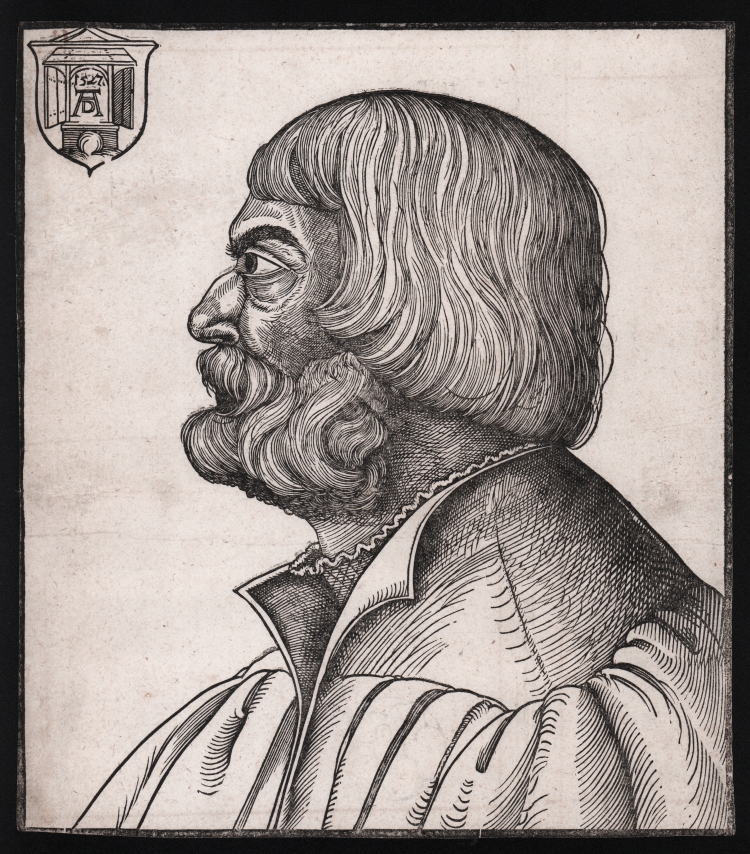
Portrait of Albrecht Dürer; bust-length in profile to left based on the medal by Matthes Gebel; in upper left corner shield with coat-of-arms with Dürer's monogram and the date 1527.
Example of the second state, without typographic text and the coat of arms with date 1527 and Dürer monogram inserted within the open door of the arms.
Formerly attributed to Albrecht Dürer himself, this woodcut is now ascribed to the hand of Erhard Schön (1491-1542). The print is based on the medal by Mathes Gebel. It was probably first issued shortly after Dürer's death in response to demand for portraits of him. Some impression was printed by Hans Glaser in Nuremberg with an additional laudatory poem by the 'Meistersinger' Hans Sachs (1494-1576), which mentions the high esteem in which Dürer is held by princes and lords near and far as well as the importance of his work on artists and craftsmen of the mid-sixteenth century ('Des wardt er bey Fürsten und Herren /Ehrlich gehalten nach und ferren / Und bey all künstlich weckleuten / Die noch sein kunst loben und deuten ); it also incorrectly gives the date of death as 6 May instead of 6 April. Such early impressions of the print are extremely rare. It was reprinted at least eight times during the sixteenth century alone, and there are five recorded copies.
Erhard Schön was born and worked in Nuremberg. After Albrecht Dürer's death in 1528, he was the most prolific woodcut artist in Nuremberg. A follower and imitator of Dürer's style, he was also influenced by Hans Springinklee. He primarily produced woodcuts with large, simple compositions, easy to print in large quantities for the general public, rather than works of particular aesthetic value aimed at the collector's market. He was employed by virtually every printer and "Briefmaler" (producer of loose sheets and minor printed matter) in Nuremberg, and also worked for printers in Bamberg, Vienna, and Lyon. In addition to his early religious works, his woodcuts illustrate mythological and historical subjects, as well as the satirical anticlerical allegories used by the Protestant Reformers, for which he is best known, but which, due to their controversial nature, were not signed.
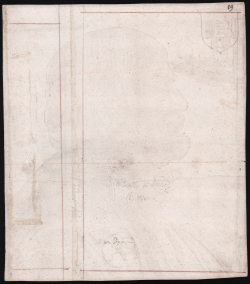
A fine impression, printed on contemporary laid paper with “Cross on Trimount” watermark (Meder 157, Briquet 1242 la data al 1556), trimmed to the borderline, a repaired print crease on the upper left, otherwise in good condition.
Bibliografia
Bartsch, Le Peintre graveur, n. 156; Hollstein, German engravings, etchings and woodcuts c.1400-1700 (156.II); G. Bartrum, 'Albrecht Dürer and his Legacy', exh. cat., London British Museum, 2002-3, n.12.
|
Schön was born in Nuremberg as the son of painter Max Schön III. He probably started to learn his trade as an artist in the workshop of his father. He was clearly influenced by the printmaking of Albrecht Dürer and may have contributed a few woodcuts to Dürer's Triumphal Arch (1515) and Theuerdank (1517). Especially Schön's way of modelling and placing figures is clearly derived from Dürer. After the death of Dürer, Schön also produced a woodcut portrait of the artist.
Such woodcut portraits was only one of the genres Schön worked in. He produced prints of various kind for the popular market and established himself as a popularly demanded artist. Around 1200 illustrations for 116 books in addition to 200 separate woodcuts have been attributed to Schön. His first known work is a series of woodcuts for a book, from 1513. Until 1524 he mainly illustrated religious books. Together with Hans Springinklee he provided illustrations of rather high quality for the popular prayer book Hortulus Animae in 1515. A Great Rosary form approximately the same time has been described as his finest religious work. From the 1520s he produced several polemical works criticising Catholicism and in favour of Lutheranism. From the mid-1520s and early 1530s these satirical works display an influence from Barthel Beham, Sebald Beham and Georg Pencz. At this time, he also expanded his repertoire from religious to secular subjects, still with a satirical tone. From the 1530s, he switched to Classical themes such as the Judgement of Paris and Laocoön. In 1538 Christoph Zell of Nuremberg published a treatise on proportion in art.
|
|
Schön was born in Nuremberg as the son of painter Max Schön III. He probably started to learn his trade as an artist in the workshop of his father. He was clearly influenced by the printmaking of Albrecht Dürer and may have contributed a few woodcuts to Dürer's Triumphal Arch (1515) and Theuerdank (1517). Especially Schön's way of modelling and placing figures is clearly derived from Dürer. After the death of Dürer, Schön also produced a woodcut portrait of the artist.
Such woodcut portraits was only one of the genres Schön worked in. He produced prints of various kind for the popular market and established himself as a popularly demanded artist. Around 1200 illustrations for 116 books in addition to 200 separate woodcuts have been attributed to Schön. His first known work is a series of woodcuts for a book, from 1513. Until 1524 he mainly illustrated religious books. Together with Hans Springinklee he provided illustrations of rather high quality for the popular prayer book Hortulus Animae in 1515. A Great Rosary form approximately the same time has been described as his finest religious work. From the 1520s he produced several polemical works criticising Catholicism and in favour of Lutheranism. From the mid-1520s and early 1530s these satirical works display an influence from Barthel Beham, Sebald Beham and Georg Pencz. At this time, he also expanded his repertoire from religious to secular subjects, still with a satirical tone. From the 1530s, he switched to Classical themes such as the Judgement of Paris and Laocoön. In 1538 Christoph Zell of Nuremberg published a treatise on proportion in art.
|