

| Reference: | S45100 |
| Author | Antonio SARTI |
| Year: | 1828 |
| Measures: | 700 x 540 mm |
| Reference: | S45100 |
| Author | Antonio SARTI |
| Year: | 1828 |
| Measures: | 700 x 540 mm |
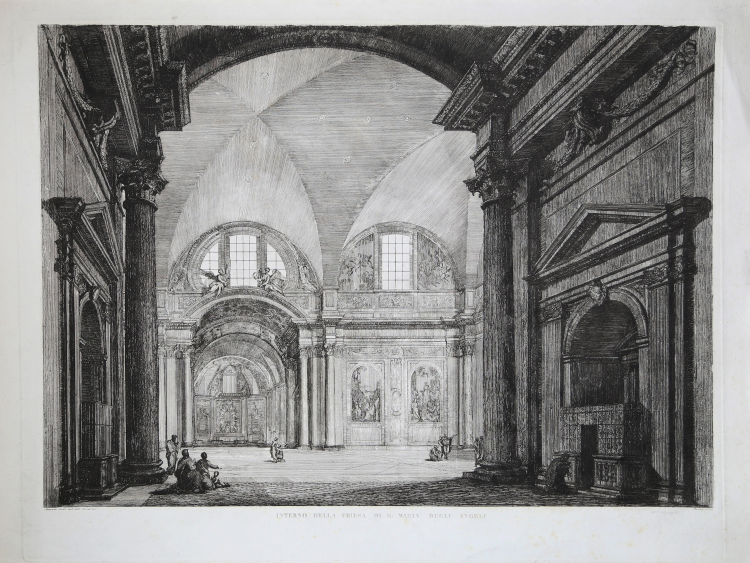
Etching, 1828, signed in plate at lower left Antonio Sarti architect dis. and inc.
Beautiful proof, printed on contemporary paper, with margins, in very good condition.
The print belongs to a series of large interiors of Roman churches that Antonio Sarti made between 1825 and 1829, in the style of his more famous contemporary Luigi Rossini.
Sarti was an important architect (Budrio 1797 - Rome 1880). Trained at the Bologna Academy, he later moved to Rome. Influenced by R. Stern and G. Valadier, he built in Terracina the church of S. Salvatore, his masterpiece, a synthesis of classical and Palladian elements. He was also active in Frosinone (delegatizio palace) and Rome; here he is remembered for his interventions in Palazzo Grazioli, Villa Torlonia, the realization of the Manifattura dei tabacchi (1859-63) and the surrounding urban intervention. In 1875 he donated his library of about 10,000 volumes to the municipality of Rome, which granted it in perpetual deposit to the Accademia di S. Luca (Biblioteca romana Sarti), of which Sarti was professor and president.
Bibliografia
C.A. Petrucci, CATALOGO GENERALE DELLE STAMPE TRATTE DAI RAMI INCISI POSSEDUTI DALLA CALCOGRAFIA NAZIONALE, 1730, p 00111, 1953.
Antonio SARTI (Budrio, 18 ottobre 1797 – Roma, 24 settembre 1880)
|
He was born in Budrio on October 18, 1797. Having learned the rudiments of drawing from the set designer Francesco Cocchi and the painter Faustino Trebbi, in 1813 he was sent to the Academy of Fine Arts in Bologna, where he attended courses in figure drawing, ornamentation, perspective, and architecture. In 1819, he won a fellowship in Rome for the architecture class, which provided a young student from the Bologna institute with the opportunity to reside in the city for a four-year period to perfect his knowledge of classical art. In the papal capital, Cardinal Ercole Consalvi, who had become his patron, introduced him to the most renowned architects and painters of the time. During those years, Sarti attended courses in architecture and drawing at the Academy of San Luca; a pupil of Raffaele Stern, upon his master's death he decided to publish his lectures: the first volume alone was published in 1822 by Giuseppe Salviucci. Having devoted himself to the practice of engraving, from 1825 he began producing etchings of architectural subjects, which aroused the appreciation of Vincenzo Camuccini; for the Chamber's Calcografia he produced the volume Parte interna delle basilicache di Roma e veduta di edifici antichi e moderni disegni e incise all'acqua forte (Rome 1825-1829; A. Cavallini, Uomini illustri romani del secolo XIX..., 1879, p. 12). For the rest of his life he devoted himself mainly to his work as an architect. Influenced by R. Stern and G. Valadier, he built the church of S. Salvatore in Terracina, his masterpiece, a synthesis of classical and Palladian elements. He was also active in Frosinone (delegation palace) and in Rome; Here we recall the works carried out at Palazzo Grazioli, Villa Torlonia, the construction of the tobacco factory (1859-63), and the surrounding urban development (subsequently altered). In 1875, he donated his library, comprising approximately 10,000 volumes, to the municipality of Rome, which granted it in perpetuity to the Academy of St. Luke (Sarti Roman Library), of which Sarti was professor and president. He died in Rome on September 24, 1880.
|
Antonio SARTI (Budrio, 18 ottobre 1797 – Roma, 24 settembre 1880)
|
He was born in Budrio on October 18, 1797. Having learned the rudiments of drawing from the set designer Francesco Cocchi and the painter Faustino Trebbi, in 1813 he was sent to the Academy of Fine Arts in Bologna, where he attended courses in figure drawing, ornamentation, perspective, and architecture. In 1819, he won a fellowship in Rome for the architecture class, which provided a young student from the Bologna institute with the opportunity to reside in the city for a four-year period to perfect his knowledge of classical art. In the papal capital, Cardinal Ercole Consalvi, who had become his patron, introduced him to the most renowned architects and painters of the time. During those years, Sarti attended courses in architecture and drawing at the Academy of San Luca; a pupil of Raffaele Stern, upon his master's death he decided to publish his lectures: the first volume alone was published in 1822 by Giuseppe Salviucci. Having devoted himself to the practice of engraving, from 1825 he began producing etchings of architectural subjects, which aroused the appreciation of Vincenzo Camuccini; for the Chamber's Calcografia he produced the volume Parte interna delle basilicache di Roma e veduta di edifici antichi e moderni disegni e incise all'acqua forte (Rome 1825-1829; A. Cavallini, Uomini illustri romani del secolo XIX..., 1879, p. 12). For the rest of his life he devoted himself mainly to his work as an architect. Influenced by R. Stern and G. Valadier, he built the church of S. Salvatore in Terracina, his masterpiece, a synthesis of classical and Palladian elements. He was also active in Frosinone (delegation palace) and in Rome; Here we recall the works carried out at Palazzo Grazioli, Villa Torlonia, the construction of the tobacco factory (1859-63), and the surrounding urban development (subsequently altered). In 1875, he donated his library, comprising approximately 10,000 volumes, to the municipality of Rome, which granted it in perpetuity to the Academy of St. Luke (Sarti Roman Library), of which Sarti was professor and president. He died in Rome on September 24, 1880.
|