
| Reference: | S48028 |
| Author | Sebastian Münster |
| Year: | 1552 |
| Zone: | Istanbul |
| Printed: | Basle |
| Measures: | 400 x 310 mm |
| Reference: | S48028 |
| Author | Sebastian Münster |
| Year: | 1552 |
| Zone: | Istanbul |
| Printed: | Basle |
| Measures: | 400 x 310 mm |
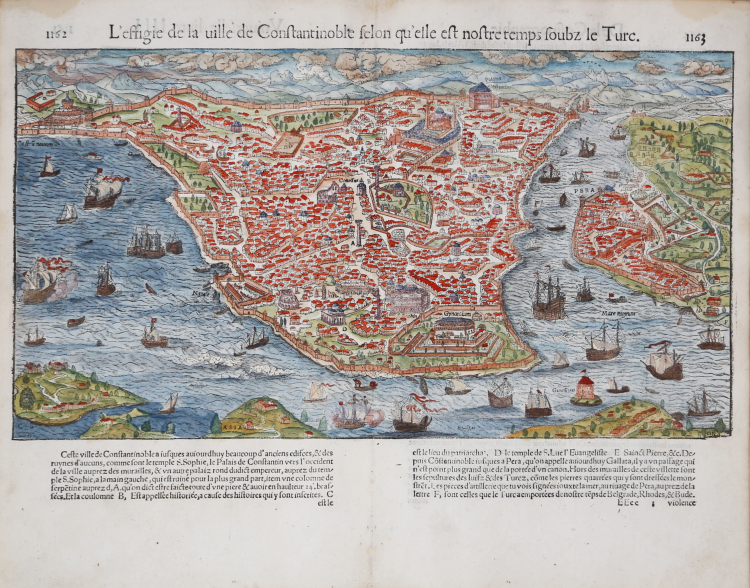
Sebastian Münster's attractive, 1550 woodcut bird's-eye view map of Constantinople (Istanbul), displays the city in detail viewed from the east, emphasizing both its ancient ruins and its contemporary monuments, including the Hagia Sophia, the palace of Constantine, the Gynoecium, and the Ottoman Imperial Arsenal. The city's suburbs of Pera can be seen to the north on the right side of the view. The waters of the Bosporus are teeming with ships of every description.
This is a derivation of the map published in Venice by Giovanni Andrea Vavassore and attributed to Giovanni Domenico Zorzi, circa 1520/30. Also known as Domenico delle Greche he lived in the then Constantinople for a period, beginning in 1525.
Zorzi-Vavassore's depiction of the city was to be the reference model taken up by all the mapss published in the 16th and 17th centuries. Some scholars speculate that for the drawing Vavassore may have been inspired by an earlier representation, now lost, perhaps by Florentine cartographer Francesco Roselli, or Venetian artist Gentile Bellini. It is also related to the manuscript map preserved in Düsseldorf, attributed to Buondelmonti, because both depict the city as it must have been toward the end of Mehmed II's reign, around 1480. Particularly striking are the coincidences in the depiction of the area outside the walls of Pera: in both plans there are cemeteries, canyons, fenced enclosures, and even written references such as "aguas frescas" or "vineyards of Pera." The two also reflect similar shipyards, docks, and arsenals in terms of location and type of activity. Vavassore also includes old and new palaces in his plan, defining elements of Ottoman power. However, he forgets some important mosques, such as Eyüp or Rum Mehmet Paşa, and instead fills the spaces with rows of buildings and a road network and incorporates erroneous elements, including a church about whose existence there is no historical evidence.
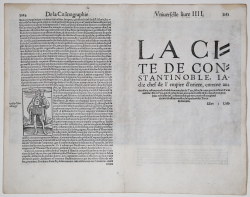
Plate taken from the Cosmographiae Universalis, Frenche edition, published with the title La cosmographie universelle, contenant la situation de toutes les parties du monde Basel, 1552 [first French edition].
The Cosmographiae Universalis of Sebastian Münster (1488-1552), printed for the first time in Basel in 1544 by the publisher Heinrich Petri, was updated several times and increased with new maps and urban representations in its many editions until the beginning of the next century. Münster had worked to collect information in order to obtain a work that did not disappoint expectations and, after a further publication in German embellished with 910 woodblock prints, arrived in 1550 to the final edition in Latin, illustrated by 970 woodcuts.
There were then numerous editions in different languages, including Latin, French, Italian, English and Czech. After his death in Münster (1552), Heinrich Petri first, and then his son Sebastian, continued the publication of the work. The Cosmographia universalis was one of the most popular and successful books of the 16th century, and saw as many as 24 editions in 100 years: the last German edition was published in 1628, long after the author's death. The Cosmographia contained not only the latest maps and views of all the most famous cities, but also a series of encyclopedic details related to the known, and unknown, world.
The particular commercial success of this work was due in part to the beautiful engravings (among whose authors can be mentioned Hans Holbein the Younger, Urs Graf, Hans Rudolph Manuel Deutsch, David Kandel).
Woodcut, fine later hand colour, in good condition.
Sebastian Münster (1488 - 1552)
|
Sebastian Münster was a German cartographer, cosmographer, and Hebrew scholar whose Cosmographia (1544; "Cosmography") was the earliest German description of the world and a major work - after the Nuremberg Chronicle of 1493 - in the revival of geography in the 16th-century Europe. Altogether, about 40 editions of the Cosmographia appeared during 1544-1628. Although other cosmographies predate Münster's, he is given first place in historical discussions of this sort of publication, and was a major influence on his subject for over 200 years.
In nearly all works by Münster, his Cosmographia is given pride of place. Despite this, we still lack a detailed survey of its contents from edition to edition, along the years from 1544 to 1628, and an account of its influence on a wide range of scientific disciplines. Münster obtained the material for his book in three ways. He used all available literary sources. He tried to obtain original manuscript material for description of the countryside and of villages and towns. Finally, he obtained further material on his travels (primarily in south-west Germany, Switzerland, and Alsace). The Cosmographia contained not only the latest maps and views of many well-known cities, but included an encyclopaedic amount of details about the known - and unknown - world and undoubtedly must have been one of the most widely read books of its time.
Aside from the well-known maps and views present in the Cosmographia, the text is thickly sprinkled with vigorous woodcuts: portraits of kings and princes, costumes and occupations, habits and customs, flora and fauna, monsters and horrors. The 1614 and 1628 editions of Cosmographia are divided into nine books. Nearly all the sections, especially those dealing with history, were enlarged. Descriptions were extended, additional places included, errors rectified.
|
Sebastian Münster (1488 - 1552)
|
Sebastian Münster was a German cartographer, cosmographer, and Hebrew scholar whose Cosmographia (1544; "Cosmography") was the earliest German description of the world and a major work - after the Nuremberg Chronicle of 1493 - in the revival of geography in the 16th-century Europe. Altogether, about 40 editions of the Cosmographia appeared during 1544-1628. Although other cosmographies predate Münster's, he is given first place in historical discussions of this sort of publication, and was a major influence on his subject for over 200 years.
In nearly all works by Münster, his Cosmographia is given pride of place. Despite this, we still lack a detailed survey of its contents from edition to edition, along the years from 1544 to 1628, and an account of its influence on a wide range of scientific disciplines. Münster obtained the material for his book in three ways. He used all available literary sources. He tried to obtain original manuscript material for description of the countryside and of villages and towns. Finally, he obtained further material on his travels (primarily in south-west Germany, Switzerland, and Alsace). The Cosmographia contained not only the latest maps and views of many well-known cities, but included an encyclopaedic amount of details about the known - and unknown - world and undoubtedly must have been one of the most widely read books of its time.
Aside from the well-known maps and views present in the Cosmographia, the text is thickly sprinkled with vigorous woodcuts: portraits of kings and princes, costumes and occupations, habits and customs, flora and fauna, monsters and horrors. The 1614 and 1628 editions of Cosmographia are divided into nine books. Nearly all the sections, especially those dealing with history, were enlarged. Descriptions were extended, additional places included, errors rectified.
|