
| Reference: | S52051 |
| Author | Carl Ludwig Hackert |
| Year: | 1781 ca. |
| Zone: | Geneve & Mont Blanc |
| Printed: | Ginevra |
| Measures: | 510 x 390 mm |
| Reference: | S52051 |
| Author | Carl Ludwig Hackert |
| Year: | 1781 ca. |
| Zone: | Geneve & Mont Blanc |
| Printed: | Ginevra |
| Measures: | 510 x 390 mm |
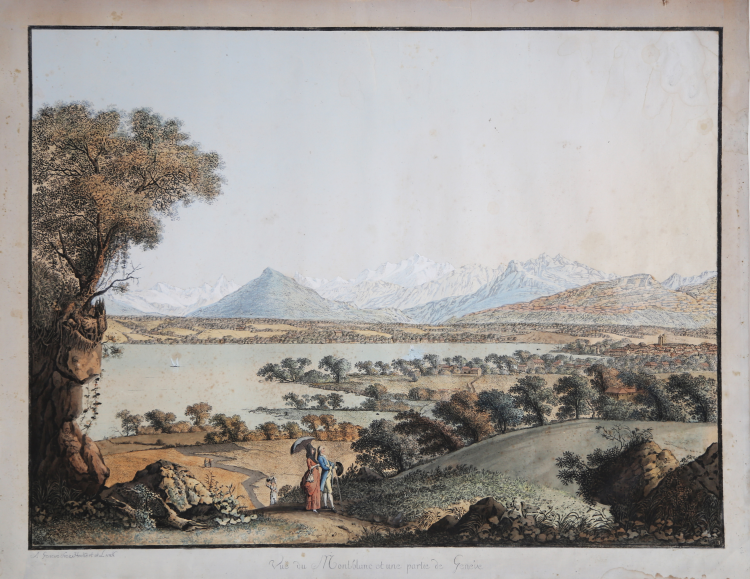
Magnificent view of Mont Blanc and part of Lake Geneva.
Etching, 1781 circa, with fine original colour, signed at lower left A Geneve chez Hackert et Link.
Carl Ludwig was the second of five Hackert brothers, all artists, whose father was a Berlin painter. The oldest son, Phillip (Prenzlau 1737 – 1807 Florence) became a very famous artist, painting for royal patrons across Europe. He traveled to Naples in the late 18th century, before settling in Rome, where he was joined by Carl Ludwig in 1772. The three younger Hackerts also visited Phillip in the Eternal City. Phillip encouraged Carl Ludwig’s work in oil and gouache, and the second son soon produced several Roman and Italian views, including the offered painting in 1777, before decamping to France and Switzerland in 1778.
A fine impression, on contemporary laid paper, light foxing, otherwise very good condition. Rare.
Bibliografia
De Loës, Geneva as seen in prints and watercolours, n. 106.
Carl Ludwig Hackert (1740-1796)
|
Carl Ludwig was the second of five Hackert brothers, all artists, whose father was a Berlin painter. The oldest son, Phillip (Prenzlau 1737 – 1807 Florence) became a very famous artist, painting for royal patrons across Europe. He traveled to Naples in the late 18th century, before settling in Rome, where he was joined by Carl Ludwig in 1772. The three younger Hackerts also visited Phillip in the Eternal City. Phillip encouraged Carl Ludwig’s work in oil and gouache, and the second son soon produced several Roman and Italian views, including the offered painting in 1777, before decamping to France and Switzerland in 1778.
Perhaps his best-known painting, completed in August, 1781, pictures the Mer de Glace (Sea of Ice), at Montenvers, in France. In 1818, Mary Wollstonecraft Shelley, in the company of husband Percy Bysshe, visited the place, describing it as “the most desolate place in the world,” and included it as a setting in Frankenstein, establishing beyond doubt the scene’s Romantic bona fides.
That desolation brought forth Carl Ludwig’s best work. Remote from his family, overshadowed by his far more famous brother, charting his own course (as second sons are said to do) he landed far afield, on his own, without a clientele for his skillful painting. Unlike Rome, with its torrent of Grand Tourists eager to shell out for captivating pictures of the city’s views, Morges, Switzerland, where Hackert eventually took his own life in 1796, was no tourist destination.
|
Carl Ludwig Hackert (1740-1796)
|
Carl Ludwig was the second of five Hackert brothers, all artists, whose father was a Berlin painter. The oldest son, Phillip (Prenzlau 1737 – 1807 Florence) became a very famous artist, painting for royal patrons across Europe. He traveled to Naples in the late 18th century, before settling in Rome, where he was joined by Carl Ludwig in 1772. The three younger Hackerts also visited Phillip in the Eternal City. Phillip encouraged Carl Ludwig’s work in oil and gouache, and the second son soon produced several Roman and Italian views, including the offered painting in 1777, before decamping to France and Switzerland in 1778.
Perhaps his best-known painting, completed in August, 1781, pictures the Mer de Glace (Sea of Ice), at Montenvers, in France. In 1818, Mary Wollstonecraft Shelley, in the company of husband Percy Bysshe, visited the place, describing it as “the most desolate place in the world,” and included it as a setting in Frankenstein, establishing beyond doubt the scene’s Romantic bona fides.
That desolation brought forth Carl Ludwig’s best work. Remote from his family, overshadowed by his far more famous brother, charting his own course (as second sons are said to do) he landed far afield, on his own, without a clientele for his skillful painting. Unlike Rome, with its torrent of Grand Tourists eager to shell out for captivating pictures of the city’s views, Morges, Switzerland, where Hackert eventually took his own life in 1796, was no tourist destination.
|