


| Reference: | A53192 |
| Author | Harmensz van Rijn detto REMBRANDT |
| Year: | 1641 ca. |
| Measures: | 65 x 95 mm |
| Reference: | A53192 |
| Author | Harmensz van Rijn detto REMBRANDT |
| Year: | 1641 ca. |
| Measures: | 65 x 95 mm |
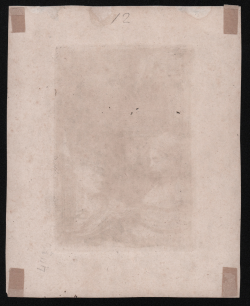
Etching, circa 1641, unsigned.
Offering a private view into the effort of an artist, Rembrandt depicts the action of drawing in Man Drawing from a Cast. Drawing after sculptures or plaster casts was a regular part of artistic training; only after having mastered this sufficiently was the young painter allowed to draw from the living model. Your own sketches, but also drawings and prints by other artists, were a reservoir of information and inspiration, to be delved into at will. These same methods appear to be employed in the workshop depicted here as well, given the large number of albums, books and papers stuffed into the cabinets in the background. A large-sized book has even been used as an improvised socle for the cast.
Rembrandt's technique is important to the success of this intimate etching. Beyond the man and his cast, the world retreats, as a single candle illuminates this quiet night scene. The limited light directs both our focus and the man's, and subtle tonal shifts move across the lowly lit forms, rendering this scene with precision. Through his use of contrasts, Rembrandt evokes the moment as not so much one of solitude, as of intimacy. There could, in addition, be a moral subtext to the work: practice makes perfect. There is surely an autobiographical element operating; the features of the artist depicted here bear a slight resemblance to Rembrandt's own, even if it is not a self-portrait.
This print features characteristics of the fourth and fifth of the six states described in The New Hollstein, with the addition of cross-hatching throughout.
A beautiful work, printed on unwatermarked laid paper, with margins, in excellent condition.
Bibliografia
The New Hollstein: Dutch and Flemish etchings, engravings and woodcuts 1450-1700 (192. IV/VI); Hind, A Catalogue of Rembrandt's Etchings; chronologically arranged and completely illustrated (191); White & Boon, Rembrandt's Etchings: An Illustrated Critical Catalogue (130).
Harmensz van Rijn detto REMBRANDT (Leida 1606 - Amsterdam 1669)
|
Born in Leiden, Holland in 1606, Rembrandt studied with Jacob Isaacsz van Swanenburgh (1571-1638) and Pieter Lastman (1583-1633). By 1626 he was an independent painter, working in Leiden alongside Jan Lievens (1607-74), another pupil of Lastman.
In 1631 Rembrandt moved to Amsterdam where he painted portraits of wealthy merchants. Three years later, he married his first wife, Saskia, and by the end of the 1630s he had moved into a substantial house (now the Rembrandt House Museum). In 1642, the year Rembrandt completed The Nightwatch (Rijksmuseum, Amsterdam), Saskia died.
By 1649, Hendrikje Stoffels had become his housekeeper and partner. Both Saskia and Hendrikje Stoffels posed for many paintings and sketches, often appearing as Susannah, Diana, Flora, Artemisa and other classical or Biblical figures. Rembrandt, however, was plagued by financial troubles and in 1656 his assets were made over to the courts, and many were sold. With his wife and son in financial control, Rembrandt continued to paint. Hendrikje died in 1663, his son Titus in 1668 and Rembrandt himself in 1669.
In his drawings, etchings and paintings, Rembrandt treated every subject: histories, landscapes, portraits, self-portraits, everyday scenes or sketches from nature. Rembrandt's biographer, Cornelis de Bie, praised his paintings, 'which enlighten every mind', and his etchings which are 'the very soul of life that lives therein'.
|
Harmensz van Rijn detto REMBRANDT (Leida 1606 - Amsterdam 1669)
|
Born in Leiden, Holland in 1606, Rembrandt studied with Jacob Isaacsz van Swanenburgh (1571-1638) and Pieter Lastman (1583-1633). By 1626 he was an independent painter, working in Leiden alongside Jan Lievens (1607-74), another pupil of Lastman.
In 1631 Rembrandt moved to Amsterdam where he painted portraits of wealthy merchants. Three years later, he married his first wife, Saskia, and by the end of the 1630s he had moved into a substantial house (now the Rembrandt House Museum). In 1642, the year Rembrandt completed The Nightwatch (Rijksmuseum, Amsterdam), Saskia died.
By 1649, Hendrikje Stoffels had become his housekeeper and partner. Both Saskia and Hendrikje Stoffels posed for many paintings and sketches, often appearing as Susannah, Diana, Flora, Artemisa and other classical or Biblical figures. Rembrandt, however, was plagued by financial troubles and in 1656 his assets were made over to the courts, and many were sold. With his wife and son in financial control, Rembrandt continued to paint. Hendrikje died in 1663, his son Titus in 1668 and Rembrandt himself in 1669.
In his drawings, etchings and paintings, Rembrandt treated every subject: histories, landscapes, portraits, self-portraits, everyday scenes or sketches from nature. Rembrandt's biographer, Cornelis de Bie, praised his paintings, 'which enlighten every mind', and his etchings which are 'the very soul of life that lives therein'.
|