


| Reference: | A53189 |
| Author | Harmensz van Rijn detto REMBRANDT |
| Year: | 1652 ca. |
| Measures: | 160 x 210 mm |
| Reference: | A53189 |
| Author | Harmensz van Rijn detto REMBRANDT |
| Year: | 1652 ca. |
| Measures: | 160 x 210 mm |
Etching, drypoint and engraving, circa 1652.
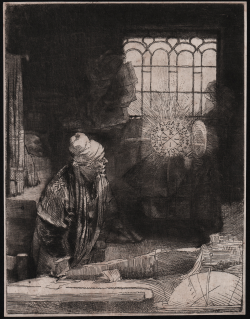
The etching depicts a man, pen in hand, leaning on a table with a writing-slope, papers and books on it. These attributes and the astrolabe in the lower right corner suggest that he is a scholar. His gaze is fixed on an apparition, partly surrounded by clouds, which looms up in front of the leaded panes of the window. Not all the details of this apparition are visible, but the hands are clearly discernible. The left one holds a foreshortened mirror, while the right points to it. The form is further concealed by a circle of radiating light that encloses a series of letters. Only the 'INRI' in the centre of this circle can immediately be identified, as being the abbreviation of the inscription placed over Christ's head during the crucifixion.
The question as to who or what precisely is depicted here still exercises experts and scholars after more than 300 years, and the interpretations are varied. In Clement de Jonghe's inventory of 1679, the subject is concisely described as the 'Practising Alchemist', but in 1731 Valerius Roever referred to the print as 'Doctor Faustus', and it has been known by this title ever since. Early in the twentieth century, P. Leendertz believed that he was able to substantiate the validity of this traditional title. He pointed to the fact that a Dutch version of Christopher Marlowe's Tragical History of Doctor Faustus was staged in Amsterdam in about 1650 and argued that Rembrandt's etching represents the moment when a good angel, in the shape of a shimmering apparition, warns Faust not to enter into a pact with the devil. Others sought alternative solutions, and several later studies concentrated primarily on solving the riddle of the letters in the circle, which are - rightly - described as a Jewish mystical text, a cabalistic anagram. The most influential theory was that advanced by Henri Van de Waal, who interpreted the traditional title of the print in an unexpected way. He argued that the etching does not depict Faust, but that it is the portrait of the founder of the Socinian sect, Faustus Socinus; the apparition in the window supposedly represents Socinus's complex ideas.
An entirely different reading of the work, and one that certainly merits consideration, was suggested by Lyckle de Vries. Drawing to some extent on earlier studies, he describes the print as an allegory of faith, illustrating a text from the Bible. In Paul's first letter to the Corinthians, the apostle likens the limitations of human knowledge, as opposed to perfect, divine knowledge, to looking in a mirror at puzzling reflections - through a glass darkly (I Corinthians 13, v. 12). De Vries believes that the circle with Christ's monogram and the mysterious text symbolises the divine knowledge, which humans can see at best as if in a mirror, in other words indirectly and distorted, and even then cannot comprehend. In this interpretation, the cabalistic anagram has no function other than to be indecipherable. We thus see a scholar - a seeker after truth and representative of the faithful in general - who is being reminded by the apparition that human knowledge or wisdom is limited, and that it is only through Christ that we can partake of perfect knowledge in the hereafter. Rembrandt devoted considerable attention to the execution of the print, creating a contrast between the dense, closely hatched background and the sketchy foreground. He never titled this work, however, and its meaning remains elusive.
The composition is based on two pictorial traditions: the iconography of “the scholar in an interior” and that of the “saint struck by a vision”. Whatever the real significance of the scene, what fascinates us is Rembrandt’s almost magical ability to master the rendering of light and to use it to convey a strong emotional message.
A good impression of the fifht state described by Hollstein, printed on laid paper without watermark, with thin margins, very slight foxing visible on the verso, otherwise very good condition.
Collection signature on verso “H. Troot 1753”.
Bibliografia
The New Hollstein: Dutch and Flemish etchings, engravings and woodcuts 1450-1700 (270.V/VII); Hind, A Catalogue of Rembrandt's Etchings; chronologically arranged and completely illustrated (260.III); White & Boon, Rembrandt's Etchings: An Illustrated Critical Catalogue (270); Hinterding, Rembrandt the Printmaker (69).
Harmensz van Rijn detto REMBRANDT (Leida 1606 - Amsterdam 1669)
|
Born in Leiden, Holland in 1606, Rembrandt studied with Jacob Isaacsz van Swanenburgh (1571-1638) and Pieter Lastman (1583-1633). By 1626 he was an independent painter, working in Leiden alongside Jan Lievens (1607-74), another pupil of Lastman.
In 1631 Rembrandt moved to Amsterdam where he painted portraits of wealthy merchants. Three years later, he married his first wife, Saskia, and by the end of the 1630s he had moved into a substantial house (now the Rembrandt House Museum). In 1642, the year Rembrandt completed The Nightwatch (Rijksmuseum, Amsterdam), Saskia died.
By 1649, Hendrikje Stoffels had become his housekeeper and partner. Both Saskia and Hendrikje Stoffels posed for many paintings and sketches, often appearing as Susannah, Diana, Flora, Artemisa and other classical or Biblical figures. Rembrandt, however, was plagued by financial troubles and in 1656 his assets were made over to the courts, and many were sold. With his wife and son in financial control, Rembrandt continued to paint. Hendrikje died in 1663, his son Titus in 1668 and Rembrandt himself in 1669.
In his drawings, etchings and paintings, Rembrandt treated every subject: histories, landscapes, portraits, self-portraits, everyday scenes or sketches from nature. Rembrandt's biographer, Cornelis de Bie, praised his paintings, 'which enlighten every mind', and his etchings which are 'the very soul of life that lives therein'.
|
Harmensz van Rijn detto REMBRANDT (Leida 1606 - Amsterdam 1669)
|
Born in Leiden, Holland in 1606, Rembrandt studied with Jacob Isaacsz van Swanenburgh (1571-1638) and Pieter Lastman (1583-1633). By 1626 he was an independent painter, working in Leiden alongside Jan Lievens (1607-74), another pupil of Lastman.
In 1631 Rembrandt moved to Amsterdam where he painted portraits of wealthy merchants. Three years later, he married his first wife, Saskia, and by the end of the 1630s he had moved into a substantial house (now the Rembrandt House Museum). In 1642, the year Rembrandt completed The Nightwatch (Rijksmuseum, Amsterdam), Saskia died.
By 1649, Hendrikje Stoffels had become his housekeeper and partner. Both Saskia and Hendrikje Stoffels posed for many paintings and sketches, often appearing as Susannah, Diana, Flora, Artemisa and other classical or Biblical figures. Rembrandt, however, was plagued by financial troubles and in 1656 his assets were made over to the courts, and many were sold. With his wife and son in financial control, Rembrandt continued to paint. Hendrikje died in 1663, his son Titus in 1668 and Rembrandt himself in 1669.
In his drawings, etchings and paintings, Rembrandt treated every subject: histories, landscapes, portraits, self-portraits, everyday scenes or sketches from nature. Rembrandt's biographer, Cornelis de Bie, praised his paintings, 'which enlighten every mind', and his etchings which are 'the very soul of life that lives therein'.
|