
| Reference: | S47123 |
| Author | Agostino CARRACCI |
| Year: | 1599 ca. |
| Measures: | 120 x 180 mm |
| Reference: | S47123 |
| Author | Agostino CARRACCI |
| Year: | 1599 ca. |
| Measures: | 120 x 180 mm |
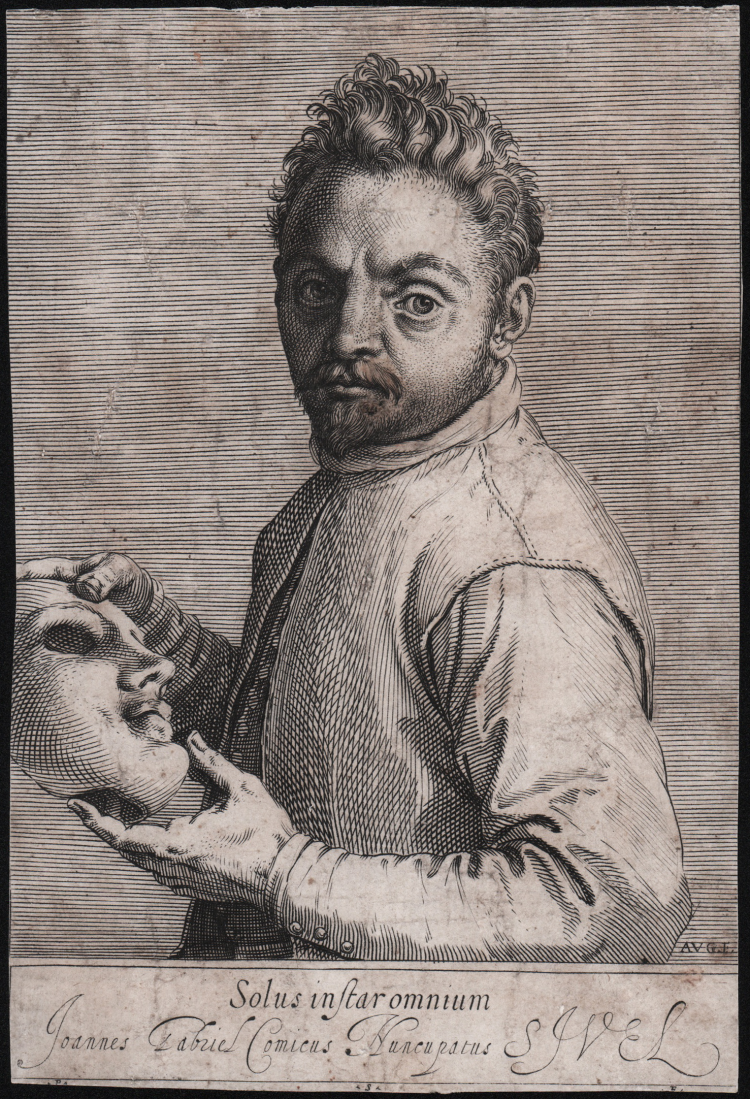
Engraving, circa 1599, signed on the plate lower right.
Good impression in its final state after the plate was completed, irregularly trimmed to the copperplate, minor defects restored, in good condition.
Giovanni Gabrieli (ca. 1557 – October 13, 1612) was an Italian composer and organist, born and died in Venice. One of the most influential musicians of his time, he represents the culmination of the Venetian school, framing the transition from Renaissance music to Baroque music. The exact date of his birth is unknown, although according to a contemporary obituary, at the time of his death he was 56 years old (or 58 years old, the handwriting is not very clear). He would have studied with his uncle, Andrea Gabrieli. Following his example, for several years he worked in Munich, at the court of Duke Albert V of Bavaria, possibly until the duke's death in 1579. There he would have studied with Orlando di Lasso, a friend of Andrea. Around 1584 he would have been substitute organist in San Marcos, in the absence of Claudio Merulo, to compete and win the position permanently in 1585. Also that year he began working as an organist at the Scuola Grande di San Rocco. He would hold both positions until his death. After the death of his uncle, he succeeded him as the main composer of San Marcos. His fame, increased by editions of his work in Germany, largely made by Caspar Hassler, attracted a large number of students, mainly from that country, among whom Heinrich Schütz stood out. Since 1606 he suffered from a kidney stone, which forced him to leave part of his responsibilities, and he died in 1612 due to complications from said disease.
Bibliografia
De Grazia D., Le stampe dei Carracci con i disegni, le incisioni, le copie ed i dipinti connessi (catalogo critico), n. 212, p. 193; AAVV, The Illustrated Bartsch, n. 153; Le Blanc C., Manuel de l'amateur d'estampes, n. 241.
Agostino CARRACCI (Bologna 1557 - Parma 1602)
|
Leading figure of the “Accademia degli Incamminati”, started in Bologna by his uncle, Lodovico Carracci, Agostino supported the anti-mannerism movement. He wanted to restore the great Italian tradition of the Renaissance, referring to artists such as Titian, Raphael, Michelangelo and Correggio.
Unlike Lodovico and Annibale, who preferred paintings and frescoes, he devouted himself to engravings, which he considered more coherent with his nature, reaching a very high quality level for the brightness of his sign and his technical skills.
He visited Parma, Venice and Rome (1594) following his brother Annibale who had been hired by the Farnese family, and this helped him to enlarge his knowledge of contemporary engravings.
His catalogue of engravings includes 234 pieces, with sacred subjects, taken from the main artists of his time (Tintoretto, Barocci, his brother Annibale, Francesco Vanni and many others); profane subjects, which he particularily loved and in which it can be seen his deep love for old, classic arts.
|
Agostino CARRACCI (Bologna 1557 - Parma 1602)
|
Leading figure of the “Accademia degli Incamminati”, started in Bologna by his uncle, Lodovico Carracci, Agostino supported the anti-mannerism movement. He wanted to restore the great Italian tradition of the Renaissance, referring to artists such as Titian, Raphael, Michelangelo and Correggio.
Unlike Lodovico and Annibale, who preferred paintings and frescoes, he devouted himself to engravings, which he considered more coherent with his nature, reaching a very high quality level for the brightness of his sign and his technical skills.
He visited Parma, Venice and Rome (1594) following his brother Annibale who had been hired by the Farnese family, and this helped him to enlarge his knowledge of contemporary engravings.
His catalogue of engravings includes 234 pieces, with sacred subjects, taken from the main artists of his time (Tintoretto, Barocci, his brother Annibale, Francesco Vanni and many others); profane subjects, which he particularily loved and in which it can be seen his deep love for old, classic arts.
|