
| Reference: | S51138 |
| Author | Galeazzo Gualdo Priorato |
| Year: | 1669 ca. |
| Zone: | Kazimierz, Krakov |
| Printed: | Wien |
| Measures: | 385 x 310 mm |
| Reference: | S51138 |
| Author | Galeazzo Gualdo Priorato |
| Year: | 1669 ca. |
| Zone: | Kazimierz, Krakov |
| Printed: | Wien |
| Measures: | 385 x 310 mm |
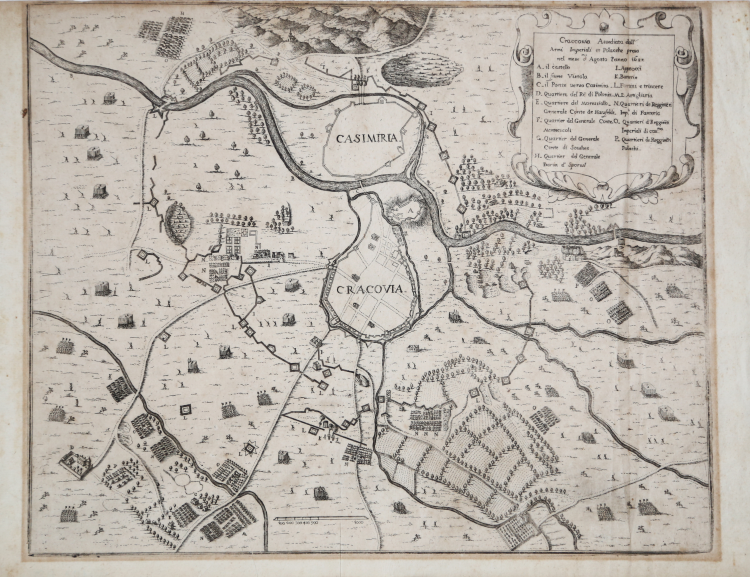
A rare map of the area around Kraków by Gualdo Priorato, showing the siege of August 1657 and published in Wien around 1669.
The map shows the positions of the combatants in and around the fortifications of Kraków and neighboring Kazimierz, on the opposite bank of the river.
Galeazzo Gualdo Priorato was born in Vicenza, in the Republic of Venice, on 23 July 1606. He followed his father into a military career at an early age. Gualdo Priorato served with Maurice, Prince of Orange, against the Spaniards, with d'Hauterive at La Rochelle, with Count Mansfeld, with Wallenstein and the Imperial Army, and finally with the Elector of Bavaria at the head of a Venetian regiment which was destroyed at the battle of Nördlingen. In later years he attached himself to the entourage of Cardinal Mazarin, becoming a naturalized French subject. In 1657, he passed into the service of Queen Christina of Sweden. Priorato left Christina's retinue to work for emperor Leopold I and subsequently received the title of imperial councillor and court historiographer. He participated in the meetings of Empress Eleonora's academy and acted as a link between it and Queen Christina. Gualdo Priorato retired eventually to Vicenza, his home town, where he prepared his works for publication. He died in Vicenza in 1678 and was buried in the family tomb in the church of S. Lorenzo.
After two years of Swedish and Transylvanian occupation, in the early summer of 1657, Polish Crown units under Hetman Jerzy Lubomirski appeared near Kraków. However, lacking artillery, the Poles limited their operations to cutting off Swedish and Transylvanian supply routes. In early August, the 17,000-man Holy Roman Army under Field Marshal Melchior von Hatzfeldt reinforced the Poles and began preparations for an assault. On August 4, however, a message from Rákóczi reached both sides. Since his army had been destroyed in the Battle of Czarny Ostrow (July 20), Rákóczi urged János Bethlen to surrender the city to the Poles.
The Transylvanians capitulated, but the Swedish garrison of Kraków, under the command of Paul Wirtz, continued to resist until August 25. Five days later, the Swedish units left the city, and on September 4, the Poles, together with the Austrians, held a military parade in the presence of King John Casimir.
Etching, good condition.
Galeazzo Gualdo Priorato (Vicenza, 23 luglio 1606 – Vicenza, 1678)
|
Galeazzo Gualdo Priorato was born in Vicenza, in the Republic of Venice, on 23 July 1606. He followed his father into a military career at an early age. Gualdo Priorato served with Maurice, Prince of Orange, against the Spaniards, with d'Hauterive at La Rochelle, with Count Mansfeld, with Wallenstein and the Imperial Army, and finally with the Elector of Bavaria at the head of a Venetian regiment which was destroyed at the battle of Nördlingen. In later years he attached himself to the entourage of Cardinal Mazarin, becoming a naturalized French subject. In 1657, he passed into the service of Queen Christina of Sweden. Priorato left Christina's retinue to work for emperor Leopold I and subsequently received the title of imperial councillor and court historiographer. He participated in the meetings of Empress Eleonora's academy and acted as a link between it and Queen Christina. Gualdo Priorato retired eventually to Vicenza, his home town, where he prepared his works for publication. He died in Vicenza in 1678 and was buried in the family tomb in the church of S. Lorenzo.
In the fourteen years spent outside of Italy Gualdo Priorato gained a wealth of political and military experience, which was to his advantage to write his many historical works. His record as historian includes an account of the military actions between the Spanish and Austrian Habsburgs and Gustavus Adolphus, a history of the Fronde and another of Mazarin's ministry (commissioned by the latter in 1652), biographies of Louis XIV and Queen Christina and books on contemporary warfare. He also wrote a history of the reign of Ferdinand III. Gualdo Priorato was the author of the first biography of Wallenstein, Historia della vita d'Alberto Valstain duca di Fritland (Lyon, 1643). Translated into Latin by Josua Arnd (1626-87), Priorato's life of Wallenstein is still one of the main near contemporary sources to the life and fate of the imperial generalissimo. Gualdo Priorato was one of the most observant narrators of the events, which took place in Germany after 1618. He not only gave the reader important information about the course of the military operations during the crucial years of the Thirty Years' War but he succeeded in describing, with great intensity, the story and the actions of the main protagonists of these events, including Gustavus Adolphus of Sweden and Wallenstein. His literary style is not affected by the flamboyance of the high Baroque era and stands out for its candour and directness. A prolific and learned author, with political but also literary ambitions, Priorato was a prominent member of the Venetian Accademia degli Incogniti. Several of Priorato's works were translated into English.
|
Galeazzo Gualdo Priorato (Vicenza, 23 luglio 1606 – Vicenza, 1678)
|
Galeazzo Gualdo Priorato was born in Vicenza, in the Republic of Venice, on 23 July 1606. He followed his father into a military career at an early age. Gualdo Priorato served with Maurice, Prince of Orange, against the Spaniards, with d'Hauterive at La Rochelle, with Count Mansfeld, with Wallenstein and the Imperial Army, and finally with the Elector of Bavaria at the head of a Venetian regiment which was destroyed at the battle of Nördlingen. In later years he attached himself to the entourage of Cardinal Mazarin, becoming a naturalized French subject. In 1657, he passed into the service of Queen Christina of Sweden. Priorato left Christina's retinue to work for emperor Leopold I and subsequently received the title of imperial councillor and court historiographer. He participated in the meetings of Empress Eleonora's academy and acted as a link between it and Queen Christina. Gualdo Priorato retired eventually to Vicenza, his home town, where he prepared his works for publication. He died in Vicenza in 1678 and was buried in the family tomb in the church of S. Lorenzo.
In the fourteen years spent outside of Italy Gualdo Priorato gained a wealth of political and military experience, which was to his advantage to write his many historical works. His record as historian includes an account of the military actions between the Spanish and Austrian Habsburgs and Gustavus Adolphus, a history of the Fronde and another of Mazarin's ministry (commissioned by the latter in 1652), biographies of Louis XIV and Queen Christina and books on contemporary warfare. He also wrote a history of the reign of Ferdinand III. Gualdo Priorato was the author of the first biography of Wallenstein, Historia della vita d'Alberto Valstain duca di Fritland (Lyon, 1643). Translated into Latin by Josua Arnd (1626-87), Priorato's life of Wallenstein is still one of the main near contemporary sources to the life and fate of the imperial generalissimo. Gualdo Priorato was one of the most observant narrators of the events, which took place in Germany after 1618. He not only gave the reader important information about the course of the military operations during the crucial years of the Thirty Years' War but he succeeded in describing, with great intensity, the story and the actions of the main protagonists of these events, including Gustavus Adolphus of Sweden and Wallenstein. His literary style is not affected by the flamboyance of the high Baroque era and stands out for its candour and directness. A prolific and learned author, with political but also literary ambitions, Priorato was a prominent member of the Venetian Accademia degli Incogniti. Several of Priorato's works were translated into English.
|