

| Reference: | S52991 |
| Author | Giovanni Battista FALDA |
| Year: | 1756 |
| Zone: | Rome |
| Printed: | Rome |
| Measures: | 890 x 690 mm |
| Reference: | S52991 |
| Author | Giovanni Battista FALDA |
| Year: | 1756 |
| Zone: | Rome |
| Printed: | Rome |
| Measures: | 890 x 690 mm |
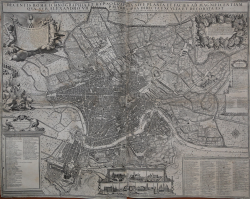
Rare third edition, with the date 1756, of the Falda's "pianta piccola (the small map)", to distinguish from the later large map, known as "pianta grande" on twelve sheets, both edited by G.B. de Rossi.
The date of the first edition of this work has been dated by Frutaz to 1667, as it includes the obelisk in the piazza S. Maria sopra Minerva. The works for the obelisk began in April 1666 and finished in February 1667.
At top left, in a cartouche, is a dedication to Pope Alexander VII, signed by G.G. De Rossi; framed in the bottom left and right is an Index with a list of places and churches. In the bottom center a view of seven chuches, included St. Peter.
Copperplate engraving, impressed on two sheets of contemporary laid paper joined together, with small margins, restorations in lower part of sheet, with partial loss of text in lower right legend, some abrasions and minor defects, otherwise in good condition.
Literature
Arrigoni-Bertarelli (1939): n. 168; Bartsch, 4725.281; Christie’s (1998): n. 1044; Frutaz (1962): pp. 218-219, n. CLVIa-b, Tavv. 345-349; Hülsen (1915): XXV, pp. 89-91, nn. 116-118; Scaccia Scarafoni (1939): pp. 102-103, n. 191.
Giovanni Battista FALDA (Valduggia, Novara, 1643; Rome, 1678)
|
Giovan Battista Falda, a native of Valduggia, was sent to Rome at the age of 14 and entrusted to the care of an uncle who pointed him out to Gian Lorenzo Bernini. But it was his meeting with printer Gian Giacomo De Rossi that marked a turning point in Falda's artistic career: in fact, his talent was directed by the publisher to the art of engraving. In De Rossi's workshop he could also appreciate the work of great engravers such as J. Callot, S. Della Bella and I. Silvestre; having completed his apprenticeship, he was benevolently received at the papal court, so much so that Alexander VII commissioned him to design the factories of the Castel Gandolfo residence. In 1665, Falda gave to the presses for the publisher De Rossi his masterpiece: the plates of the first book of the Nuovo Teatro delle fabbriche, et edificii, in prospettiva di Roma moderna sotto il felice pontificato di n. s. Alessandro VII, which was followed, between 1665 and '69, by the second and third. The work was intended to popularize the new image of Rome: the Pope, in fact, decided to open new streets, to embellish the city with fountains and monuments, also as a demonstration of the financial and cultural power of his family. With the Nuovo Teatro, as with the later collections devoted to fountains and palaces, Falda became the popularizer of these aspects; his engraved views, characterized by attention to both perspective rules and scenographic effects, skillfully exploit the vigor of line and the richness of the contrast between black and white, in keeping with the spatial criteria of Baroque art. The specifically popular and commercial aspect of the engraved views was skillfully exploited by the publisher De Rossi, who established an inseparable and effective partnership with Falda, to whom much of the printed production of the century in Rome was owed, with a fortune comparable only to that which would be paid to the work of Giovan Battista Piranesi. Falda's activity was tireless despite the brevity of the time span in which he worked (he died at the age of 35 on August 22, 1678 and was buried in S. Maria della Scala in Trastevere). By the end of his life he had engraved about 300 plates: many of these are preserved in Rome at the Calcografia nazionale.
|
Giovanni Battista FALDA (Valduggia, Novara, 1643; Rome, 1678)
|
Giovan Battista Falda, a native of Valduggia, was sent to Rome at the age of 14 and entrusted to the care of an uncle who pointed him out to Gian Lorenzo Bernini. But it was his meeting with printer Gian Giacomo De Rossi that marked a turning point in Falda's artistic career: in fact, his talent was directed by the publisher to the art of engraving. In De Rossi's workshop he could also appreciate the work of great engravers such as J. Callot, S. Della Bella and I. Silvestre; having completed his apprenticeship, he was benevolently received at the papal court, so much so that Alexander VII commissioned him to design the factories of the Castel Gandolfo residence. In 1665, Falda gave to the presses for the publisher De Rossi his masterpiece: the plates of the first book of the Nuovo Teatro delle fabbriche, et edificii, in prospettiva di Roma moderna sotto il felice pontificato di n. s. Alessandro VII, which was followed, between 1665 and '69, by the second and third. The work was intended to popularize the new image of Rome: the Pope, in fact, decided to open new streets, to embellish the city with fountains and monuments, also as a demonstration of the financial and cultural power of his family. With the Nuovo Teatro, as with the later collections devoted to fountains and palaces, Falda became the popularizer of these aspects; his engraved views, characterized by attention to both perspective rules and scenographic effects, skillfully exploit the vigor of line and the richness of the contrast between black and white, in keeping with the spatial criteria of Baroque art. The specifically popular and commercial aspect of the engraved views was skillfully exploited by the publisher De Rossi, who established an inseparable and effective partnership with Falda, to whom much of the printed production of the century in Rome was owed, with a fortune comparable only to that which would be paid to the work of Giovan Battista Piranesi. Falda's activity was tireless despite the brevity of the time span in which he worked (he died at the age of 35 on August 22, 1678 and was buried in S. Maria della Scala in Trastevere). By the end of his life he had engraved about 300 plates: many of these are preserved in Rome at the Calcografia nazionale.
|