
| Reference: | A52552 |
| Author | Tommaso CUCCIONI |
| Year: | 1848 ca. |
| Zone: | Rome |
| Printed: | Rome |
| Measures: | 660 x 550 mm |
| Reference: | A52552 |
| Author | Tommaso CUCCIONI |
| Year: | 1848 ca. |
| Zone: | Rome |
| Printed: | Rome |
| Measures: | 660 x 550 mm |
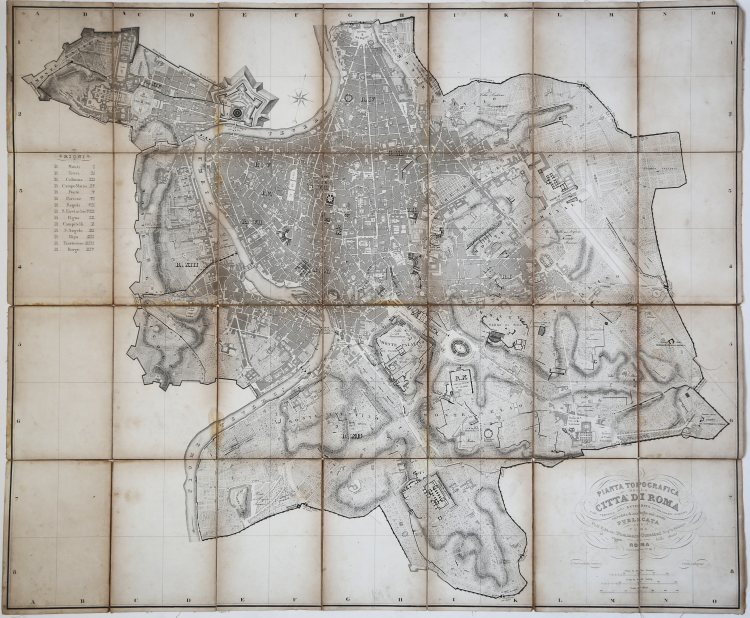
Rara pianta di Roma della metà del secolo XIX, incisa da Luigi Nisi Cavalieri e pubblicata da Tommaso Cuccioni. La pianta, seppur non datata, è riconducibile al 1848 e venne ristampata nel 1863.
“La data compare su un indice allegato pubblicato da Salviucci: nella seconda edizione (Scaccia Scarafoni n. 310) conservata ala BVE (Biblioteca Nazionale di Roma), l’indice è invece pubblicato dalla tipografia di E. Saninberghi. I lotti edificati sono campiti a tratteggio ed i resti archeologici sono chiaramente leggibili per la campitura nera. La raffigurazione della città termina alla cinta muraria e tutt’attorno si staglia su campo bianco. Sulla sinistra elenco dei XIV rioni. Secondo Scaccia Scarafoni la pianta è in scala 1:8800” (cfr. Marigliani, Le Piante di Roma nelle collezioni private, p. 362, n. 296).
Acquaforte, impressa su carta coeva, tagliata a scacchi ed applicata su supporto di tela, più volte ripiegata ad astuccio, leggera brunitura, per il resto in buono stato di conservazione. Esemplare da viaggio di questa rara pianta di Roma.
Bibliografia
Scaccia Scarafoni n. 310; Marigliani, Le Piante di Roma nelle collezioni private, p. 362, n. 296.
Tommaso CUCCIONI (Roma, 1790 circa – 23 agosto 1864)
|
He is one of the first and most renowned Roman photographers of the nineteenth century whose date of death (1864), but not his date of birth. His initial activity, however, was that of engraver and chalcographer, devoting himself to the trade of prints, with a store first in Via della Croce, n. 88, and then in Via Condotti, n. 18, as can be seen from the repertoires of the time of Gregory XVI who indicate him as a dealer of prints, paintings and fine art objects. In the Forties, together with the sale of chalcographic prints, he also began the sale of daguerreotypes and calotypes that he did not yet execute personally, but he commissioned to other Roman professionals of the origins and especially to G. Caneva, his great friend. Only after 1851, that is after the finalization of the wet collodion process, Cuccioni began his new and very lucky career as a photographer because only then, and not before, photography really set itself as an alternative means - with respect to the other reproductive techniques of the past - in the field of image production and reproduction.
Translated with www.DeepL.com/Translator (free version)
|
Tommaso CUCCIONI (Roma, 1790 circa – 23 agosto 1864)
|
He is one of the first and most renowned Roman photographers of the nineteenth century whose date of death (1864), but not his date of birth. His initial activity, however, was that of engraver and chalcographer, devoting himself to the trade of prints, with a store first in Via della Croce, n. 88, and then in Via Condotti, n. 18, as can be seen from the repertoires of the time of Gregory XVI who indicate him as a dealer of prints, paintings and fine art objects. In the Forties, together with the sale of chalcographic prints, he also began the sale of daguerreotypes and calotypes that he did not yet execute personally, but he commissioned to other Roman professionals of the origins and especially to G. Caneva, his great friend. Only after 1851, that is after the finalization of the wet collodion process, Cuccioni began his new and very lucky career as a photographer because only then, and not before, photography really set itself as an alternative means - with respect to the other reproductive techniques of the past - in the field of image production and reproduction.
Translated with www.DeepL.com/Translator (free version)
|