
| Reference: | S49635 |
| Author | William Nicholson |
| Year: | 1700 |
| Zone: | Rome |
| Printed: | London |
| Measures: | 450 x 315 mm |
| Reference: | S49635 |
| Author | William Nicholson |
| Year: | 1700 |
| Zone: | Rome |
| Printed: | London |
| Measures: | 450 x 315 mm |
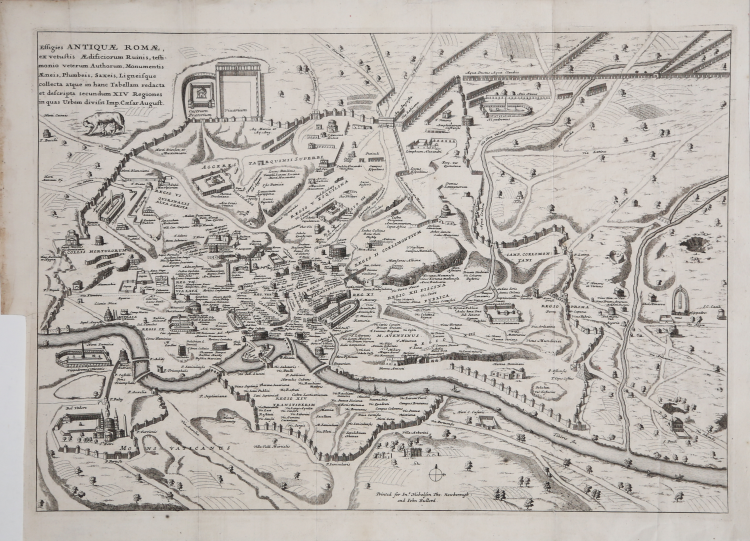
Rare archaeological map of Rome published in London in the translation of Pierre Danet's work (1650-1709), printed by William Nicholson and John Bullard in 1700 with the title A complete dictionary of the Greek and Roman antiquities explaining the obscure places in classic authors and ancient historians relating to the religion, mythology, history, geography and chronology of the ancient Greeks and Romans, their ... rites and customs, laws, polity, arts and engines of war: also an account of their navigations, arts and sciences and the inventors of them: with the lives and opinions of their philosophers / compiled originally in French ... by Monsieur Danet; made English, with the addition of very useful maps.
The map is based on the model introduced by Paolo Aringhi (1651) in Roma subterranea, which in turn was based on Pirro Ligorio's “small” archaeological map of 1553.
Etching, printed on contemporary laid paper, in excellent condition. Not described in Alberto Caldana's Roma Antica.
|
English artist well known for his unique style of woodcut prints. Beginning in the 1890s, he created posters with his brother-in-law James Pryde, using the pseudonyms J. & W. Beggarstaff. In 1897, Nicholson produced a woodcut print of Queen Victoria that was very well received and helped establish his reputation with the British public. About that same time Nicholson cut a series of wood blocks of An Illustrated Alphabet for publisher William Heinemann. Originally issued in a very small run of hand colored woodcuts, their popularity led to the images being transferred to lithographic stones and printed in a bound volume. This was soon followed by two other similar series of images, An Almanac of Twelve Sports and London Types. Nicholson's style is instantly recognizable, with the broad strokes from his original woodcuts printed with subtle variations of earth tones, harking back to earlier British chap book illustrations. After the turn of the century, Nicholson turned more to painting, though he did continue to produce illustrations for several books. The prints from his three bound plates volumes offer a wonderful sample of Nicholson's vision and also of British culture at the end of the nineteenth century.
|
|
English artist well known for his unique style of woodcut prints. Beginning in the 1890s, he created posters with his brother-in-law James Pryde, using the pseudonyms J. & W. Beggarstaff. In 1897, Nicholson produced a woodcut print of Queen Victoria that was very well received and helped establish his reputation with the British public. About that same time Nicholson cut a series of wood blocks of An Illustrated Alphabet for publisher William Heinemann. Originally issued in a very small run of hand colored woodcuts, their popularity led to the images being transferred to lithographic stones and printed in a bound volume. This was soon followed by two other similar series of images, An Almanac of Twelve Sports and London Types. Nicholson's style is instantly recognizable, with the broad strokes from his original woodcuts printed with subtle variations of earth tones, harking back to earlier British chap book illustrations. After the turn of the century, Nicholson turned more to painting, though he did continue to produce illustrations for several books. The prints from his three bound plates volumes offer a wonderful sample of Nicholson's vision and also of British culture at the end of the nineteenth century.
|