
| Reference: | S29757 |
| Author | Antonio LAFRERI |
| Year: | 1565 |
| Zone: | Valletta |
| Printed: | Rome |
| Measures: | 510 x 535 mm |
| Reference: | S29757 |
| Author | Antonio LAFRERI |
| Year: | 1565 |
| Zone: | Valletta |
| Printed: | Rome |
| Measures: | 510 x 535 mm |
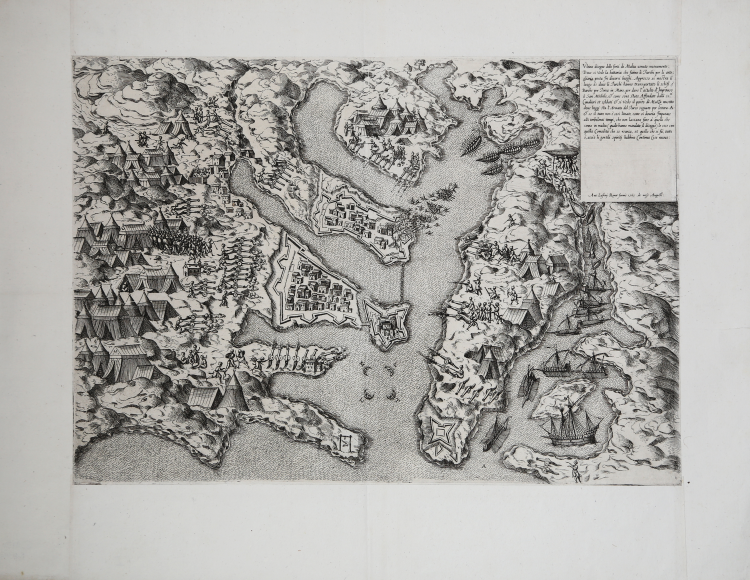
In the upper right cartouche: Ultimo disegno delli forti di Malta venuto nuovamente. Dove si vede la battaria che fanno li Turchi per li artegliaria posta in diversi luoghi. Appresso si mostra il luogo de dove li Turchi hanno transportato li schifi e Barche per Terra in Mare, per dare l’assalto d’Inproviso a San Michele, & come sono state affondate dalli ss.ri Cavalieri et soldati& si Vedo il porto di Marza musetto dove hoggi sta l’Armata del Turco segnato per lettera .A. & se il tutto non e cosi limato come si dovria Imputase alli torbolenti tempi, che non lassano fare a quelli che sonno in malta (quali hanno mandato il disegno) le cose con quella Comodita che se recerca, et quello che si fa, tutto e, accio li gentili spiritj habbino Continuo Cose Nuove: Ant. Lafrerj Romae formis 1565 de mese Augusti.
Etching and engraving, 1565, signed and dated in the plate. Example of the very rare first state of four describe by Albert Ganado.
Plant of the siege of 1565 in Valletta, carried out in August of 1565, as stated in the title “Ant. Lafrej Romae formis 1565 de mese Augusti”. Of the plate there is always a second state published in August of 1565, an update consists of new information reached the Lafreri who spoke of building a bridge of boats in Dockyard Creek. The first state of the plate then had a very low circulation and is therefore very rare, there are only 10 known specimens in the Lafreri collections.
The map, perhaps because of its incredible beauty, had two later issues by Giovanni Orlandi several decades later.
“Per illustrare le notizie che arrivavano da Malta relative al Grande Assedio, Lafreri non si limitò ad aggiornare la sua precedente tavola, ma fece incidere questa nuova versione del porto di Malta. L’opera raffigura una fase avanzata dell’assedio, con gli avvenimenti relativi alla metà di luglio, ed e stampata nell’agosto del 1565. Un aggiornamento della tavola, con piccole modifiche nella baia di Dockyard Creek, venne pubblicato a stretto giro, sempre nel mese di agosto. La matrice doveva essere tra le opere del catalogo della tipografia Lafreri (n. 91) raggruppate sotto la voce “Malta con li suoi assedi diversi”. Attraverso Claudio Duchetti e i suoi eredi, la matrice fu acquistata da Giovanni Orlandi, che la stampa nel 1602” (cfr. Bifolco-Ronca, Cartografia e topografia italiana del XVI secolo, p. 1766).
The history of the island of Malta, the construction of the walled city, the war against the Turks and the famous siege of the island, is a matter of great interest in European Renaissance culture, so as to produce a relatively large literature and above all a remarkable iconographic production of sequence of events. The year 1565 is a landmark in the history of the Maltese Islands. It was also a turning-point in the struggle of Christendom against the forces of the Ottoman Empire, on which the battle of Lepanto (1571) put the final seal. Despite these two disasters, the Turks continued to ravage the coasts of the western Mediterranean during the rest of the century, after having recovered Cyprus from the Venetians and Tunis from the Spaniards; but the decline of their empire was in sight. The siege of Malta, which lasted from May till September 1565, was watched with trepidation not only in Naples, Rome and Venice, but even in Vienna, London and Madrid, in Paris, Antwerp and Brussels. News of the slow progress of the besiegers and of the desperate defence of the island reached Sicily through letters written by Grand Master La Valette, battle-sketches despatched by the Knights of the Order of St. John and “Relationi” written by soldiers or seamen. Thence it spread fanlike to all the centers of Christendom stretching from the Iberian Peninsula in the west to Hungary in the east. Picture-maps of the siege were produced in France, Germany, Spain and Italy to illustrate for the layman the stand being put up by Catholic Malta against the armed might of the Crescent, the main centers of production being Rome and Venice, which even turned out several editions of various broadsheets to bring up to date the latest developments in the bitter and uneven struggle. Albert Ganado, the major expert of Maltese cartography, clists over 60 maps on the island, in their various states, concentrated in a very short space of just 10 years.
Magnificent proof, printed on contemporary laid paper with watermark "eagle in circle with crown" (Woodward 55), trimmed to the copperplate and with margins added, in a perfect state of preservation.
Bibliografia
Bifolco-Ronca, Cartografia e topografia italiana del XVI secolo, p. 1766, n. 892 I/IV; A. Ganado, A study in depth of 143 Maps representing the Great Siege of Malta of 1565, pp. 237/246, n. 50; Tooley, Italian Atlases, n. 384; Ganado-Vadalà (1995): pp. 237-246, nn. 50-52, tavv. 48-51; Rubach (2016): n. 237.
Antonio LAFRERI (Orgelet 1512 - Roma 1577)
|
An engraver, publisher and dealer in prints and books. He moved in Rome about 1544, and began a series of joint ventures with the older Roman publisher Antonio Salamanca that continued until the latter's death in 1562. Lafrery in best known for prints showing the architecture and sculpture of ancient Rome. He commissioned a title page Speculum Romanae Magnificentiae, engraved by E. Duperac in 1573, to enable the buyer to compile his own collection from Lafrery's stock. Similarly realized collections of maps, different in the number and type of maps included with the title Geografia/Tavole moderne di geografia/de la maggior parte del mondo/di diversi autori/raccolte et messe secondo l’ordine/di Tolomeo/con i disegni di molte città et/fortezze di diverse provintie/stampate in rame con studio et diligenza/in Roma, known as Atlanti Lafrery. Besides the Speculum, Lafrery published two title pages for collections of religious subjects.
|
Antonio LAFRERI (Orgelet 1512 - Roma 1577)
|
An engraver, publisher and dealer in prints and books. He moved in Rome about 1544, and began a series of joint ventures with the older Roman publisher Antonio Salamanca that continued until the latter's death in 1562. Lafrery in best known for prints showing the architecture and sculpture of ancient Rome. He commissioned a title page Speculum Romanae Magnificentiae, engraved by E. Duperac in 1573, to enable the buyer to compile his own collection from Lafrery's stock. Similarly realized collections of maps, different in the number and type of maps included with the title Geografia/Tavole moderne di geografia/de la maggior parte del mondo/di diversi autori/raccolte et messe secondo l’ordine/di Tolomeo/con i disegni di molte città et/fortezze di diverse provintie/stampate in rame con studio et diligenza/in Roma, known as Atlanti Lafrery. Besides the Speculum, Lafrery published two title pages for collections of religious subjects.
|