
| Reference: | S50322 |
| Author | Antonio SALAMANCA |
| Year: | 1542 ca. |
| Measures: | 285 x 405 mm |
| Reference: | S50322 |
| Author | Antonio SALAMANCA |
| Year: | 1542 ca. |
| Measures: | 285 x 405 mm |
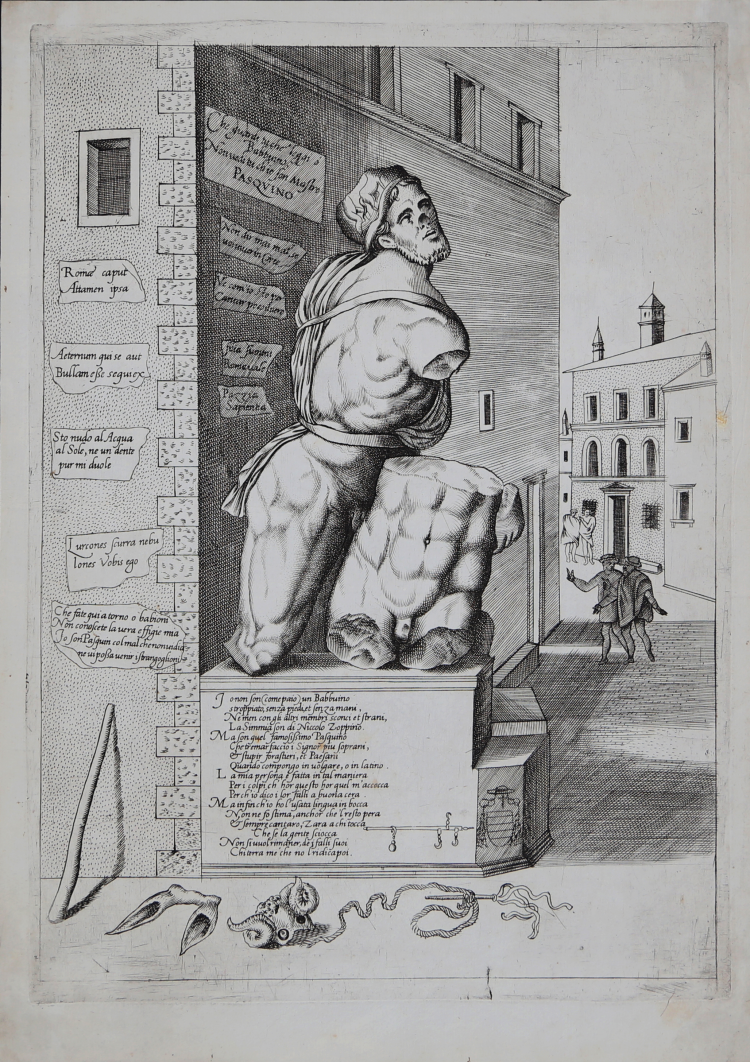
Engraving, circa 1542, unsigned and undated.
This is the first version of the famous representation of the talking statue of Pasquino, probably engraved by Nicoalas Beatrizet for the publisher Antonio Salamanca. Beatrizet certainly produced one for Salamanca's rival, Antonio Lafreri (see Huelsen no. 71a). When the two publishers joined forces, the two plates were merged into the same printing house; at Salamanca's death, two Pasquino plates were in Lafreri's possession, as documented in the printer's catalog.
“There are several versions of this motif, two or more of which are presumably in the possession of Lafreri […] The plate with Lafreri's address is a copy in the same style as the Salamanca engraving of 1542 (BNC Roma 18.6.G.5, fol. 2a). In Stefano Duchetti's sales inventory, a copy is listed on line 27 as "Basquino" (Pagani 2008a, Table A), which could be either the Salamanca engraving itself or another copy in the same style. In its first state, this copy is unaddressed and without year (HAB Wolfenbüttel, Ud gr. 2° 15, 70 and Ud gr. 2°, 16, 65); in its second state, it bears the year 1570; and later, this plate came into the possession of Nicolas van Aelst (KB Berlin OS 2651m, Bl. 267; HAB Wolfenbüttel, 2.3 Geogr. 2°, 104, 2.1 Geom. 2° (1-38)). The state with the van Aelst address also shows the erased address of Paolo Graziano. However, in another version of the Salamanca print, his address has been erased and that of Marcello Clodius has been added (BM London 1947,0319.26.128)” (translation from B. Rubach, Ant. Lafreri Formis Romae no. 337).
Alessia Alberti also identifies the work, in a issue with Paolo Graziani's address: "In the second state, they have the name of P. Graziani at the bottom right, 'Pauli Gratiani formis .Romæ.'" It can be recognized by the vertical fracture of the plate, approximately 1 cm in the lower right corner; in the last two lines of the verses, the words 'suoi' and 'puoi' are almost perfectly aligned; in the third state, Van Aelst's address appears" (see Antonio Lafrery's index, no. A132).
Therefore, this print had numerous editions. Ours is certainly a first-state example, prior to the Salamanca address. By cross-referencing Rubach and Alberti's research, we can hypothesize that it is the first of six states, preceding the addresses of Salamanca, Graziani, Clodio, Van Aelst, and De Rossi.
A magnificent work, rich in tone, printed on contemporary laid paper with a "Paschal Lamb in a Circle" watermark, with margins, in perfect condition.
Attributed to the sculptor Antigonus of Karyostos, the statue of the celebrated Pasquino dates back to the 1st century BC. The exquisite craftsmanship of the work was deemed by Bernini and other artists to be "one of the finest statues in Rome." The sculpture was part of the collection of Neapolitan Cardinal Oliviero Carafa, who in 1501 placed it for public viewing in Piazza Parione on a pedestal bearing the inscription: OLIVERII CARAFFAE BENEFICIO HIC SUM ANNO SALUTIS MDI ("I am here through the generosity of Oliviero Carafa," 1501). The coat of arms of the donor, Cardinal Carafa, is visible at the base of Lafréry's engraving. The statue soon became a sacred place for satire among the Roman people, especially in the period from 1501, when it was erected, to 1870, which marked the end of the Papal State.
The work belongs to the Speculum Romanae Magnificentiae, the earliest iconography of ancient Rome.
The Speculum originated in the publishing activities of Antonio Salamanca and Antonio Lafreri (Lafrery). During their Roman publishing careers, the two editors-who worked together between 1553 and 1563-started the production of prints of architecture, statuary, and city views related to ancient and modern Rome. The prints could be purchased individually by tourists and collectors, but they were also purchased in larger groups that were often bound together in an album. In 1573, Lafreri commissioned a frontispiece for this purpose, where the title Speculum Romanae Magnificentiae appears for the first time. Upon Lafreri's death, two-thirds of the existing copperplates went to the Duchetti family (Claudio and Stefano), while another third was distributed among several publishers. Claudio Duchetti continued the publishing activity, implementing the Speculum plates with copies of those "lost" in the hereditary division, which he had engraved by the Milanese Amborgio Brambilla. Upon Claudio's death (1585) the plates were sold - after a brief period of publication by the heirs, particularly in the figure of Giacomo Gherardi - to Giovanni Orlandi, who in 1614 sold his printing house to the Flemish publisher Hendrick van Schoel. Stefano Duchetti, on the other hand, sold his own plates to the publisher Paolo Graziani, who partnered with Pietro de Nobili; the stock flowed into the De Rossi typography passing through the hands of publishers such as Marcello Clodio, Claudio Arbotti and Giovan Battista de Cavalleris. The remaining third of plates in the Lafreri division was divided and split among different publishers, some of them French: curious to see how some plates were reprinted in Paris by Francois Jollain in the mid-17th century. Different way had some plates printed by Antonio Salamanca in his early period; through his son Francesco, they goes to Nicolas van Aelst's. Other editors who contributed to the Speculum were the brothers Michele and Francesco Tramezzino (authors of numerous plates that flowed in part to the Lafreri printing house), Tommaso Barlacchi, and Mario Cartaro, who was the executor of Lafreri's will, and printed some derivative plates. All the best engravers of the time - such as Nicola Beatrizet (Beatricetto), Enea Vico, Etienne Duperac, Ambrogio Brambilla, and others - were called to Rome and employed for the intaglio of the works.
All these publishers-engravers and merchants-the proliferation of intaglio workshops and artisans helped to create the myth of the Speculum Romanae Magnificentiae, the oldest and most important iconography of Rome. The first scholar to attempt to systematically analyze the print production of 16th-century Roman printers was Christian Hülsen, with his Das Speculum Romanae Magnificentiae des Antonio Lafreri of 1921. In more recent times, very important have been the studies of Peter Parshall (2006) Alessia Alberti (2010), Birte Rubach and Clemente Marigliani (2016).
A very rare work.
Bibliografia
C. Hülsen, Das Speculum Romanae Magnificentiae des Antonio Lafreri (1921), n. 71; cfr. B. Rubach, Ant. Lafreri Formis Romae (2016), n. 337; A. Alberti, L’indice di Antonio Lafrery (2010), n. A132; Bianchi 2004-IV, S. 6, Nr. D 22 copia A.
Antonio SALAMANCA (Milano ?, 1478 – Roma, 1562)
|
Print publisher and dealer in books and prints from Salamanca. Active in Rome. His family name was Martinez. He was in Rome by 1505. From 1517 till his death he was active as a publisher and book and print seller; also as a banker. His shop was in Campo dè Fiori and was recorded as a place where learned antiquarian conversations took place. Many of the prints he published were of Roman antiquities, starting in 1538 with prints such as the Colosseum engraved by Fagiuolo after Giuntalodi. In 1553 he formed a partnership with Antonio Lafreri, which was dissolved only after his death by his son Francesco.
|
Antonio SALAMANCA (Milano ?, 1478 – Roma, 1562)
|
Print publisher and dealer in books and prints from Salamanca. Active in Rome. His family name was Martinez. He was in Rome by 1505. From 1517 till his death he was active as a publisher and book and print seller; also as a banker. His shop was in Campo dè Fiori and was recorded as a place where learned antiquarian conversations took place. Many of the prints he published were of Roman antiquities, starting in 1538 with prints such as the Colosseum engraved by Fagiuolo after Giuntalodi. In 1553 he formed a partnership with Antonio Lafreri, which was dissolved only after his death by his son Francesco.
|