
| Reference: | S40245 |
| Author | Antonio LAFRERI |
| Year: | 1561 |
| Measures: | 470 x 325 mm |
| Reference: | S40245 |
| Author | Antonio LAFRERI |
| Year: | 1561 |
| Measures: | 470 x 325 mm |
Engraving, 1561, by Jacob Bos for the publisher Antonio Lafreri and part of the Speculum Romanae Magnificentiae.
Example of the first state of three (first of two for Rubach that does not describe Van Schoel's last issue), before Giovanni Orlandi's imprint.
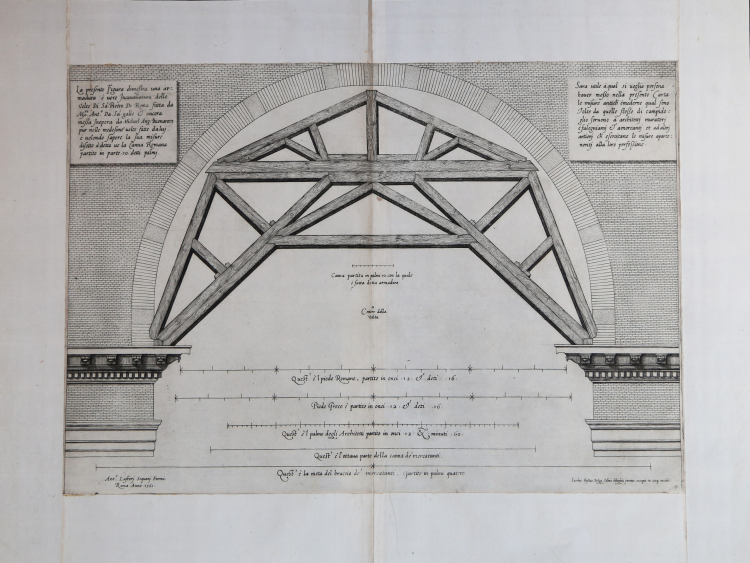
The engraving reproduces the armor used by Antonio da Sangallo the Younger and Michelangelo for the construction site of St. Peter's Basilica. Of great interest are the measures of reference expressed in Roman foot, Greek foot, Palm of the Architects, cane de' mercatanti, arm de' mercatanti.
Inscribed at the top left: «La presente Figura dimostra una armatura o uero Incauallatura delle volte di Sa[n] Pietro Di Roma fatta da M[ast]ro Ant[onio]o Da Sa[n] gallo et ancora meßa inopera da Michael Ang[elo] Buonaroto pur nelle medesime uolte fatte da luj. e uolendo sapere la sua misure [sic], disotto a detta ue [= c’è] la Canna Romana partito [sic] in parte 10 detti palmj».
Inscribed in the top right hand corner: «Sara utile à qual si uoglia persona hauer meßo nella presente Carta le misure antich[e] e moderne qual sono tolte da quelle steße di campidoglio. seruono à architettj muratorj e[t] falegniamj et a mercantj et ad altrj artierj ch[e] esercitano le misure apartenentj alla loro perfeßione».
Signed and dated at the bottom left: “Ant.o Lafrerj Sequanj Formis - Roma Anno 1561”.
Signed at bottom right: “Iacobus Boßius Boßius Belga Sum[m]a diligentia circino excepit in aesq[ue] incidit”.
The work appears in the catalog Lafreri - Index 201: Figura del armatura ouero incuallatura delli uolti di detto tempio con tutte le misure adoperate dagli antichi & moderni.
The work belongs to the Speculum Romanae Magnificentiae, the earliest iconography of ancient Rome.
The Speculum originated in the publishing activities of Antonio Salamanca and Antonio Lafreri (Lafrery). During their Roman publishing careers, the two editors-who worked together between 1553 and 1563-started the production of prints of architecture, statuary, and city views related to ancient and modern Rome. The prints could be purchased individually by tourists and collectors, but they were also purchased in larger groups that were often bound together in an album. In 1573, Lafreri commissioned a frontispiece for this purpose, where the title Speculum Romanae Magnificentiae appears for the first time. Upon Lafreri's death, two-thirds of the existing copperplates went to the Duchetti family (Claudio and Stefano), while another third was distributed among several publishers. Claudio Duchetti continued the publishing activity, implementing the Speculum plates with copies of those "lost" in the hereditary division, which he had engraved by the Milanese Amborgio Brambilla. Upon Claudio's death (1585) the plates were sold - after a brief period of publication by the heirs, particularly in the figure of Giacomo Gherardi - to Giovanni Orlandi, who in 1614 sold his printing house to the Flemish publisher Hendrick van Schoel. Stefano Duchetti, on the other hand, sold his own plates to the publisher Paolo Graziani, who partnered with Pietro de Nobili; the stock flowed into the De Rossi typography passing through the hands of publishers such as Marcello Clodio, Claudio Arbotti and Giovan Battista de Cavalleris. The remaining third of plates in the Lafreri division was divided and split among different publishers, some of them French: curious to see how some plates were reprinted in Paris by Francois Jollain in the mid-17th century. Different way had some plates printed by Antonio Salamanca in his early period; through his son Francesco, they goes to Nicolas van Aelst's. Other editors who contributed to the Speculum were the brothers Michele and Francesco Tramezzino (authors of numerous plates that flowed in part to the Lafreri printing house), Tommaso Barlacchi, and Mario Cartaro, who was the executor of Lafreri's will, and printed some derivative plates. All the best engravers of the time - such as Nicola Beatrizet (Beatricetto), Enea Vico, Etienne Duperac, Ambrogio Brambilla, and others - were called to Rome and employed for the intaglio of the works.
All these publishers-engravers and merchants-the proliferation of intaglio workshops and artisans helped to create the myth of the Speculum Romanae Magnificentiae, the oldest and most important iconography of Rome. The first scholar to attempt to systematically analyze the print production of 16th-century Roman printers was Christian Hülsen, with his Das Speculum Romanae Magnificentiae des Antonio Lafreri of 1921. In more recent times, very important have been the studies of Peter Parshall (2006) Alessia Alberti (2010), Birte Rubach and Clemente Marigliani (2016).
Magnificent proof, printed on contemporary laid paper with “horse in the circle with star” watermark, trimmed to the platemark and with original margins added, in excellent condition.
Bibliografia
B. Rubach, Ant. Lafreri Formis Romae (2016), n. 370, I/II; A. Alberti, L’indice di Antonio Lafrery (2010), n. 96, I/III; Marigliani, Lo splendore di Roma nell’Arte incisoria del Cinquecento (2016), n. VIII.9; C. Hülsen, 1921, p. 162, 97, A; F. Borsi, 1989, p. 307; S. Corsi - P. Ragionieri, 2004, p. 66; N. Gramaccini - H. J. Meier, 2009, p. 65; M. Mussolin, 2009, p. 300; González de Zárate 1992- 1996, II, p. 26, n. 9.
Antonio LAFRERI (Orgelet 1512 - Roma 1577)
|
An engraver, publisher and dealer in prints and books. He moved in Rome about 1544, and began a series of joint ventures with the older Roman publisher Antonio Salamanca that continued until the latter's death in 1562. Lafrery in best known for prints showing the architecture and sculpture of ancient Rome. He commissioned a title page Speculum Romanae Magnificentiae, engraved by E. Duperac in 1573, to enable the buyer to compile his own collection from Lafrery's stock. Similarly realized collections of maps, different in the number and type of maps included with the title Geografia/Tavole moderne di geografia/de la maggior parte del mondo/di diversi autori/raccolte et messe secondo l’ordine/di Tolomeo/con i disegni di molte città et/fortezze di diverse provintie/stampate in rame con studio et diligenza/in Roma, known as Atlanti Lafrery. Besides the Speculum, Lafrery published two title pages for collections of religious subjects.
|
Antonio LAFRERI (Orgelet 1512 - Roma 1577)
|
An engraver, publisher and dealer in prints and books. He moved in Rome about 1544, and began a series of joint ventures with the older Roman publisher Antonio Salamanca that continued until the latter's death in 1562. Lafrery in best known for prints showing the architecture and sculpture of ancient Rome. He commissioned a title page Speculum Romanae Magnificentiae, engraved by E. Duperac in 1573, to enable the buyer to compile his own collection from Lafrery's stock. Similarly realized collections of maps, different in the number and type of maps included with the title Geografia/Tavole moderne di geografia/de la maggior parte del mondo/di diversi autori/raccolte et messe secondo l’ordine/di Tolomeo/con i disegni di molte città et/fortezze di diverse provintie/stampate in rame con studio et diligenza/in Roma, known as Atlanti Lafrery. Besides the Speculum, Lafrery published two title pages for collections of religious subjects.
|