


| Reference: | A53195.1 |
| Author | Giuseppe VASI |
| Year: | 1774 |
| Zone: | San Pietro |
| Printed: | Rome |
| Measures: | 970 x 705 mm |
| Reference: | A53195.1 |
| Author | Giuseppe VASI |
| Year: | 1774 |
| Zone: | San Pietro |
| Printed: | Rome |
| Measures: | 970 x 705 mm |
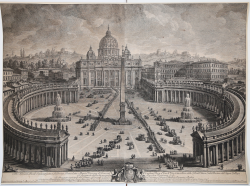
Title in lower margin: Il prospetto principale del tempio e piazza S. Pietro in Vaticano, e palazzo pontificio presenta, e dedica l'umilissimo devotissimo obbligatissimo servo Giuseppe Vasi conte palatino e cavaliere dell'aula lateranense, dal medesimo disegnato ed inciso l'anno 1774.
Dedication in the lower margin: All'altezza reale eminentissima di Errigo Benedetto Maria Vescovo di Frascati.
A bird eye's view shows the Basilica Vaticana, the Piazza San Pietro, and the Palazzo Vaticano, with a detailed rendering of Bernini's colonnade, as well as the surrounding landscape and buildings. Many small figures populate the space. This staffage includes pilgrims, clerics, beggars, well-dressed onlookers, and carriages.
This work is dedicated to Henry Benedict Stuart, the Cardinal Duke of York, grandson of King James II and Catholic heir to the British throne.
Etching, 1774, printed from two plates on two sheets joined down the center.
A magnificent, richly toned work, printed on two sheets of contemporary laid paper, irregularly trimmed at the platemark and mounted on a 19th-century paper, minor oxidation, otherwise in excellent condition.
First edition, the only contemporary one, of this magnificent engraving.
Bibliografia
Scalabroni, Giuseppe Vasi, n. 435.
Giuseppe VASI (Corleone, 27 Agosto 1710 - Roma, 16 Aprile 1782)
|
Italian engraver and painter. After completing a classical education, he trained as a printmaker in Palermo, possibly at the Collegio Carolino, which was founded by the Jesuit Order in 1728 and at which the etcher Francesco Ciché ( fl before 1707; d Palermo, 1742) was a teacher. Vasi was already an accomplished engraver when, in 1736, he contributed to the illustration of La reggia in trionfo by Pietro La Placa, which described the festivities held in Palermo to mark the coronation of Charles VII of Naples (the future Charles III of Spain). That same year Vasi moved to Rome, where, as a Neapolitan subject, he was immediately afforded the protection of the ambassador, Cardinal Troiano Aquaviva d’Aragona (1694–1747). In Rome he met other artists who worked for the same patron: Sebastiano Conca, Luigi Vanvitelli and Ferdinando Fuga. It is against this background that Vasi’s work in Rome, when he was in residence at the Palazzo Farnese, should be considered: his monopoly as the engraver of the Roman records of the monarch, the plates for the festivals of the ‘Chinea’ and the triumphal arches erected in front of the Palatine gardens on the occasion of temporal sovereignty over Rome
|
Giuseppe VASI (Corleone, 27 Agosto 1710 - Roma, 16 Aprile 1782)
|
Italian engraver and painter. After completing a classical education, he trained as a printmaker in Palermo, possibly at the Collegio Carolino, which was founded by the Jesuit Order in 1728 and at which the etcher Francesco Ciché ( fl before 1707; d Palermo, 1742) was a teacher. Vasi was already an accomplished engraver when, in 1736, he contributed to the illustration of La reggia in trionfo by Pietro La Placa, which described the festivities held in Palermo to mark the coronation of Charles VII of Naples (the future Charles III of Spain). That same year Vasi moved to Rome, where, as a Neapolitan subject, he was immediately afforded the protection of the ambassador, Cardinal Troiano Aquaviva d’Aragona (1694–1747). In Rome he met other artists who worked for the same patron: Sebastiano Conca, Luigi Vanvitelli and Ferdinando Fuga. It is against this background that Vasi’s work in Rome, when he was in residence at the Palazzo Farnese, should be considered: his monopoly as the engraver of the Roman records of the monarch, the plates for the festivals of the ‘Chinea’ and the triumphal arches erected in front of the Palatine gardens on the occasion of temporal sovereignty over Rome
|