

| Reference: | A51122 |
| Author | Albrecht DURER |
| Year: | 1519 ca. |
| Measures: | 380 x 545 mm |
| Reference: | A51122 |
| Author | Albrecht DURER |
| Year: | 1519 ca. |
| Measures: | 380 x 545 mm |
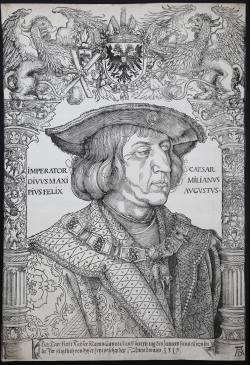
Portrait of Emperor Maximilian I, showing the emperor wearing the collar of the Golden Fleece over a brocade cloak and a fur-lined hat with an oval medallion of the Virgin and Child attached to the brim, set within an architectural frame.
Woodcut, circa 1519, signed in the woodblock at lower right.
This is a second-state example, with the added monogram, in the first of four variants described by Meder (a/d).
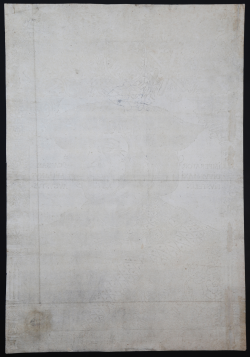
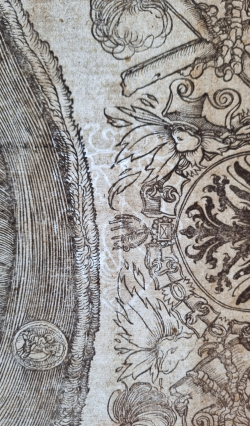
A magnificent, richly toned work, printed on contemporary laid paper with a “Crest of Nuremberg” watermark (Meder 206, describes it as typical of this first variant of the second state of the work), trimmed to the margin, with paper creases and minor restorations in the lower section visible on the verso. Otherwise in excellent condition.
Portrait of Emperor Maximilian I is an oil painting by Albrecht Dürer, dating back to 1519 and now housed in the Kunsthistorisches Museum in Vienna, Austria. It portrays Maximilian I, Holy Roman Emperor. Dürer painted a portrait in the company of the emperor in Augsburg in 1518, producing the drawing now housed in the Albertina in Vienna, from which he later produced two paintings and a woodcut. The artist and the sitter first met in the spring of 1512, when the newly elected Emperor Maximilian I of Habsburg stayed in Dürer's hometown of Nuremberg, where he met the artist. As part of Maximilian's extensive printmaking program, the artist was commissioned to create the enormous multi-sheet woodcut "Triumphal Arch" to celebrate the emperor and his family, for which he received an annual reward of 100 florins. Copies of the sheets were sent to cities across the empire to be hung on the walls of palaces and public buildings. In 1518, during the Diet of Augsburg, Maximilian called upon Dürer to paint his portrait. The artist met the emperor in the castle and made a pencil drawing of him, from which he later painted the panel portrait and his woodcut. On the drawing's margin, he noted: "Is the emperor Maximilian that I Albrecht Dürer portrayed in Augsburg, up in the high palace, in his small room, Monday 28 June 1518".
The studio (Vienna, Albertina) served as a model for a painted portrait, which may have been commissioned by Jakob Fugger, founder of the Fuggerei in Augsburg (the oldest social settlement in the world) and the Fugger trading company. Dürer portrays the emperor as an elegant, private gentleman. Here, the painter adopted a pre-existing typology in the tradition of Habsburg portraits, but combined it with an unparalleled mastery of the demands of a state portrait. The emperor does not wear the external signs of his high rank; even the otherwise obligatory necklace of the Order of the Golden Fleece is not worn on the emperor's body, but appears in the upper left background. The desired impression of power and dignity is instead conveyed by the emperor's filling the frame, the precious fabrics, and the brilliantly painted fur collar. Timelessness and distance are suggested by the monochrome background. The monumentality of Maximilian's physical appearance has an imperial character; The precise depiction of the quiet melancholy and weariness on her face in no way diminishes the extraordinary importance of the subject.
The woodcut was probably made shortly thereafter; four different versions of the portrait are known: “Opinion is still divided regarding exactly which of the four remaining blocks of this portrait of Emperor Maximilian I is the original. Because Dürer's monogram is absent on all of them it is uncertain whether Dürer is to be credited with the actual publication of this woodcut portrait. There cannot be any question, however, that all versions are based on Dürer's portrait drawing of the emperor, done on 28 June 1518 at Augsburg (SD.1518/19). Maximilian is pictured without any of the usual Imperial regalia, save the collar of the Order of the Golden Fleece. Great attention has been paid to details of this decoration, as well as to other ornamental facets: the lozenge pattern of the lapel, the pomegranate embroidery of the fabric, the medallion of the Madonna on the beret. Yet for all of this filigree work, the bust of the emperor is placed on a stark white background, thus emphasizing the subject in the most drastic manner. Nothing interferes with the image of majesty, "of a noble gentleman, full of affability, fantasy, and temperament-spirited and flexible, and with the characteristic anomalies of the Hapsburg profile humanized. The artist - none other than Dürer - has succeeded in establishing for posterity a lasting image, sympathetic yet uncompromising, that has become a part of our visual vocabulary of history” (cfr. W. Strauss, The Woodcuts and woodblocks of Albrecht Durer, p. 543).
This version of the woodcut portrait, the only one enriched by a marvelous, highly decorative allegorical frame - the carving of which is attributed to Hans Weiditz (cf. Heinrich Rottinger, Dürer Doppelanger, 1926) - is the only one to feature, in its final version, Dürer's monogram at the bottom right.
A magnificent example of this iconic portrait.
Bibliografia
Meder, Dürer Katalog (255.4.2 a/d); Bartsch, Le Peintre graveur (VII.163.154); Schoch, Albrecht Dürer, das druckgraphische Werk (II.252.4.2); W. Strauss, The Woodcuts and woodblocks of Albrecht Durer, 190, Block IV; Campbell Dodgson, Dürer's portrait of Maximilian I, in 'The British Museum Quarterly”, 3 (1928/9), pp.77-79; Katherine Crawford Luber, Albrecht Dürer's Maximilian portraits: an investigation of versions, in “Master Drawings”, 29, 1991(1), pp. 30-47.
Albrecht DURER (Norimberga 1471 - 1528)
|
Dürer was a German painter, wood carver, engraver, and mathematician. He is best known for his woodcuts in series, including the Apocalypse (1498), two series on the crucifixion of Christ, the Great Passion (1498-1510) and the Little Passion (1510-11) as well as many of his individual prints, such as Knight, Death, and the Devil(1513) and Melancholia I (1514).
Dürer was born in the Imperial Free City of Nuremberg. His family came from the Kingdom of Hungary, germanizing the family name of Thürer when they settled in Nuremberg soon after the middle of the 15th century. His father, also called Albrecht, was a goldsmith and served as assistant to Hieronymus Helfer, marrying his daughter Barbara in 1468. They had eighteen children, Albrecht was the second. Albrecht's brother, Hans Dürer, also became a renowned artist.
As a youngster, Albrecht the younger apprenticed under his father, where he learned the fine art of goldsmithing, and to handle a burin. Then at the age of fifteen Dürer was apprenticed to the principal painter of the town, Michael Wolgemut, a prolific if undistinguished producer of small works in the late Gothic style. Dürer learned not only painting but also wood carving and elementary copper engraving under Wolgemut. At the end of his apprenticeship in 1490 he travelled (the so-called Wanderjahre). In 1492 he arrived in Colmar, intending to study under Martin Schöngauer, a well regarded painter-engraver of his time. He found that Schongauer had died the previous year, but he was received kindly by the family of the deceased master there and in Basel. Under them he evidently had some practice both in metal-engraving and in furnishing designs for the woodcutter. He left Basel some time in 1494 and travelled briefly in the Low Countries before he returned to Nuremberg. From this period, little of the work that can be attributed to him with certainty survives, though several of the illustrations of the Nuremberg Chronicle are sometimes attributed to him.
On July 9, 1494 Dürer was married, according to an arrangement made during his absence, to Agnes Frey, the daughter of a local merchant. His relationship with his wife is unclear and her reputation has suffered from a posthumous assault by Dürer's friends. He did not remain in Nuremberg long; in the autumn of 1494 he travelled to Italy, leaving his wife at Nuremberg. He went to Venice, evidence of his travels being derived from drawings and engravings that are closely linked to existing northern Italian works by Mantegna, Antonio Pollaiuolo, Lorenzo di Credi and others. Some time in 1495 Dürer must have returned to Nuremberg, where he seems to have lived and worked for possibly the next ten years, producing most of his notable prints.
During the first few years from 1495 onwards he worked in the established Germanic and northern forms but was open to the influences of the Renaissance. His best works in this period were for wood-block printing, typical scenes of popular devotion developed into his famous series of sixteen great designs for the Apocalypse, first carved in 1498. Counterpointed with the first seven of scenes of the Great Passion in the same year, and a little later a series of eleven on the Holy Family and of saints. Around 1504-1505 he carved the first seventeen prints of a set illustrating the life of the Virgin. Neither these nor the Great Passion were published till several years later.
Dürer trained himself in the more finely detailed and expensive copper-engraving. He attempted no subjects of the scale of his woodcuts, but produced a number of Madonnas, single figures from scripture or of the saints, some nude mythologies, and groups, sometimes satirical, of ordinary people. The Venetian artist Jacopo de Barbari, whom Dürer had met in Venice, came to Nuremberg for a while in 1500. He influenced Dürer with the new developments in perspective, anatomy and proportion, from which Dürer began his own studies. A series of extant drawings shows Dürer's experiments in human proportion, up to the famous engraving of Adam and Eve (1504) which showed his firm and detailed grasp of landscape had extended into the quality of flesh surfaces by the subtlest use of the graving-tool known to him. Two or three other technical masterpieces were produced up to 1505, when he made a second visit to Italy.
In Italy he turned his hand to painting, at first producing a series of works by tempera-painting on linen, including portraits and altarpieces, notably the Paumgartner altarpiece and the Adoration of the Magi. In early 1506 he returned to Venice, and stayed there until the spring of 1507. The occasion of this journey has been erroneously stated by Vasari. Dürer's engravings had by this time attained great popularity and had begun to be copied. In Venice he was given a valuable commission from the emigrant German community for the church of St. Bartholomew. The picture painted by Dürer was closer to the Italian style - the Adoration of the Virgin, also known as the Feast of Rose Garlands; it was subsequently acquired by the Emperor Rudolf II and taken to Prague. Other paintings Dürer produced in Venice include The Virgin and Child with the Goldfinch, a Christ disputing with the Doctors (apparently produced in a mere five days) and a number of smaller works.
Despite the regard in which he was held by the Venetians, Dürer was back in Nuremberg by mid-1507. He remained in Germany until 1520. His reputation spread all over Europe. He was on terms of friendship or friendly communication with all the masters of the age, and Raphael held himself honored in exchanging drawings with Dürer.
The years between his return from Venice and his journey to the Netherlands are commonly divided according to the type of work with which he was principally occupied. The first five years, 1507-1511, are pre-eminently the painting years of his life. In them, working with a vast number of preliminary drawings and studies, he produced what have been accounted his four best works in painting - Adam and Eve (1507), Virgin with the Iris (1508), the altarpiece the Assumption of the Virgin (1509), and the Adoration of the Trinity by all the Saints (1511). During this period he also completed the two woodcut series of the Great Passion and the Life of the Virgin, both published in 1511 together with a second edition of the Apocalypse series.
From 1511 to 1514, Dürer concentrated on engraving, both on wood and copper, but especially the latter. The major work he produced in this period was the thirty-seven subjects of the Little Passion on wood, published first in 1511, and a set of fifteen small copper-engravings on the same theme in 1512. In 1513 and 1514 appeared the three most famous of Dürer's works in copper-engraving, The Knight and Death (or simply The Knight, as he called it, 1513), Melancolia and St Jerome in his Study (both 1514).
In the years leading to 1520 he produced a wide range of works. Tempera on linen portraits in 1516. Engravings on many subjects, experiments in etching on plates of iron and zinc. A part of the Triumphal Gate and the Triumphal March for the Emperor Maximilian. He also did the marginal decorations for the Emperor's prayer-book and a portrait-drawing of the Emperor shortly before his death in 1519.
In the summer of 1520 the desire of Dürer to secure new patronage following the death of Maximilian and an outbreak of sickness in Nuremberg, gave occasion to his fourth and last journey. Together with his wife and her maid he set out in July for the Netherlands in order to be present at the coronation of the new Emperor Charles V. He journeyed by the Rhine, Cologne, and then to Antwerp, where he was well received and produced numerous drawings in silverpoint, chalk or charcoal. Besides going to Aachen for the coronation, he made excursions to Cologne, Nijmwegen, Hertogenbosch, Brussels, Bruges, Ghent and Zeeland. He finally returned home in July 1521, having caught an undetermined illness which afflicted him for the rest of his life.
|
Albrecht DURER (Norimberga 1471 - 1528)
|
Dürer was a German painter, wood carver, engraver, and mathematician. He is best known for his woodcuts in series, including the Apocalypse (1498), two series on the crucifixion of Christ, the Great Passion (1498-1510) and the Little Passion (1510-11) as well as many of his individual prints, such as Knight, Death, and the Devil(1513) and Melancholia I (1514).
Dürer was born in the Imperial Free City of Nuremberg. His family came from the Kingdom of Hungary, germanizing the family name of Thürer when they settled in Nuremberg soon after the middle of the 15th century. His father, also called Albrecht, was a goldsmith and served as assistant to Hieronymus Helfer, marrying his daughter Barbara in 1468. They had eighteen children, Albrecht was the second. Albrecht's brother, Hans Dürer, also became a renowned artist.
As a youngster, Albrecht the younger apprenticed under his father, where he learned the fine art of goldsmithing, and to handle a burin. Then at the age of fifteen Dürer was apprenticed to the principal painter of the town, Michael Wolgemut, a prolific if undistinguished producer of small works in the late Gothic style. Dürer learned not only painting but also wood carving and elementary copper engraving under Wolgemut. At the end of his apprenticeship in 1490 he travelled (the so-called Wanderjahre). In 1492 he arrived in Colmar, intending to study under Martin Schöngauer, a well regarded painter-engraver of his time. He found that Schongauer had died the previous year, but he was received kindly by the family of the deceased master there and in Basel. Under them he evidently had some practice both in metal-engraving and in furnishing designs for the woodcutter. He left Basel some time in 1494 and travelled briefly in the Low Countries before he returned to Nuremberg. From this period, little of the work that can be attributed to him with certainty survives, though several of the illustrations of the Nuremberg Chronicle are sometimes attributed to him.
On July 9, 1494 Dürer was married, according to an arrangement made during his absence, to Agnes Frey, the daughter of a local merchant. His relationship with his wife is unclear and her reputation has suffered from a posthumous assault by Dürer's friends. He did not remain in Nuremberg long; in the autumn of 1494 he travelled to Italy, leaving his wife at Nuremberg. He went to Venice, evidence of his travels being derived from drawings and engravings that are closely linked to existing northern Italian works by Mantegna, Antonio Pollaiuolo, Lorenzo di Credi and others. Some time in 1495 Dürer must have returned to Nuremberg, where he seems to have lived and worked for possibly the next ten years, producing most of his notable prints.
During the first few years from 1495 onwards he worked in the established Germanic and northern forms but was open to the influences of the Renaissance. His best works in this period were for wood-block printing, typical scenes of popular devotion developed into his famous series of sixteen great designs for the Apocalypse, first carved in 1498. Counterpointed with the first seven of scenes of the Great Passion in the same year, and a little later a series of eleven on the Holy Family and of saints. Around 1504-1505 he carved the first seventeen prints of a set illustrating the life of the Virgin. Neither these nor the Great Passion were published till several years later.
Dürer trained himself in the more finely detailed and expensive copper-engraving. He attempted no subjects of the scale of his woodcuts, but produced a number of Madonnas, single figures from scripture or of the saints, some nude mythologies, and groups, sometimes satirical, of ordinary people. The Venetian artist Jacopo de Barbari, whom Dürer had met in Venice, came to Nuremberg for a while in 1500. He influenced Dürer with the new developments in perspective, anatomy and proportion, from which Dürer began his own studies. A series of extant drawings shows Dürer's experiments in human proportion, up to the famous engraving of Adam and Eve (1504) which showed his firm and detailed grasp of landscape had extended into the quality of flesh surfaces by the subtlest use of the graving-tool known to him. Two or three other technical masterpieces were produced up to 1505, when he made a second visit to Italy.
In Italy he turned his hand to painting, at first producing a series of works by tempera-painting on linen, including portraits and altarpieces, notably the Paumgartner altarpiece and the Adoration of the Magi. In early 1506 he returned to Venice, and stayed there until the spring of 1507. The occasion of this journey has been erroneously stated by Vasari. Dürer's engravings had by this time attained great popularity and had begun to be copied. In Venice he was given a valuable commission from the emigrant German community for the church of St. Bartholomew. The picture painted by Dürer was closer to the Italian style - the Adoration of the Virgin, also known as the Feast of Rose Garlands; it was subsequently acquired by the Emperor Rudolf II and taken to Prague. Other paintings Dürer produced in Venice include The Virgin and Child with the Goldfinch, a Christ disputing with the Doctors (apparently produced in a mere five days) and a number of smaller works.
Despite the regard in which he was held by the Venetians, Dürer was back in Nuremberg by mid-1507. He remained in Germany until 1520. His reputation spread all over Europe. He was on terms of friendship or friendly communication with all the masters of the age, and Raphael held himself honored in exchanging drawings with Dürer.
The years between his return from Venice and his journey to the Netherlands are commonly divided according to the type of work with which he was principally occupied. The first five years, 1507-1511, are pre-eminently the painting years of his life. In them, working with a vast number of preliminary drawings and studies, he produced what have been accounted his four best works in painting - Adam and Eve (1507), Virgin with the Iris (1508), the altarpiece the Assumption of the Virgin (1509), and the Adoration of the Trinity by all the Saints (1511). During this period he also completed the two woodcut series of the Great Passion and the Life of the Virgin, both published in 1511 together with a second edition of the Apocalypse series.
From 1511 to 1514, Dürer concentrated on engraving, both on wood and copper, but especially the latter. The major work he produced in this period was the thirty-seven subjects of the Little Passion on wood, published first in 1511, and a set of fifteen small copper-engravings on the same theme in 1512. In 1513 and 1514 appeared the three most famous of Dürer's works in copper-engraving, The Knight and Death (or simply The Knight, as he called it, 1513), Melancolia and St Jerome in his Study (both 1514).
In the years leading to 1520 he produced a wide range of works. Tempera on linen portraits in 1516. Engravings on many subjects, experiments in etching on plates of iron and zinc. A part of the Triumphal Gate and the Triumphal March for the Emperor Maximilian. He also did the marginal decorations for the Emperor's prayer-book and a portrait-drawing of the Emperor shortly before his death in 1519.
In the summer of 1520 the desire of Dürer to secure new patronage following the death of Maximilian and an outbreak of sickness in Nuremberg, gave occasion to his fourth and last journey. Together with his wife and her maid he set out in July for the Netherlands in order to be present at the coronation of the new Emperor Charles V. He journeyed by the Rhine, Cologne, and then to Antwerp, where he was well received and produced numerous drawings in silverpoint, chalk or charcoal. Besides going to Aachen for the coronation, he made excursions to Cologne, Nijmwegen, Hertogenbosch, Brussels, Bruges, Ghent and Zeeland. He finally returned home in July 1521, having caught an undetermined illness which afflicted him for the rest of his life.
|