
- New

| Reference: | S47041 |
| Author | Cherubino ALBERTI |
| Year: | 1591 |
| Measures: | 230 x 430 mm |
| Reference: | S47041 |
| Author | Cherubino ALBERTI |
| Year: | 1591 |
| Measures: | 230 x 430 mm |
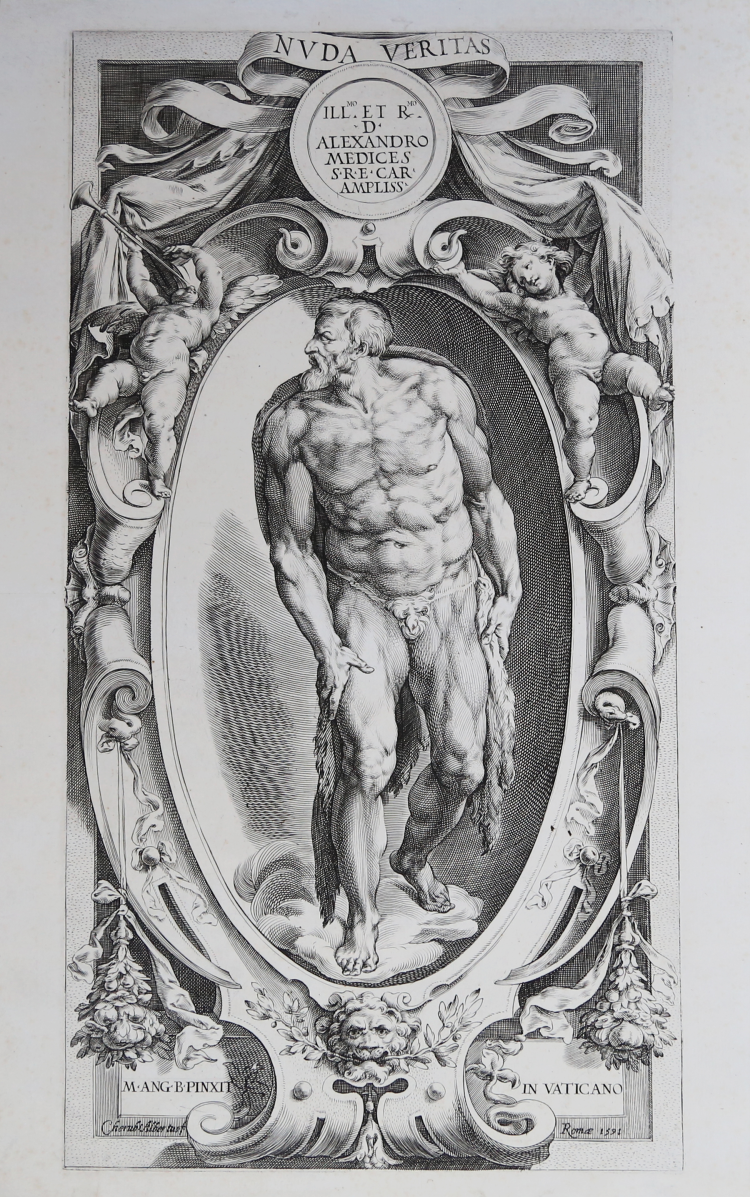
Engraving, 1591, signed and dated at the bottom.
Along the bottom frame «Cherub.s Albertus.f. Romæ ·1591·»; in the bottom frame "M-ANG-B-PINXIT IN VATICANO"; in the fluttering ribbon at the top "NVDA VERITAS", and inside the circular frame the dedication "ILL.MO ET R.MO / -D- / ALEXANDRO/ MEDICES / S-R-E-CAR- / AMPLISS-".
After a drawing by Michelangelo for the 'The Last Judgment' fresco in the Sistine Chapel.
Example in the third state o four, the first with the letter. The previous states can be considered as proof.
The work was intended by the engraver to form a pair with Petit Aethera, like this one dated 1591, and dedicated to Cardinal Alessandro de' Medici. The two prints are of a very similar format and are the only Sistine engravings by Alberti that are specular with respect to the fresco.
“The figure, here shown in reverse, stands on Christ's right in Michelangelo's fresco of the Last Judgement. The extraction of figures from Michelangelo's compositions and their presentation in prints is a phenomenon found from an early date. Among the first are Marcantonio's engravings after figures from the Battle of Cascina cartoon, one of which is dated 1510 (Bartsch XIV.361.487). Before 1562, Bonasone had isolated a figure from the Last Judgement and presented it in reverse as a self-standing invention (Massari, 1983, p.72, no.81). Alberti goes further by enclosing Michelangelo's invention in an elaborate cartouche with angels, one of whom proclaims its fame. The combination of image and motto-like title in the frame gives it the character of an emblem. Borea (Moltedo, p.29) notes that this print marks the end of a period in which printmakers all over Europe had given great attention to Michelangelo. Given the title, there is some irony in the fact that the Baptist's genitals are discretely covered, as had actually been carried out on the fresco itself” (Text from Michael Bury, 'The Print in Italy 1550-1620', London, 2001).
Magnificent work, rich in tone, printed on contemporary laid paper with an illegible watermark, with margins, very light trace of a horizontal fold, otherwise in excellent condition.
Bibliografia
A. Alberti, D’Apres Michelangelo, p. 103, n. 202; Barnes, p. 194, n. 63; Le Blanc I, p. 9; TIB 34, p. 187, n. 67; P. M. Lukehart, Nuda Veritas…, in “After 1564 Michelangelo’s Legacy”, pp. 37 – 55; Michael Bury, 'The Print in Italy 1550-1620', n. 94.
Cherubino ALBERTI Borgo San Sepolcro 1553 - Roma 1615
|
Engraver, painter and constructor of crossbows, from Borgo San Sepolcro. Active in San Sepolcro
and Rome. Record of death 18 October 1615.
The earliest dated engravings are of 1571.The bulk of his engraved work was produced between 1571 and 1590. Mythological,devotional and ornamental subject ;portraits and antiquities. Prints after Raphael,Michelangelo,Polidoro da Caravaggio,Andrea del Sarto, Rosso Fiorentino, Taddeo and Federico Zuccaro. He kept control of the majorityof his plates and was responsible for publishing them. After his death his heirs reissued many of them, with a privilege of Pope Urban VIII.
|
Cherubino ALBERTI Borgo San Sepolcro 1553 - Roma 1615
|
Engraver, painter and constructor of crossbows, from Borgo San Sepolcro. Active in San Sepolcro
and Rome. Record of death 18 October 1615.
The earliest dated engravings are of 1571.The bulk of his engraved work was produced between 1571 and 1590. Mythological,devotional and ornamental subject ;portraits and antiquities. Prints after Raphael,Michelangelo,Polidoro da Caravaggio,Andrea del Sarto, Rosso Fiorentino, Taddeo and Federico Zuccaro. He kept control of the majorityof his plates and was responsible for publishing them. After his death his heirs reissued many of them, with a privilege of Pope Urban VIII.
|