
| Reference: | A53182 |
| Author | Giovanni Benedetto CASTIGLIONE detto "Il Grechetto" |
| Year: | 1647 ca. |
| Measures: | 310 x 225 mm |
| Reference: | A53182 |
| Author | Giovanni Benedetto CASTIGLIONE detto "Il Grechetto" |
| Year: | 1647 ca. |
| Measures: | 310 x 225 mm |
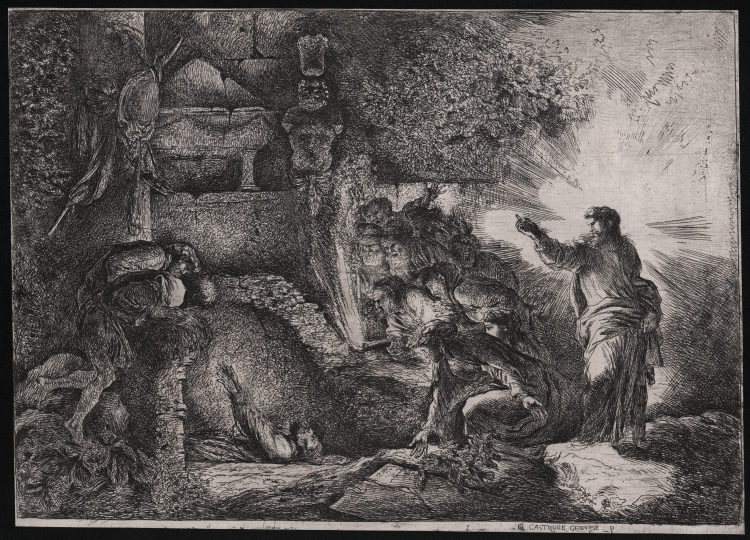
The raising of Lazarus from the dead.
Etching, circa 1647-51, with etched signature 'GB Castilione Genovese p' at bottom right in margin.
Example of the second state of four described by Paolo Bellini with an horizontal line, measuring about 90 mm, above the figure of Christ, approximately 23 mm from his head. Two other horizontal lines cross Christ's chest. Several spots appear at upper right, probably because of oxidation. Bellini believes that the oxidation of the upper part of the plate suggests the existence of a first state, which he admits he has never seen. Therefore, what he describes as the second state should be considered first.
“The etching dates to 1647-51, the period of Castiglione's interest in the effects of nocturnal illumination. Both "Tobit Burying the Dead" and "The Supposed Finding of the Remains of St. Peter and St. Paul" can be dated to this same period. No impressions of the first state have been found, though its existence is confirmed by the damages (oxidation and scratches) that appear in the second state and that were certainly not present in the first. A drawing in the Cooper Union Museum is probably a partial preparatory study for the etching. It is in reverse and relates to the figure of Christ and to the central area of the etching. Castiglione executed this same subject in two other drawings, both at Windsor (inv. 3834 and 3832), one representing the image in reverse and with several variations, and the second in a vertical format. The subject also appears in a monotype (Albertina; 122-Mon. 6), in reverse and with variations. Castiglione's subject was adopted by Antonio Travi in a painting, and the figure of Christ, in the same direction and with some modifications, was used in an etching by Gaetano Zompini” (cfr. Paolo Bellini in The Illustrated Bartsch, p. 18).
It does not appear to have been noticed that Castiglione's Christ is based on the saviour's appearance in Parmigianino's Christ Healing the Lepers, a thematically similar subject to Lazarus and thus a natural reference for Castiglione. Parmigianino's design was disseminated in a woodcut by Niccolò Vicentino and was later reproduced in etching by Schiavone.
Perhaps the most important Genoese artist of the seventeenth century, Castiglione was a product of the city’s unique cosmopolitanism. Receptive to the works of everyone from Paggi to van Dyck and Strozzi, he created a distinctly elaborate, expressive style in paint and print that won him admiration right across Europe despite his violent personality. Favouring rapid lines, Castiglione was a natural etcher, and he became one of the most gifted, experimental printmakers of the seventeenth century.
Etching, printed with extraordinary tones on contemporary laid paper with unidentified watermark, trimmed to the platemark, in very good condition.
Bibliografia
Bartsch, Le Peintre graveur (XXI.12.6); The Illustrated Bartsch, 006, II/IV; Bellini, L'Opera incisa di Giovanni Benedetto Castiglione, n. 57, II/IV; Le Blanc, 1858, L. n. 16, Percy, 1971, n. E 22.
Giovanni Benedetto CASTIGLIONE detto "Il Grechetto" (Genova 1616 - Mantova 1670)
|
His origin and his edication in Genua led Castiglione to make acquaitance with the Flemish painting, especially through Jaan Roos e Van Dyck from whom he took the warm, vibrating chromatism.
He lived in Rome from 1632 to 1635 and from 1647 to 1651; among the two periods in Rome, he lived in Naples and he also started studying the intellectualistic classicism of Poussin.
His favourite subjects, both in painting and engraving, were taken from the classical moralism of Stoicism, very typical in Poussin, which enabled him to create his own peculiar repertoire, much more refined in comparison with contemporary artists.
He spent his last working years in Mantua, at the Duke’s Palace; the production of this period enhances his chromatism and the visionary elements of his previous production.
Castiglione has been a silful engraver; he loved this particular art for he thought it was the main mean to widespread his iconography. He was the first, in Italy, to appreciate and imitate Rembrandt.
|
Giovanni Benedetto CASTIGLIONE detto "Il Grechetto" (Genova 1616 - Mantova 1670)
|
His origin and his edication in Genua led Castiglione to make acquaitance with the Flemish painting, especially through Jaan Roos e Van Dyck from whom he took the warm, vibrating chromatism.
He lived in Rome from 1632 to 1635 and from 1647 to 1651; among the two periods in Rome, he lived in Naples and he also started studying the intellectualistic classicism of Poussin.
His favourite subjects, both in painting and engraving, were taken from the classical moralism of Stoicism, very typical in Poussin, which enabled him to create his own peculiar repertoire, much more refined in comparison with contemporary artists.
He spent his last working years in Mantua, at the Duke’s Palace; the production of this period enhances his chromatism and the visionary elements of his previous production.
Castiglione has been a silful engraver; he loved this particular art for he thought it was the main mean to widespread his iconography. He was the first, in Italy, to appreciate and imitate Rembrandt.
|