
| Reference: | A53184 |
| Author | Giovanni Benedetto CASTIGLIONE detto "Il Grechetto" |
| Year: | 1647 ca. |
| Measures: | 295 x 200 mm |
| Reference: | A53184 |
| Author | Giovanni Benedetto CASTIGLIONE detto "Il Grechetto" |
| Year: | 1647 ca. |
| Measures: | 295 x 200 mm |
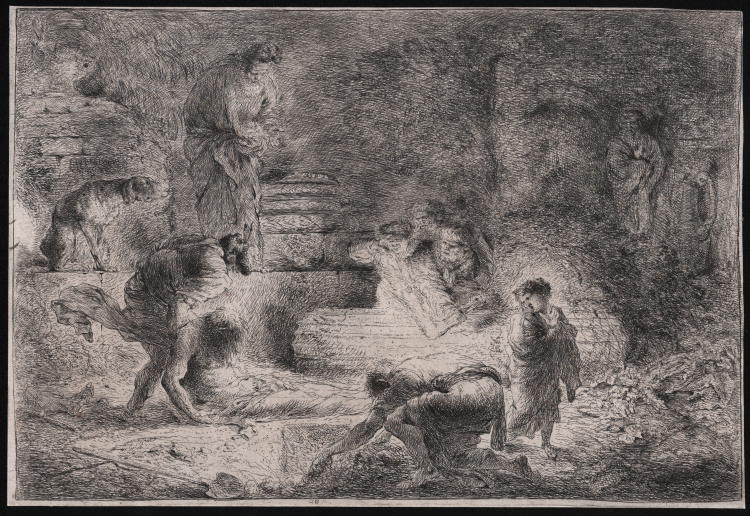
Etching, circa 1647-51, signed above dog at left 'Gio Benedetto Castiglione P' and lower margin “G. B. C.”.
The pious Tobit watches as a corpse is secretly prepared for burial at dead of night during the Jewish exile in Assyria. The only source of light is a torch so bright that a bystander has to cover his eyes. Castiglione’s night print is far lighter that those of his Dutch contemporaries. Instead of making his print dark, he uses a very loose drawing style. This hard-to-read style is effective because the viewer slowly picks out details from the tangle of lines in a process that parallels our vision as our eyes adjust to darkness.
“The figure of Tobit appears, with some variations, in a drawing attributed to Castiglione in the Parson Collection, London. The drawing is in the same direction as the etching. This work dates to about 1647-51, during the period of Castiglione’s interest in the effects of nocturnal illumination. This etching, more notably than others, displays Castiglione use of Rembrandtesque chiaroscuro” (cf. Paolo Bellini in The Illustrated Bartsch, p. 18).
Perhaps the most important Genoese artist of the seventeenth century, Castiglione was a product of the city’s unique cosmopolitanism. Receptive to the works of everyone from Paggi to van Dyck and Strozzi, he created a distinctly elaborate, expressive style in paint and print that won him admiration right across Europe despite his violent personality. Favouring rapid lines, Castiglione was a natural etcher, and he became one of the most gifted, experimental printmakers of the seventeenth century.
Etching, printed with tone on contemporary laid paper with unidentified watermark, trimmed to the platemark, in very good condition.
Bibliografia
Bartsch, Le Peintre graveur (XXI.12.5); The Illustrated Bartsch, 006; Bellini, L'Opera incisa di Giovanni Benedetto Castiglione, n. 57); Le Blanc, 1858, L. n. 4, Percy, 1971, n. E 20.
Giovanni Benedetto CASTIGLIONE detto "Il Grechetto" (Genova 1616 - Mantova 1670)
|
His origin and his edication in Genua led Castiglione to make acquaitance with the Flemish painting, especially through Jaan Roos e Van Dyck from whom he took the warm, vibrating chromatism.
He lived in Rome from 1632 to 1635 and from 1647 to 1651; among the two periods in Rome, he lived in Naples and he also started studying the intellectualistic classicism of Poussin.
His favourite subjects, both in painting and engraving, were taken from the classical moralism of Stoicism, very typical in Poussin, which enabled him to create his own peculiar repertoire, much more refined in comparison with contemporary artists.
He spent his last working years in Mantua, at the Duke’s Palace; the production of this period enhances his chromatism and the visionary elements of his previous production.
Castiglione has been a silful engraver; he loved this particular art for he thought it was the main mean to widespread his iconography. He was the first, in Italy, to appreciate and imitate Rembrandt.
|
Giovanni Benedetto CASTIGLIONE detto "Il Grechetto" (Genova 1616 - Mantova 1670)
|
His origin and his edication in Genua led Castiglione to make acquaitance with the Flemish painting, especially through Jaan Roos e Van Dyck from whom he took the warm, vibrating chromatism.
He lived in Rome from 1632 to 1635 and from 1647 to 1651; among the two periods in Rome, he lived in Naples and he also started studying the intellectualistic classicism of Poussin.
His favourite subjects, both in painting and engraving, were taken from the classical moralism of Stoicism, very typical in Poussin, which enabled him to create his own peculiar repertoire, much more refined in comparison with contemporary artists.
He spent his last working years in Mantua, at the Duke’s Palace; the production of this period enhances his chromatism and the visionary elements of his previous production.
Castiglione has been a silful engraver; he loved this particular art for he thought it was the main mean to widespread his iconography. He was the first, in Italy, to appreciate and imitate Rembrandt.
|