

| Reference: | A53183 |
| Author | Giovanni Benedetto CASTIGLIONE detto "Il Grechetto" |
| Year: | 1650 ca. |
| Measures: | 305 x 213 mm |
| Reference: | A53183 |
| Author | Giovanni Benedetto CASTIGLIONE detto "Il Grechetto" |
| Year: | 1650 ca. |
| Measures: | 305 x 213 mm |
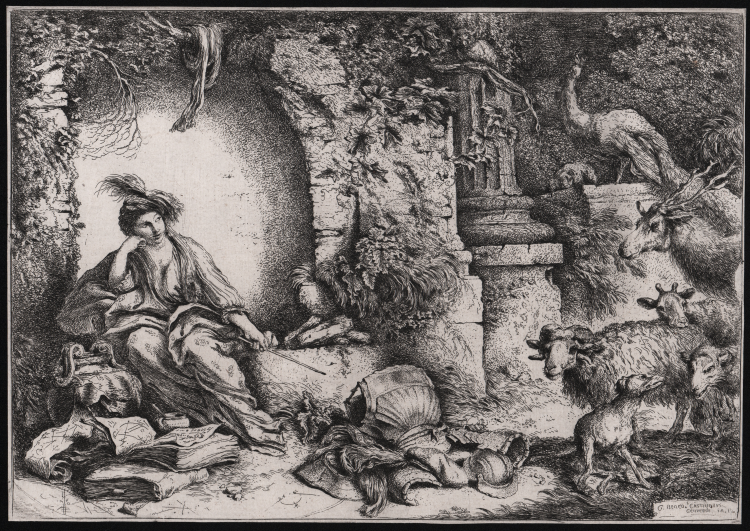
Etching, circa 1650, with etched signature 'G Bened Castilionus Genuensis in pin' at bottom right corner.
Example of the first state of two described by Paolo Bellini (cf. The Illutrated Bartsch p. 35, 022), before the diagonal mark on the tuft of grass below the helmet in the group of arms.
Magnificent work, rich in tones, printed on thin contemporary laid paper with a "lily in a shield with a crown" watermark, trimmed to the copperplate, in perfect condition.
The subject of this etching has been interpreted by some authors as a Melancholy (as does Bartsch, for example). Gioconda Albricci, however, argued in support of the contention that it probably refers to Circe and her transformations of Ulysses' companions. Ann Percy also supports this interpretation, whereas Henri Focillon posits a fanciful and unsubstantiated theory that the etching is the artist's attempt to reproduce graphically his volatile moods and his unusual views on art (Maîtres de l'estampe. Images et idées. Paris, 1930). The etching dates to 1650-51, prior to Castiglione's departure from Rome. This is indicated by the presence of the adjective "genuensis" in the signature and by the use of chiaroscuro, characteristic of Castiglione's works of the late 1640s when he was interested in nocturnal illumination. No preparatory drawing is known for this etching, although several preceding works by the artist may have influenced it.
Perhaps the most important Genoese artist of the seventeenth century, Castiglione was a product of the city’s unique cosmopolitanism. Receptive to the works of everyone from Paggi to van Dyck and Strozzi, he created a distinctly elaborate, expressive style in paint and print that won him admiration right across Europe despite his violent personality. Circe was one of Castiglione’s favourite mythological subjects. A sorceress surrounded by a menagerie of men she had turned into animals, her story was precisely the sort of exotic subject matter that suited Castiglione’s rich, extravagant style. With total mastery of the burin, he serves up a visual feast of lines, surfaces and textures, some softly receding into darkness, others strongly silhouetted against the white paper. Favouring rapid lines, Castiglione was a natural etcher, and he became one of the most gifted, experimental printmakers of the seventeenth century.
In the Book X of the Greek Odyssey Homer told the story of Odysseus and the sorceress Circe who turned his sailors into swine. Ovid reprises many tales of her wicked spells in the Latin verse of the Metamorphoses. She either collects herbs and poisonous plants in the woods and fields of her magical island or is enthroned on a 'splendid chair in a beautiful apse and wearing a dazzling robe wrapped round with a golden cloak' in her sumptuous palace. In this popular etching with its rich painterly technique, the Genoese Baroque artist Castiglione, pictures Circe in contemplative mood amongst the romantic ruins of classical antiquity, with a wand in her hand before piles of grimoires (books of magic spells and diagrams for the use of necromancers) and occult signs on the ground. Discarded armour lies before her, and the transformed intruders parade in the forms of cloven-hoofed sheep, goats and deer, with a dog and a peacock to guard them. In his mid-century travels Castiglione came into contact with Salvator Rosa, and both artists reflect a similar fascination with fantastical capriccio etchings of exotic 'oriental' figures, or philosophers and magicians in romantic landscape settings.
A wonderful example of this iconic etching.
Bibliografia
D. Petherbridge, Withces & Wicked Bodies, p. 37, n. 14; Bartsch, Le Peintre graveur (XXI.21.22); The Illustrated Bartsch, 022, I/II; Bellini, L'Opera incisa di Giovanni Benedetto Castiglione, n. 60 I/II); G. Albricci, La vera Malinconia del Castiglione, in "Quaderni del conoscitore di stampe", 1973, n. 6, pp. 40-43; S. Massari, Tra Mito e Allegoria, p. 416, n. 157; Gori Gandellini, 1810, VIII, n. XVI; Le Blanc, 1858, L. n. 58, Percy, 1971, n. E 23.
Giovanni Benedetto CASTIGLIONE detto "Il Grechetto" (Genova 1616 - Mantova 1670)
|
His origin and his edication in Genua led Castiglione to make acquaitance with the Flemish painting, especially through Jaan Roos e Van Dyck from whom he took the warm, vibrating chromatism.
He lived in Rome from 1632 to 1635 and from 1647 to 1651; among the two periods in Rome, he lived in Naples and he also started studying the intellectualistic classicism of Poussin.
His favourite subjects, both in painting and engraving, were taken from the classical moralism of Stoicism, very typical in Poussin, which enabled him to create his own peculiar repertoire, much more refined in comparison with contemporary artists.
He spent his last working years in Mantua, at the Duke’s Palace; the production of this period enhances his chromatism and the visionary elements of his previous production.
Castiglione has been a silful engraver; he loved this particular art for he thought it was the main mean to widespread his iconography. He was the first, in Italy, to appreciate and imitate Rembrandt.
|
Giovanni Benedetto CASTIGLIONE detto "Il Grechetto" (Genova 1616 - Mantova 1670)
|
His origin and his edication in Genua led Castiglione to make acquaitance with the Flemish painting, especially through Jaan Roos e Van Dyck from whom he took the warm, vibrating chromatism.
He lived in Rome from 1632 to 1635 and from 1647 to 1651; among the two periods in Rome, he lived in Naples and he also started studying the intellectualistic classicism of Poussin.
His favourite subjects, both in painting and engraving, were taken from the classical moralism of Stoicism, very typical in Poussin, which enabled him to create his own peculiar repertoire, much more refined in comparison with contemporary artists.
He spent his last working years in Mantua, at the Duke’s Palace; the production of this period enhances his chromatism and the visionary elements of his previous production.
Castiglione has been a silful engraver; he loved this particular art for he thought it was the main mean to widespread his iconography. He was the first, in Italy, to appreciate and imitate Rembrandt.
|