
| Reference: | S47004 |
| Author | Giovanni Francesco Barbieri Guercino |
| Year: | 1650 ca. |
| Measures: | 112 x 150 mm |
| Reference: | S47004 |
| Author | Giovanni Francesco Barbieri Guercino |
| Year: | 1650 ca. |
| Measures: | 112 x 150 mm |
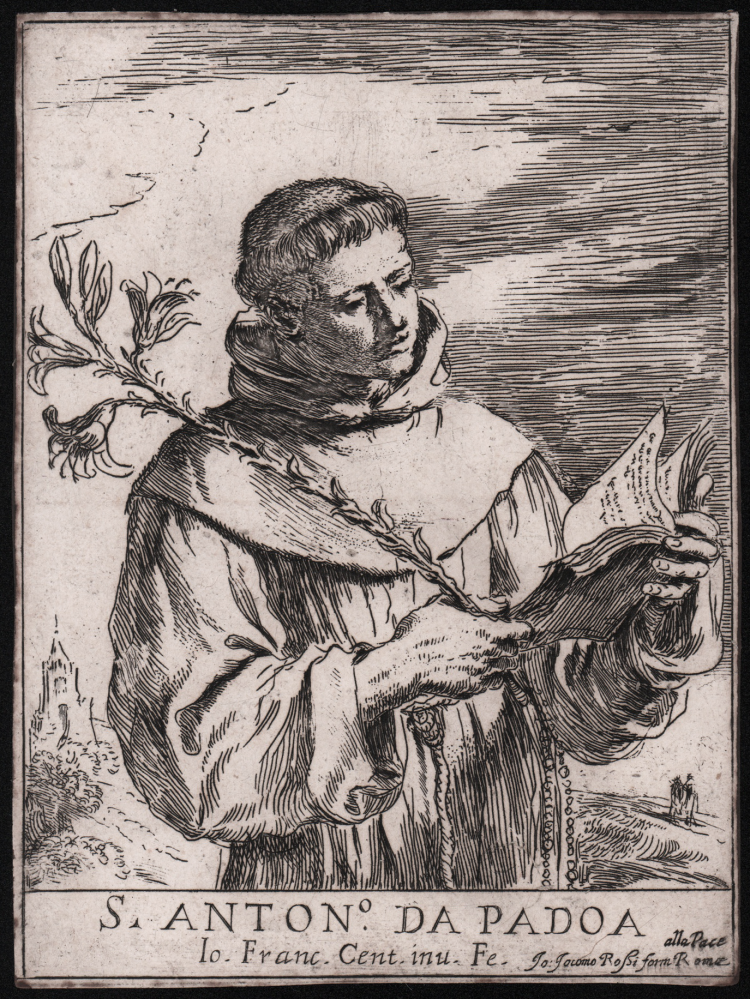
St Antony of Padua half-length holding a lily and reading from a book.
Etching, signed in bottom margin 'S.Anton da Pada. Io Franc. Cent. inv fe.'.
Example of the second state, with Giovanni Giacomo de Rossi address added at lower right.
After his own drawing. For further information see Nicholas Turner, in 'Print Quarterly' XXIV 2007, pp. 145-9 for Guercino's preparatory drawing for this plate, now in an American private collection.
Over a long and distinguished career as a painter and draughtsman, Guercino (1591-1666) made only two prints, the etchings St Antony of Padua, and The Infant St John the Baptist Seated in a Landscape. Probably rightly he felt his time was better employed supplying his patrons with paintings, which had become increasingly sought after as his fame increased.
Guercino only devoted himself to etching for a short period of his artistic career; it is not surprising, therefore, that his use of conventional hatching and cross-hatching was very limited and hasty. It is also not surprising that he encountered some technical difficulties with his etchings: “In Saint Anthony, for instance, the deeply shaded areas on the side of the saint's head were overbitten, and engraving was used to restore the breakdown that occurred there. Further, although both Saint Anthony and Young Saint John the Baptist are admirable realizations in etching of the luminous vivacity seen in Guercino's drawings, it is hard to escape the feeling that they lack the easy, fluent mastery of the drawings, especially in his translation of washes into etched line. Perhaps he felt these limitations too. At any rate, his experiment with etching was oddly short-lived, given what would seem to have been a natural predisposition toward the medium. Despite the rather informal execution of both prints, they are quite conservative in their calm, controlled, essentially classical approach, and should probably be dated late in the artist's career, possibly in the 1650s” (Richard Wallace in Italian Etchers pf the Reinassance & Barocque, p. 138).
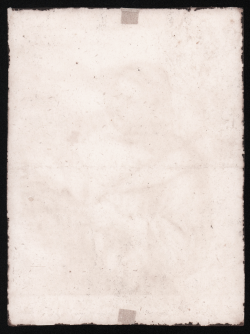
A very good impression, printed on contemporary laid paper, in good condition.
Bibliografia
Bartsch, Le Peintre graveur (XVIII.362.1); The Illustrated Bartsch, 1, V. 40 p. 371; Le Blanc C., Manuel de L'amateur D'estampes, 1, V. 1 p. 147, 1854-59; Nicholas Turner, Guercino’s First Idea for hie Etching of St Anthony of Padua, in 'Print Quarterly' XXIV 2007, pp.145-9.
Giovanni Francesco Barbieri Guercino (Cento 1591 – Ferrara 1666)
|
Giovanni Francesco Barbieri, called Guercino because of his squint (“guercio”), was born in February 1591 in Cento, near Ferrara. There were no leading artists in Cento at this time so apart from a brief apprenticeship, Guercino was largely self-taught. By the age of 23, he had moved to Bologna.
In Bologna, Guercino was profoundly influenced by the glowing colourism and emotion of Lodovico Carracci (1555-1619), who praised the younger artist and encouraged him. For the next five years, Guercino painted altar pieces in rich, intense colours, with energetic movement and a dramatic chiaroscuro reflecting the growing influence of Caravaggio (1571-1610).
In 1621, Guercino was summoned by Pope Gregory XV to Rome where he spent two highly productive years. He returned to Cento in 1623, where he remained until 1642, when his contemporary Guido Reni (1575-1642) died. Guercino then moved back to Bologna, taking over Reni's role as the city's leading painter. Guercino continued to paint and teach there for the rest of his life, amassing a considerable fortune.
|
Giovanni Francesco Barbieri Guercino (Cento 1591 – Ferrara 1666)
|
Giovanni Francesco Barbieri, called Guercino because of his squint (“guercio”), was born in February 1591 in Cento, near Ferrara. There were no leading artists in Cento at this time so apart from a brief apprenticeship, Guercino was largely self-taught. By the age of 23, he had moved to Bologna.
In Bologna, Guercino was profoundly influenced by the glowing colourism and emotion of Lodovico Carracci (1555-1619), who praised the younger artist and encouraged him. For the next five years, Guercino painted altar pieces in rich, intense colours, with energetic movement and a dramatic chiaroscuro reflecting the growing influence of Caravaggio (1571-1610).
In 1621, Guercino was summoned by Pope Gregory XV to Rome where he spent two highly productive years. He returned to Cento in 1623, where he remained until 1642, when his contemporary Guido Reni (1575-1642) died. Guercino then moved back to Bologna, taking over Reni's role as the city's leading painter. Guercino continued to paint and teach there for the rest of his life, amassing a considerable fortune.
|