
| Reference: | S47012 |
| Author | Guido RENI |
| Year: | 1620 ca. |
| Measures: | 130 x 95 mm |
| Reference: | S47012 |
| Author | Guido RENI |
| Year: | 1620 ca. |
| Measures: | 130 x 95 mm |
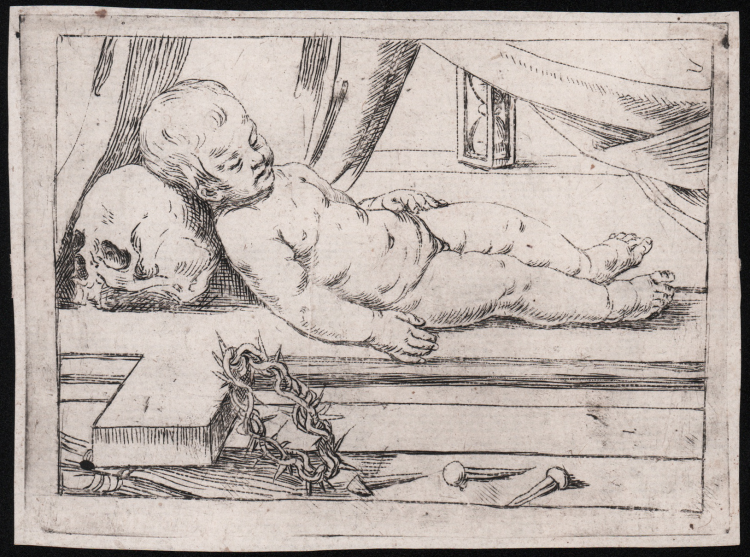
The print depicts the sleeping infant Christ. His head rests on a large skull, while his body rests on a cross. In the foreground are the crown of thorns and nails.
The print is an invention of Guido Reni. The name of the engraver is unknown, but based on a stylistic, technical, and art-historical analysis, it is believed to be an anonymous artist active in the 17th century. However, it cannot be ruled out that it is an engraving by Reni himself; a chiaroscuro replica by Bartolomeo Coriolano is known.
A magnificent work, printed on thin, contemporary laid paper without a watermark, with narrow margins, a small vertical print crease, otherwise in perfect condition.
Bibliografia
Adam von Bartsch Le Peintre graveur. Vienna, 1803, cat. no. XVIII.318.7, p. 318; TIB The Illustrated Bartsch. cat. no. 40[18]318.7, p. 226.
Guido RENI (Calvenzano 1575 - Bologna 1642)
|
A famous painter, he was nearly deified by French and English artistic literature of XVIII and XIX centuries. His first graphic works kept strict to Parmigianino’s art. Moreover, in Rome he copied the painter’s plates depicting the Deposizione and the Armi della famiglia Sforza. Parmigianino’s influence can be found all along his artistic life, especially in the gentleness of his Madonne col Bambino and the Sacre Famiglie.
It is also important to remind the contribution young Guido gave in 1603 for the realization of the funeral service of Agostino Carracci in Bologna, which has the same style of the series of engravings Reni realized when Pope Clemente VIII of the Aldobrandini’s family entered in Bologna.
His graphic acrtivity played a smaller role in his pictorial production and was mainly about religious subjects. He was in fact convinced that he could intensify and widespread the religious and emotional aspects of the Counter-Reformation in his works.
|
Guido RENI (Calvenzano 1575 - Bologna 1642)
|
A famous painter, he was nearly deified by French and English artistic literature of XVIII and XIX centuries. His first graphic works kept strict to Parmigianino’s art. Moreover, in Rome he copied the painter’s plates depicting the Deposizione and the Armi della famiglia Sforza. Parmigianino’s influence can be found all along his artistic life, especially in the gentleness of his Madonne col Bambino and the Sacre Famiglie.
It is also important to remind the contribution young Guido gave in 1603 for the realization of the funeral service of Agostino Carracci in Bologna, which has the same style of the series of engravings Reni realized when Pope Clemente VIII of the Aldobrandini’s family entered in Bologna.
His graphic acrtivity played a smaller role in his pictorial production and was mainly about religious subjects. He was in fact convinced that he could intensify and widespread the religious and emotional aspects of the Counter-Reformation in his works.
|