
| Reference: | A53749 |
| Author | Giulio BONASONE |
| Year: | 1540 ca. |
| Measures: | 344 x 274 mm |
| Reference: | A53749 |
| Author | Giulio BONASONE |
| Year: | 1540 ca. |
| Measures: | 344 x 274 mm |
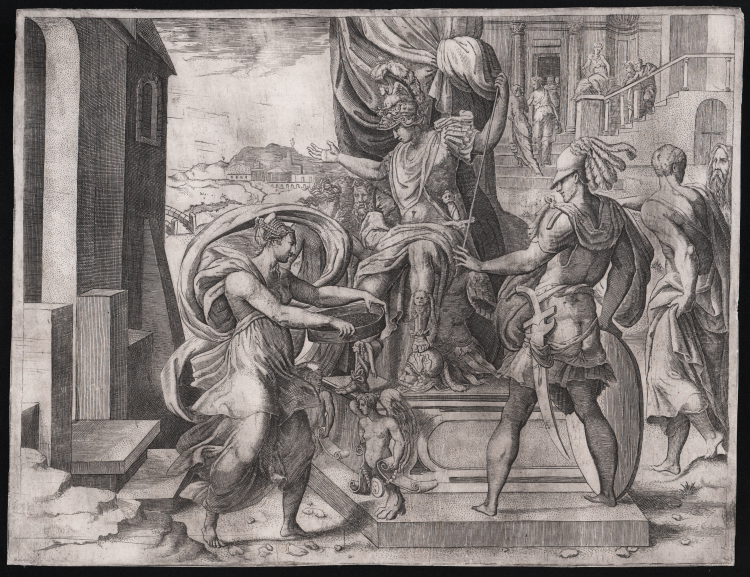
Roman emperor seated with outstretched arms, on the left the Vestal Virgin Tuccia holding a sieve, on the right a soldier with a shield.
Engraving, circa 1540, without printing details. From a subject by Francesco Mazzola, known as Parmigianino.
The history of this engraving is controversial. Unknown to Bartsch, it was catalogued by Stefania Massari in the graphic works of Giulio Bonasone, an attribution now accepted by leading scholars. Massari, referring to Cumberland's statement, catalogues the work under the title Alexander on the Throne. However, the female figure on the left clearly appears to depict the Vestal Virgin Tuccia, holding the sieve.
Tuccia or Tuzia was a legendary Roman Vestal Virgin, the protagonist of a story narrated by Titus Livius, Valerius Maximus, and Dionysius of Halicarnassus. Tuccia had been unjustly accused of violating her vow of chastity (incestum), a crime punishable by a very severe penalty. The vestal denied the accusation and asked to prove her innocence by undergoing an ordeal consisting of collecting water from the Tiber with a sieve. The pontiffs agreed, finding it utterly impossible. Tuccia went to the river and, after invoking the help of the goddess Vesta, collected the water and managed to carry it with the sieve to the Roman Forum to pour it at the feet of the pontiffs. The ordeal was successful, and Tuccia was found innocent.
The figure of the vestal appears convincing in its attribution to Bonasone, when compared with Bonasone's Circe (Bartsch 86, Massari 14), which features the same graphic ductus and fluttering veil. Furthermore, several similarities are found between the faces of Ulysses' companions appearing in the same engraving and the figures in the background of this sheet, which is believed to have been created in the first years of the fourth decade (see S. Massari, Giulio Bonasone, p. 43). Tuccia also seems to correlate with two prints by Master FP. The soldier on the right is related to the figure in Parmigianino's drawing in the Devonshire Collection, Chatsworth (A. E. Popham, Catalogue of Drawings by Parmigianino, 1971, vol. I, p. 211, no. 726 verso).
A beautiful work, printed on contemporary laid paper with a "triangle within a circle with a flower" watermark, trimmed to the platemark, small restorations in the lower left corner and minimal abrasions; otherwise in excellent condition.
Bibliografia
S. Massari, Giulio Bonasone, p. 43, n. 15; Le Blanc C., Manuel de L'amateur D'estampes, n. 243.
Giulio BONASONE (Bologna circa 1500 - Roma circa 1580)
|
Giulio Bonasone was born in Bologna in 1510; he was engraver, etcher and, as a painter, he was a pupil of Lorenzo Sabbatici.
The critics have ascribed to him 400 prints; nearly all of them are kept nowadays in the Institute of Graphic Design in Rome, widening the list of Bartsch, who had identified just 354 subjects. Bonasone started working in 1531 as copperplate engraver, as it can be seen from his S. Cecilia, and he was considered a follower of Marcantonio’s style in the last years. But Bonasone showed his own style quite soon, for Parmigianino asked him to engrave many of his works.
He lived in Rome between 1544 and 1547, working for the most important publishers of the time (Salamanca, Barlacchi, Lafrery), engraving subjects from Michelangelo, Raphael, Giulio Romano, Perin del Vaga and Polidoro da Caravaggio with his peculiar style.
|
Giulio BONASONE (Bologna circa 1500 - Roma circa 1580)
|
Giulio Bonasone was born in Bologna in 1510; he was engraver, etcher and, as a painter, he was a pupil of Lorenzo Sabbatici.
The critics have ascribed to him 400 prints; nearly all of them are kept nowadays in the Institute of Graphic Design in Rome, widening the list of Bartsch, who had identified just 354 subjects. Bonasone started working in 1531 as copperplate engraver, as it can be seen from his S. Cecilia, and he was considered a follower of Marcantonio’s style in the last years. But Bonasone showed his own style quite soon, for Parmigianino asked him to engrave many of his works.
He lived in Rome between 1544 and 1547, working for the most important publishers of the time (Salamanca, Barlacchi, Lafrery), engraving subjects from Michelangelo, Raphael, Giulio Romano, Perin del Vaga and Polidoro da Caravaggio with his peculiar style.
|