
| Reference: | S39004 |
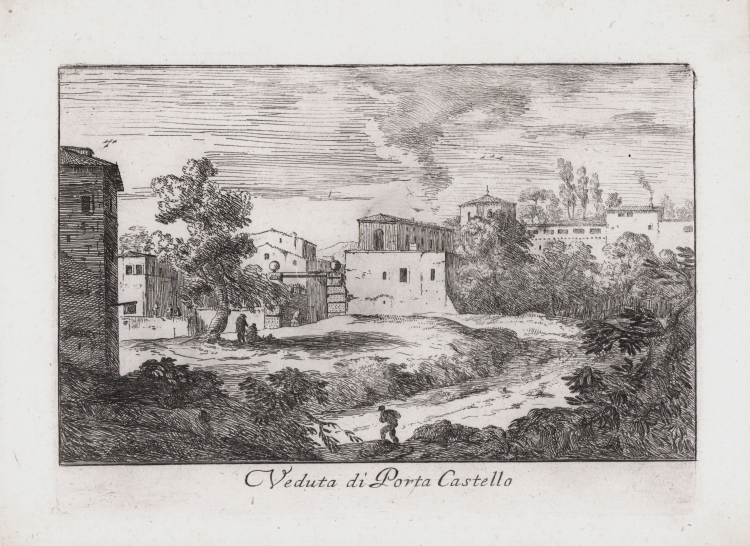
| Author | Paolo ANESI |
| Year: | 1725 ca. |
| Zone: | Porta Castello |
| Printed: | Rome |
| Measures: | 190 x 130 mm |
| Reference: | S39004 |
| Author | Paolo ANESI |
| Year: | 1725 ca. |
| Zone: | Porta Castello |
| Printed: | Rome |
| Measures: | 190 x 130 mm |
Etching, circa 1725, signed on plate.
A fine impression, on contemporary laid paper, with margins, very good conditions.
Paolo Anesi was an Italian painter and printmaker. His paintings are remembered for the characteristics of the Rococo artistic movement to which he belonged. Born in Rome in 1697, his artistic training immediately focused on vedutism, of which Arnesi was one of the leading exponents in the 18th century. His mentors included Giuseppe Bartolomeo Chiari, Andrea Locatelli, Sebastiano Conca, and Bernardino Fergioni. Except for a period spent in Florence, the painter spent the rest of his life in Rome, where his paintings gained a certain renown. Initially inspired by the Bamboccesque movement, he eventually abandoned it in favor of the new 18th-century movements. Several of his vedutist works were destined for foreign art dealers, mostly English; they were small, elegant, and refined landscapes. He was admitted as a member of the Accademia dei Virtuosi al Pantheon in 1757. In 1761, his paintings depicting Villa Albani, Palazzo Sergardi in Siena, Villa Doria Pamphilj, and Villa Chigi were particularly successful. Anesi's works also include his engravings, particularly a volume entitled "Varie vedute inventate ed intagliate da Paolo Anesi" (Various views invented and engraved by Paolo Anesi) from 1725. Some of his works have been exhibited at the Galleria Doria Pamphilj, the Galleria Corsini, and the Galleria Pallavicini. One of his most successful frescoes was undoubtedly "Capricci with ruins of the Forum."
Paolo Anesi has been reevaluated based on the studies conducted by Busiri Vici, who recognized the painter's pictorial and vedutistic qualities, equating his achievements with Andrea Locatelli. His canvases are an example of his ordinary production and demonstrate the painter's role in 18th-century Roman landscape painting. It is no coincidence that Anesi was one of the most popular artists among travelers on the Grand Tour, especially the English, and his works found their way into the most important collections in Rome. It is also worth noting how Anesi combined the tradition of Van Bloemen's ideal landscape with resolutions that seem to anticipate the Romantic view.
Bibliografia
Busiri Vici, Trittico paesistico romano del '700. Paolo Anesi, Paolo Monaldi, Alessio De Marchis, Roma 1975, pp. 3-71; L. Salerno, I pittori di vedute in Italia (1580-1830), Roma 1991, pp. 128-129; A. Ottani Cavina, E. Calbi, La pittura di paesaggio in Italia. Il Settecento, Milano 2005, pp. 102-103.
Paolo ANESI (Roma, 9 Luglio 1697 - 1773)
|
Italian painter, draughtsman and engraver. He was the son of Pietro Anesi, a silk weaver from Venice. Paolo studied figure painting with Giuseppe Chiari and, in 1715, landscape painting with Bernardino Fergioni (1674–1738), who was also teaching Andrea Locatelli at that time. Sebastiano Conca was another of Anesi’s teachers. In 1723 Anesi married the daughter of the architect Giuseppe Sardi. His earliest known work is a drawing (1719; Florence, Uffizi), but he made his reputation with the only known example of his engraved work: Varie vedute inventate ed intagliate, dedicated to Cardinal Giuseppe Renato Imperiali and published in Rome in 1725.
|
Paolo ANESI (Roma, 9 Luglio 1697 - 1773)
|
Italian painter, draughtsman and engraver. He was the son of Pietro Anesi, a silk weaver from Venice. Paolo studied figure painting with Giuseppe Chiari and, in 1715, landscape painting with Bernardino Fergioni (1674–1738), who was also teaching Andrea Locatelli at that time. Sebastiano Conca was another of Anesi’s teachers. In 1723 Anesi married the daughter of the architect Giuseppe Sardi. His earliest known work is a drawing (1719; Florence, Uffizi), but he made his reputation with the only known example of his engraved work: Varie vedute inventate ed intagliate, dedicated to Cardinal Giuseppe Renato Imperiali and published in Rome in 1725.
|