
| Reference: | A53186 |
| Author | Erasmus Quellinus, il Giovane |
| Year: | 1640 |
| Measures: | 295 x 237 mm |
| Reference: | A53186 |
| Author | Erasmus Quellinus, il Giovane |
| Year: | 1640 |
| Measures: | 295 x 237 mm |
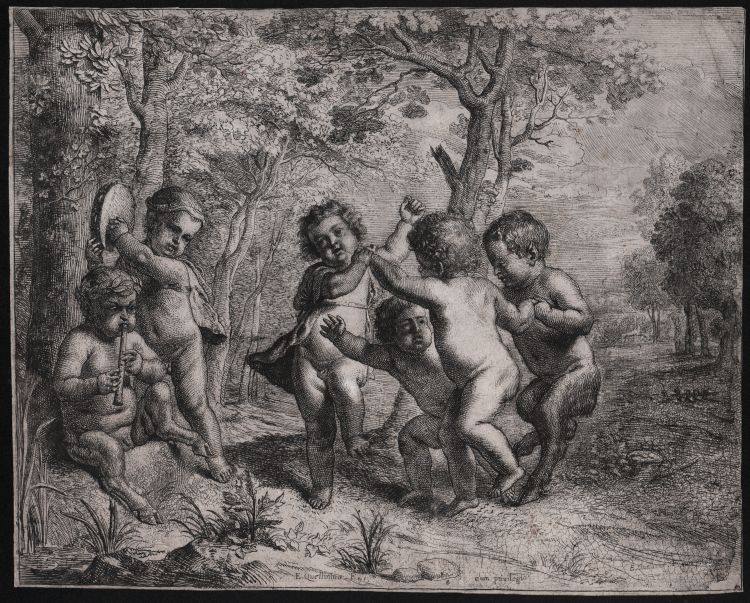
Bacchantes; amongst trees, three dancing putti and a young satyr accompanied by, at left, a satyr playing a recorder and a putti with a tambourine.
Etching, circa 1640/50, lettered below center in the design "E. Quellinus F" and towards right "cum privilegio".
A very good impression, rich in tones, printed on contemporary laid paper, trimmed to the copperplate, traces of glue on the back, otherwise in excellent condition.
Erasmus Quellinus the Younger (Antwerp, 1607-1678) was a Flemish painter specializing in perspective studies. Initially a pupil of Wallerant Vaillant, he collaborated with several members of his artistic family, including Jan Philips van Thielen, before becoming a pupil of Peter Paul Rubens. His biblical, mythological, and historical paintings with numerous figures are notable for their effective and powerful overall construction. The landscape is treated schematically as a background, while scenes from the New Testament and the lives of the Saints are sometimes surrounded by a garland of flowers and fruit by the painter D. Seghers or J.P. van Thielen. The best paintings are still sometimes attributed to Rubens.
Bibliografia
F. W. H. Hollstein Dutch and Flemish Etchings, Engravings and Woodcuts. vols. 1-64, Amsterdam, 1954–2010, cat. no. 4, p. 281; Eugène Dutuit Manuel de L'Amateur d'Estampes, 1881, p. 282.
Erasmus Quellinus, il Giovane (Anversa, 1607 – Anversa, 1678)
|
Erasmus Quellinus the Younger (Antwerp, 1607 – Antwerp, 1678) was a Flemish painter specializing in perspective studies and a pupil of Peter Paul Rubens. Born in Antwerp, he was the son of Erasmus Quellinus the Elder and Elizabeth van Uden. Initially a pupil of Wallerant Vaillant, he collaborated with numerous members of his artistic family, including Jan Philips van Thielen. His brother Artus Quellinus the Elder was a famous sculptor, and his children and grandchildren included a number of painters. He married Catharina de Hemelaer in 1634, with whom he had a son, Jan-Erasmus Quellinus. In his second marriage, he married Françoise de Fren, sister of Isabella de Fren, wife of David Teniers the Younger. His biblical, mythological, and historical paintings, featuring numerous figures, are notable for their effective and powerful overall composition. The landscape is treated schematically, like a background. Scenes from the New Testament and the lives of the saints are sometimes surrounded by a garland of flowers and fruit by the painter D. Seghers or J.P.v. Thielen. He occasionally contributed individual figures in Jan Fyt's still lifes with birds. Portraits are rare. The best paintings are still sometimes attributed to Rubens.
|
Erasmus Quellinus, il Giovane (Anversa, 1607 – Anversa, 1678)
|
Erasmus Quellinus the Younger (Antwerp, 1607 – Antwerp, 1678) was a Flemish painter specializing in perspective studies and a pupil of Peter Paul Rubens. Born in Antwerp, he was the son of Erasmus Quellinus the Elder and Elizabeth van Uden. Initially a pupil of Wallerant Vaillant, he collaborated with numerous members of his artistic family, including Jan Philips van Thielen. His brother Artus Quellinus the Elder was a famous sculptor, and his children and grandchildren included a number of painters. He married Catharina de Hemelaer in 1634, with whom he had a son, Jan-Erasmus Quellinus. In his second marriage, he married Françoise de Fren, sister of Isabella de Fren, wife of David Teniers the Younger. His biblical, mythological, and historical paintings, featuring numerous figures, are notable for their effective and powerful overall composition. The landscape is treated schematically, like a background. Scenes from the New Testament and the lives of the saints are sometimes surrounded by a garland of flowers and fruit by the painter D. Seghers or J.P.v. Thielen. He occasionally contributed individual figures in Jan Fyt's still lifes with birds. Portraits are rare. The best paintings are still sometimes attributed to Rubens.
|