
| Reference: | S52056 |
| Author | Raphael SADELER II |
| Year: | 1600 |
| Measures: | 105 x 145 mm |
| Reference: | S52056 |
| Author | Raphael SADELER II |
| Year: | 1600 |
| Measures: | 105 x 145 mm |
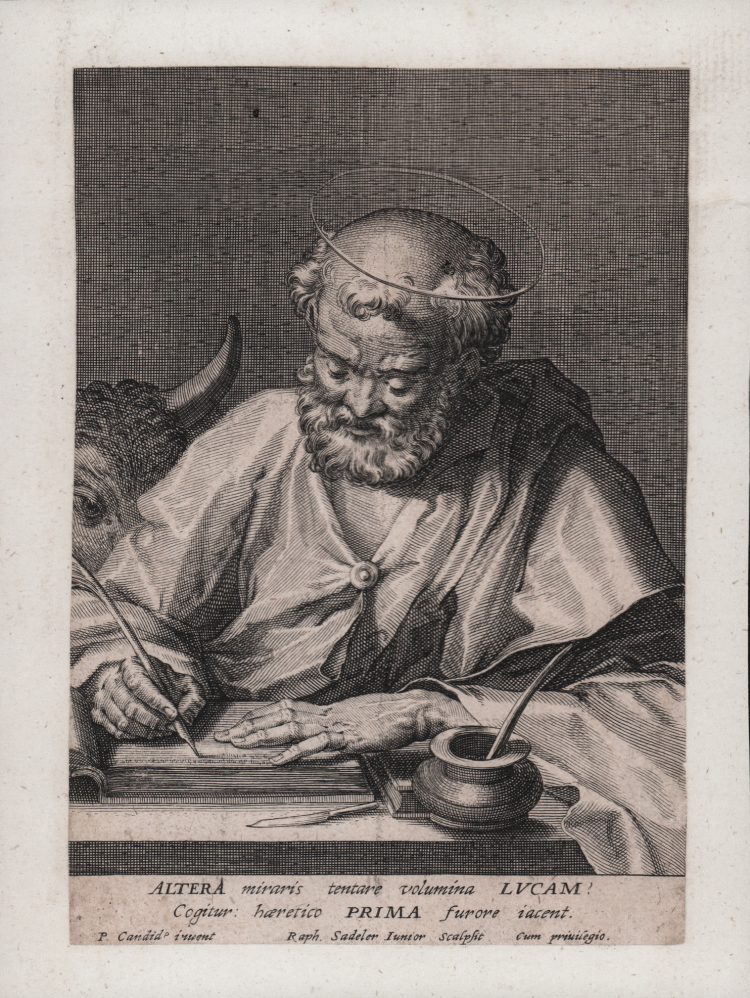
St Luke writing at a table, a quill and an inkpot in front of him, bull beyond; after Peter de Witte (Petrus Candid).
Engraving, circa 1600, lettered and signed in lower margin, three lines: "ALTERA miraris ... / ... furore iacent." and "P. Candid. inuent." and "Raph. Sadeler Iunior scalpsit Cum privilegio.".
A fine impression, printed on contemporary laid paper, trimmed to the borderline, in good condition. Laid down on antique paper.
Bibliografia
Hollstein, Dutch and Flemish etchings, engravings and woodcuts c.1450-1700 (36).
Raphael SADELER II (Anversa, 1584 - Praga, dopo 1627, o Monaco, 1632)
|
The SADELER: Flemish family of artists, active throughout Europe. For three generations this family of engravers, publishers and print-sellers played a dominant role in European graphic art, producing work of great variety and high quality. They were descended from a line of steel-chisellers from Aalst . Jan de Saeyelleer (Sadeleer) had three sons, Jan Sadeler I, Aegidius Sadeler I and Raphael Sadeler I, the first generation of engravers, publishers and print-sellers. The religious and political uncertainties of the time forced them to emigrate, and they worked in Cologne, Frankfurt am Main, Munich, Venice and Prague. The next generation followed in their footsteps, of whom Aegidius Sadeler II, who worked for Rudolf II and his successors, was the most notable. Justus Sadeler, the son of Jan Sadeler I, and the three sons of Raphael Sadeler I—Jan Sadeler II, Raphael Sadeler II and Filips Sadeler—were lesser artists but continued the family tradition. The third generation was represented by Tobias Sadeler (fl Vienna, 1670–75), son of Aegidius Sadeler II; he executed engravings for topographical books. RAPHAEL SADELER II: Engraver, son of Raphael Sadeler I. He was trained as an engraver by his father. From 1601 to 1604 he was in Venice. He engraved drawings by Paolo Piazza (e.g. the Mirror of Poverty, the Mirror of Chastity and the Mirror of Obedience). In 1610 Raphael II was admitted to the Antwerp Guild of St Luke as a master’s son. From 1604 to 1632 he lived in Munich, where he collaborated with his father, for instance on engravings after Kager for the second and third books of Bavaria sancta et pia. Raphael II’s better work includes the four etchings in Expeditiones in utramque Austriam et Bohemiam ephemeris. At the end of his life Raphael II collaborated with his brothers Jan II and Filips on illustrations for books by H. Drechsels.
|
Raphael SADELER II (Anversa, 1584 - Praga, dopo 1627, o Monaco, 1632)
|
The SADELER: Flemish family of artists, active throughout Europe. For three generations this family of engravers, publishers and print-sellers played a dominant role in European graphic art, producing work of great variety and high quality. They were descended from a line of steel-chisellers from Aalst . Jan de Saeyelleer (Sadeleer) had three sons, Jan Sadeler I, Aegidius Sadeler I and Raphael Sadeler I, the first generation of engravers, publishers and print-sellers. The religious and political uncertainties of the time forced them to emigrate, and they worked in Cologne, Frankfurt am Main, Munich, Venice and Prague. The next generation followed in their footsteps, of whom Aegidius Sadeler II, who worked for Rudolf II and his successors, was the most notable. Justus Sadeler, the son of Jan Sadeler I, and the three sons of Raphael Sadeler I—Jan Sadeler II, Raphael Sadeler II and Filips Sadeler—were lesser artists but continued the family tradition. The third generation was represented by Tobias Sadeler (fl Vienna, 1670–75), son of Aegidius Sadeler II; he executed engravings for topographical books. RAPHAEL SADELER II: Engraver, son of Raphael Sadeler I. He was trained as an engraver by his father. From 1601 to 1604 he was in Venice. He engraved drawings by Paolo Piazza (e.g. the Mirror of Poverty, the Mirror of Chastity and the Mirror of Obedience). In 1610 Raphael II was admitted to the Antwerp Guild of St Luke as a master’s son. From 1604 to 1632 he lived in Munich, where he collaborated with his father, for instance on engravings after Kager for the second and third books of Bavaria sancta et pia. Raphael II’s better work includes the four etchings in Expeditiones in utramque Austriam et Bohemiam ephemeris. At the end of his life Raphael II collaborated with his brothers Jan II and Filips on illustrations for books by H. Drechsels.
|