
| Reference: | A53744 |
| Author | Francois de POILLY |
| Year: | 1651 ca. |
| Zone: | Piazza Navona |
| Printed: | Rome |
| Measures: | 700 x 480 mm |
| Reference: | A53744 |
| Author | Francois de POILLY |
| Year: | 1651 ca. |
| Zone: | Piazza Navona |
| Printed: | Rome |
| Measures: | 700 x 480 mm |
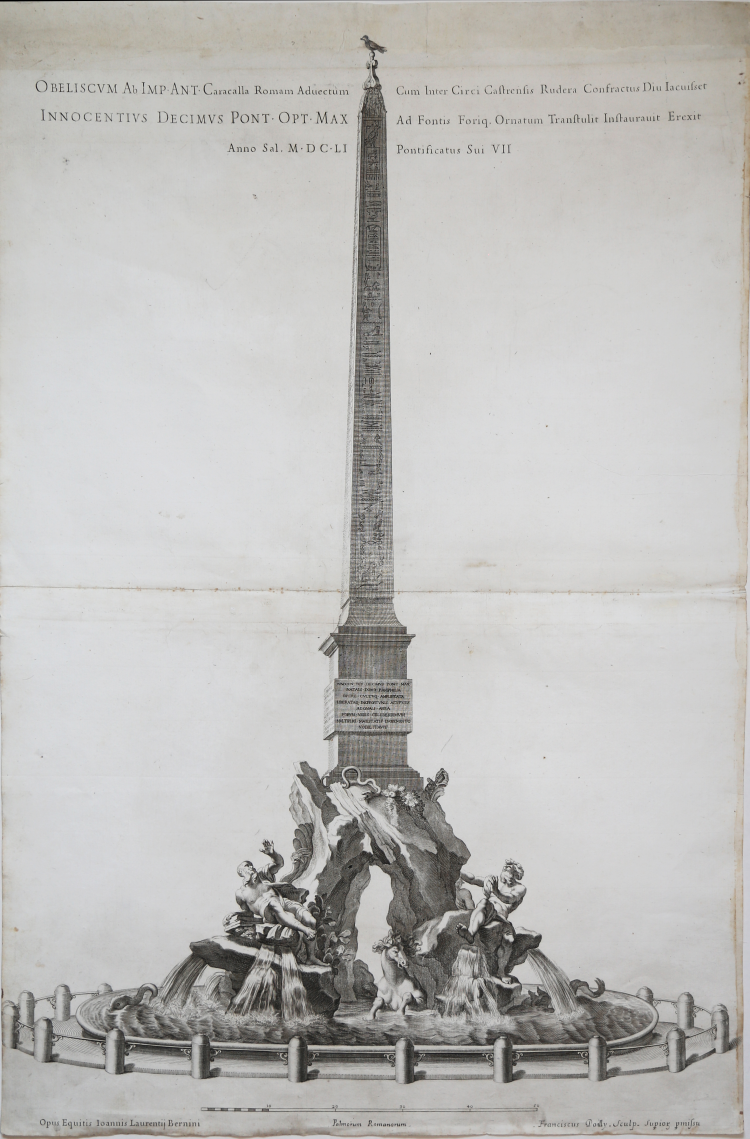
View of the Fontana de Fiumi in Piazza Navona, made in 1651 for the inauguration of Bernini's fountain.
Etching, 1651, signed lower right Franciscus Poilly Sculp. Supior pmisu. Bottom left: Opus Ioannis Laurentij Bernini.
Title at the top: OBELISCVM ab IMP. ANT. Caracalla Romam aduectum, cum inter Circi Castrensis Rudera Confractus Diu Iacuisset, INNOCENTIVS DECIMUS. PONT MAX Ad Fontis, Foriq. Ornatum Transtulit Instaurauit Erexit Anno Sal. MDCLI. Pontificatus Sui VII.
Exemple in the very rare first state (of three) ahead of the inscription Tabula prima quae… prospectum a parte occidentale ostendit which appears in the second state after the date.
The work shows the baroque fountain with the central obelisk (Obelisco Agonale), the statues representing the four main rivers and the dove with an olive branch on top, symbol of the Pamphilj family. Bernini created it after falling out of favor with the Pamphili family; his great fame had in fact suffered a setback, following the failure of his bell tower in St. Peter's and for having worked with the Barberini family, who had always been in antagonism with the Pamphili family. It was his sister-in-law, Donna Olimpia, who presented Innocent X with a vision of the silver model of Bernini's fountain, which left a very favorable impression on the pontiff, and so the important commission was entrusted to the sculptor, who developed the extraordinary allegory that aimed to express the triumph of the Catholic Church over the four continents symbolized by the personifications of the rivers: the Nile, the Ganges, the Rio de la Plata, and the Danube.
François de Poilly I (Abeville 1622 – Paris 1693) was the son of a goldsmith who gave him his first drawing lessons, and later apprenticed to the Parisian engraver Pierre Daret. Between 1649 and 1656, he lived in Rome, where he spent seven years in the workshop of Cornelis Bloemaert II, who taught him his art. His oeuvre includes approximately four hundred engravings reproducing Italian and French masters, primarily religious subjects.
A magnificent work, printed on contemporary laid paper, with horizontal paper creases and minor oxidation, otherwise in excellent condition.
Bibliografia
José Lothe, L'Oeuvre Gravé de François et Nicolas de Poilly, Paris, 1994, n. 357; Indice delle stampe De Rossi, 31, c. 3, 1735; Indice delle stampe De Rossi, 10, c. 13, 1677.
Francois de POILLY (Abbeville, 1623 – Parigi, 1693)
|
François Poilly, or François de Poilly, (1623 – 1693) was a French engraver. He was born in Abbeville, the son of a goldsmith who gave him his first drawing lessons. He was apprenticed to the Parisian engraver Pierre Daret. Poilly then travelled to Rome where he stayed for seven years with the engraver Cornelis Bloemaert, where he acquired mastership of the art. He died in Paris. Poilly's is noted for approximately 400 engravings. He is known for mainly religious subjects after Raphael, Guido Reni, Annibale Carracci, Pierre Mignard, Charles Le Brun, Nicolas Poussin, Sébastien Bourdon, and Eustache Lesueur.
|
Francois de POILLY (Abbeville, 1623 – Parigi, 1693)
|
François Poilly, or François de Poilly, (1623 – 1693) was a French engraver. He was born in Abbeville, the son of a goldsmith who gave him his first drawing lessons. He was apprenticed to the Parisian engraver Pierre Daret. Poilly then travelled to Rome where he stayed for seven years with the engraver Cornelis Bloemaert, where he acquired mastership of the art. He died in Paris. Poilly's is noted for approximately 400 engravings. He is known for mainly religious subjects after Raphael, Guido Reni, Annibale Carracci, Pierre Mignard, Charles Le Brun, Nicolas Poussin, Sébastien Bourdon, and Eustache Lesueur.
|