
| Reference: | S50130 |
| Author | Hieronimus COCK |
| Year: | 1550 ca. |
| Zone: | Tempio della Pace |
| Printed: | Antwerpen |
| Measures: | 283 x 225 mm |
| Reference: | S50130 |
| Author | Hieronimus COCK |
| Year: | 1550 ca. |
| Zone: | Tempio della Pace |
| Printed: | Antwerpen |
| Measures: | 283 x 225 mm |
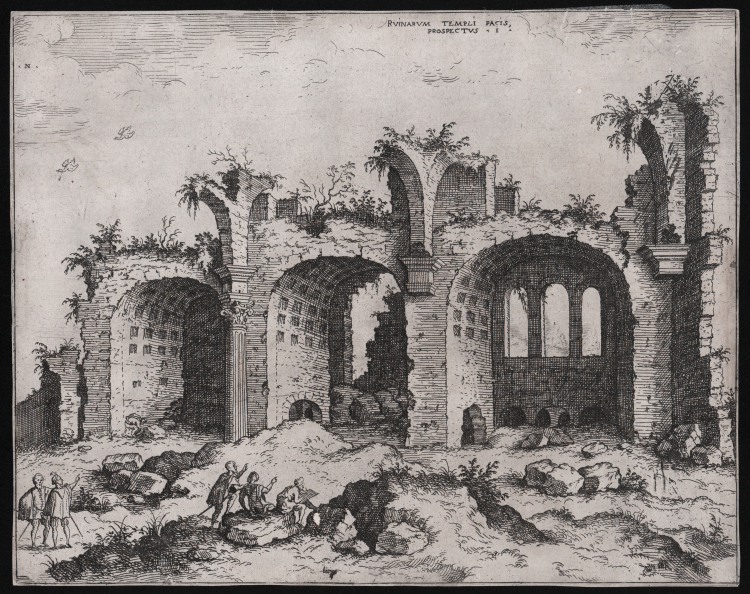
Etching, circa 1550, not signed.
This engraving is part of the famous suite Præcipua Aliquot Romane Antiquitatis Ruinarum Monimenta Vivis Prospectibus, published in Antwerp in 1551.
The prints in the series reproduce views that Cock likely drew in Rome (1546–1548) and possibly sketches by other artists. The corpus includes some of Rome's largest ruins — the Basilica of Constantine, the Colosseum, and the Palatine Hill — but none are topographically accurate or structurally precise, to the point that the renowned archaeologist and topographer Christian Hulsen concluded that their divergence from the physical remains rendered them "worthless". However, archaeological accuracy was not Cock's goal, since his stated aim was to provide a repertoire of architectural motifs for use by Northern artists who could not study antiquities firsthand.
Unlike his contemporaries Antonio Lafreri and Antonio Salamanca, who proposed reconstructed images of individual buildings, Cock's engravings demonstrate his taste for ruins inserted into landscapes.
European interest in the ruins of ancient Rome arose during the early Renaissance. Artists visiting Rome and its environs produced drawings of both entire complexes and architectural details. Upon returning home, they would then elaborate on the sketches made on site. The drawings were collected by artists and other interested parties. Printmaking clearly offered an excellent way to meet the growing demand for illustrations of ancient Rome. Jacques Androuet du Cerceau's series of engravings after Léonard Thiry from 1550 and Hieronymus Cock's Præcipua Aliquot Romane Antiquitatis Ruinarum Monimenta Vivis Prospectibus were the fascinating beginning of this process.
Unlike Thiry's prints, which contain details of buildings, Cock's depicts the ruins in their rural setting. This creates greater distance between the viewer and the image, while the topographical aspect is reinforced by the titles on the prints. The manner of depicting the ruins is similar to that of Maarten van Heemskerck, who included ruins in his paintings and drawings for prints.
It is generally accepted that Cock made the drawings of the ruins in Rome, and those of the landscapes in Antwerp. The absence of the names of the artists on the prints, however, cannot be considered proof that Cock did not use sketches by other artists. In several cases, the buildings cannot be identified, and the presence of incorrect titles raises the question of whether Cock actually drew the buildings on site. It is possible that he made preparatory drawings in Antwerp based on what other artists had brought him from Rome. One of these artists may have been van Heemskerck. He indeed produced numerous drawings of ruins, and Cock was in close contact with him.
Cock's trip to Rome is usually dated between 1546, the year he joined the guild, and 1548, the year his first series of prints appeared. Regardless of whether Cock himself ever visited Rome, as previously stated, it is important to establish whether he personally produced the drawings from which the prints were based. A recent study of Cock's depiction of the Palatine in his series of prints has shown that there are too many deviations from the actual topography to make this hypothesis plausible.
In the dedication to his patron Antoine Perrenot de Granvelle, Bishop of Arras and advisor to Charles V, Cock mentions that Granvelle, as a champion of virtue and education and an admirer of venerable antiquity, had provided the impetus for the publication of the images of the ruins.
Although the prints could not satisfy the archaeological interest of Granvelle and others, Cock merits the honour of aroming attention to ruins as historical monuments of Roman antiquity and of being a major contributor to what is sometimes referred to as 'ruin mania. His engravings were copied by Jacques Androuet du Cerceau and Battista Pittoni, later used by Vincenzo Scamozzi in his Discorsi sopra l'antichità di Roma (Venice 1583). Cock himself republished the series in 1561, when the imperial privilege had expired, adding twelve new compositions engraved by Johannes van Doetecum.
A beautiful work, printed on contemporary laid paper without watermark, trimmed to the platemark, good condition. Very rare.
Bibliografia
Pieter Fuhring, Hieronymus Cock, The Reinassance in Print, pp. 90-99; Timothy Allan Riggs, Hieronymus Cock, printmaker and publisher, p. 258.
Hieronimus COCK (Anversa 1518 - 1570)
|
Hieronymus Cock, or Hieronymus Wellens de Cock (1518 – 3 October 1570) was a Flemish painter and etcher as well as a publisher and distributor of prints. Cock is regarded as one of the most important print publishers of his time in northern Europe. His publishing house played a key role in the transformation of printmaking from an activity of individual artists and craftsmen into an industry based on division of labour. His house published more than 1,100 prints between 1548 and his death in 1570, a vast number by earlier standards.
While far more important and influential as a publisher, Cock was also an artist of talent, as seen in his last series of 12 landscape etchings of 1558, which are somewhat in the fantastic style of the paintings of his brother Matthys Cock. Altogether he etched 62 plates.
Hieronymus Cock was born into an artistic family. His father Jan Wellens de Cock and his brother Matthys Cock were both painters and draftsmen. He was admitted as a master painter in the Guild of Saint Luke in Antwerp in 1545. He resided in Rome from 1546 to 1547. When he returned to Antwerp in 1547, he married Volcxken Diericx. Together with his wife he founded in 1548 the publishing house Aux quatre vents or In de Vier Winden (the "House of the Four Winds"). The publishing house issued its first prints in 1548. The majority of Cock's prints were made after paintings or designs purposely made for him by artists from the Low Countries such as Frans Floris, Pieter Brueghel the Elder, Lambert Lombard, Maarten van Heemskerck and Hieronymus Bosch as well as architectural and ornament designs by Cornelis Floris and Hans Vredeman de Vries. Cock employed some of the best engravers of his time such as Johannes Wierix, Adriaen Collaert, Philip Galle, Cornelis Cort and the Italian Giorgio Ghisi.
In 1559 and 1561 he published two series of landscape prints by an anonymous Flemish draughtsman now referred to as the Master of the Small Landscapes. The series of landscapes were drawn from nature in the vicinity of Antwerp and had an important influence on the development of Flemish and Dutch realist landscape art.
The publishing house Aux Quatre Vents played an important role in the spread of the Italian High Renaissance throughout northern Europe as Cock published prints made by prominent engravers such as Giorgio Ghisi, Dirck Volckertsz Coornhert and Cornelis Cort after the work of leading Italian painters like Raphael, Primaticcio, Bronzino, Giulio Romano and Andrea del Sarto. The Italian historian of architecture Vincenzo Scamozzi copied many of the engravings published by Cock in 1551 for his volume on Rome entitled 'Discorsi sopra L'antichita di Roma' (Venice: Ziletti, 1583). Cock collaborated with the Spanish cartographer Diego Gutiérrez on a 1562 Map of America. Hieronymus Cock collaborated with Antwerp architect and designer Cornelis Floris de Vriendt in the publishing of Cornelis Floris' designs for monuments and ornaments: the ‘’Veelderley niewe inuentien van antycksche sepultueren’’ (‘The many new designs of antique sculptures') was published in 1557 and the ‘’Veelderley veranderinghe van grotissen’’ (‘Many varieties of grotesques’) in 1556. The publication of these books contributed to the spread of the so-called Floris style throughout the Netherlands. The Dutch publisher Philip Galle worked at Cock's printing house from 1557 and succeeded him in 1570.
|
Hieronimus COCK (Anversa 1518 - 1570)
|
Hieronymus Cock, or Hieronymus Wellens de Cock (1518 – 3 October 1570) was a Flemish painter and etcher as well as a publisher and distributor of prints. Cock is regarded as one of the most important print publishers of his time in northern Europe. His publishing house played a key role in the transformation of printmaking from an activity of individual artists and craftsmen into an industry based on division of labour. His house published more than 1,100 prints between 1548 and his death in 1570, a vast number by earlier standards.
While far more important and influential as a publisher, Cock was also an artist of talent, as seen in his last series of 12 landscape etchings of 1558, which are somewhat in the fantastic style of the paintings of his brother Matthys Cock. Altogether he etched 62 plates.
Hieronymus Cock was born into an artistic family. His father Jan Wellens de Cock and his brother Matthys Cock were both painters and draftsmen. He was admitted as a master painter in the Guild of Saint Luke in Antwerp in 1545. He resided in Rome from 1546 to 1547. When he returned to Antwerp in 1547, he married Volcxken Diericx. Together with his wife he founded in 1548 the publishing house Aux quatre vents or In de Vier Winden (the "House of the Four Winds"). The publishing house issued its first prints in 1548. The majority of Cock's prints were made after paintings or designs purposely made for him by artists from the Low Countries such as Frans Floris, Pieter Brueghel the Elder, Lambert Lombard, Maarten van Heemskerck and Hieronymus Bosch as well as architectural and ornament designs by Cornelis Floris and Hans Vredeman de Vries. Cock employed some of the best engravers of his time such as Johannes Wierix, Adriaen Collaert, Philip Galle, Cornelis Cort and the Italian Giorgio Ghisi.
In 1559 and 1561 he published two series of landscape prints by an anonymous Flemish draughtsman now referred to as the Master of the Small Landscapes. The series of landscapes were drawn from nature in the vicinity of Antwerp and had an important influence on the development of Flemish and Dutch realist landscape art.
The publishing house Aux Quatre Vents played an important role in the spread of the Italian High Renaissance throughout northern Europe as Cock published prints made by prominent engravers such as Giorgio Ghisi, Dirck Volckertsz Coornhert and Cornelis Cort after the work of leading Italian painters like Raphael, Primaticcio, Bronzino, Giulio Romano and Andrea del Sarto. The Italian historian of architecture Vincenzo Scamozzi copied many of the engravings published by Cock in 1551 for his volume on Rome entitled 'Discorsi sopra L'antichita di Roma' (Venice: Ziletti, 1583). Cock collaborated with the Spanish cartographer Diego Gutiérrez on a 1562 Map of America. Hieronymus Cock collaborated with Antwerp architect and designer Cornelis Floris de Vriendt in the publishing of Cornelis Floris' designs for monuments and ornaments: the ‘’Veelderley niewe inuentien van antycksche sepultueren’’ (‘The many new designs of antique sculptures') was published in 1557 and the ‘’Veelderley veranderinghe van grotissen’’ (‘Many varieties of grotesques’) in 1556. The publication of these books contributed to the spread of the so-called Floris style throughout the Netherlands. The Dutch publisher Philip Galle worked at Cock's printing house from 1557 and succeeded him in 1570.
|