
| Reference: | S49669 |
| Author | Jacob MATHAM |
| Year: | 1589 |
| Measures: | 255 x 255 mm |
| Reference: | S49669 |
| Author | Jacob MATHAM |
| Year: | 1589 |
| Measures: | 255 x 255 mm |
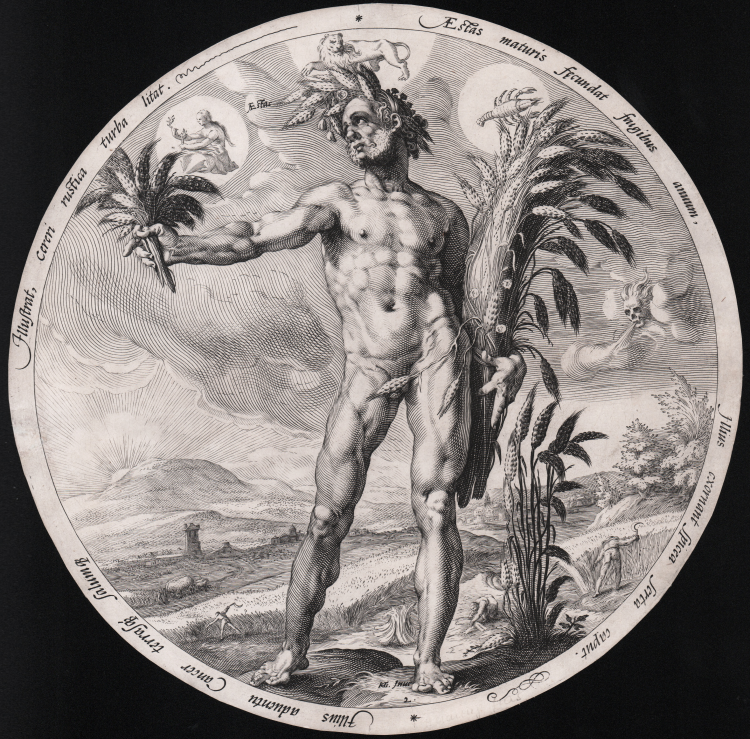
Summer, whole-length, holding a wheatsheaf and wearing ears of corn in his hair; beyond harvest is taking place and there are signs of the zodiac in the sky.
Engraving, 1589, lettered above with the title, below "HG. Inue"; around the plate "Æstas maturis ... turba litat". Numbered below "2".
From a series of four plates (Hollstein 300-303), the Allegory of the four seasons, engraved by Jacob Matham under the direction of Hendrick Goltzius, who also took care of the printing of the works.
Between 1589 and 1601, Hendrick Goltzius produced four different cycles of the four seasons which demonstrate a clear development of his artistic language. Ilja Veldman, who has studied this development in detail, identifies a trend from the purely allegorical use of personifications through to genre-like, semi-realistic scenes. The first two cycles of the seasons engraved by Jacob Matham are still in the classical tradition. They show the personifications in landscape settings, together with the appropriate signs of the zodiac and winds. The third of the series of four seasons designed by Hendrick Goltzius occupies a transitional position. It would seem that here he has turned to realistic depictions of everyday scenes. This cycle, designed by Goltzius around 1594, was probably engraved by Jan Saenredam. The accompanying Latin texts were composed by Cornelis Schonaeus, the headmaster of the Haarlem Latin School. The last series of allegories of the seasons reflects instead the stylistic change following his trip to Italy.
A fine impression, printed on contemporary laid paper with “Crest of Basel on Escutcheon with Three rings attached” watermark (Strauss p. 761), trimmed to the platemark, a small repaired area in the white left margin, otherwise very good condition.
Bibliografia
The New Hollstein: Dutch and Flemish etchings, engravings and woodcuts 1450-1700, Jacob Matham, n. 216.I; Hollstein, Dutch and Flemish etchings, engravings and woodcuts c.1450-1700, n. 301; Bartsch, Le Peintre graveur (III.167.140); Christiane Lauterbach, Masked allegory: the cycle of the four seasons by Hendrick Goltzius, с. 1594-95.
Jacob MATHAM (Haarlem 1571 - 1631)
|
Jacob Adriaenszoon Matham (Haarlem, October 15, 1571 (baptized) - Haarlem, January 20, 1631) was a Dutch engraver and draftsman of the Golden Century.
Father of engravers Jan, Adriaen and Theodor, was a pupil and stepson of Hendrick Goltzius, who married Jacob's mother in 1579, took him as his apprentice. He was active first in Italy from 1593 to 1597, where he stayed mainly in Venice and Rome, and then in his hometown from 1598 to 1631. In 1600 he became a member of the local Guild of San Luca. In 1601 he obtained a printing privilege from King Rudolph II in Prague. He devoted himself mainly to the realization of religious subjects, producing also devotional prints, landscapes and portraits, especially of his contemporaries made on copper. His works show the influence of Hendrick Goltzius, from whose drawings and paintings he made several engravings and whose manner he imitated closely. A very prolific author, he made several engravings both from the works of Italian authors (from his own drawings or those of Goltzius), and from the works of Pieter Paul Rubens from 1611-1615 and Pieter Aertsen. Matham had several pupils including Johannes Everardsz van Bronckhorst, Pieter Soutman, Jan van de Velde II and his son Adriaen.
|
Jacob MATHAM (Haarlem 1571 - 1631)
|
Jacob Adriaenszoon Matham (Haarlem, October 15, 1571 (baptized) - Haarlem, January 20, 1631) was a Dutch engraver and draftsman of the Golden Century.
Father of engravers Jan, Adriaen and Theodor, was a pupil and stepson of Hendrick Goltzius, who married Jacob's mother in 1579, took him as his apprentice. He was active first in Italy from 1593 to 1597, where he stayed mainly in Venice and Rome, and then in his hometown from 1598 to 1631. In 1600 he became a member of the local Guild of San Luca. In 1601 he obtained a printing privilege from King Rudolph II in Prague. He devoted himself mainly to the realization of religious subjects, producing also devotional prints, landscapes and portraits, especially of his contemporaries made on copper. His works show the influence of Hendrick Goltzius, from whose drawings and paintings he made several engravings and whose manner he imitated closely. A very prolific author, he made several engravings both from the works of Italian authors (from his own drawings or those of Goltzius), and from the works of Pieter Paul Rubens from 1611-1615 and Pieter Aertsen. Matham had several pupils including Johannes Everardsz van Bronckhorst, Pieter Soutman, Jan van de Velde II and his son Adriaen.
|