
| Reference: | S30548 |
| Author | Pieter OVERADT |
| Year: | 1600 ca. |
| Measures: | 134 x 196 mm |
| Reference: | S30548 |
| Author | Pieter OVERADT |
| Year: | 1600 ca. |
| Measures: | 134 x 196 mm |
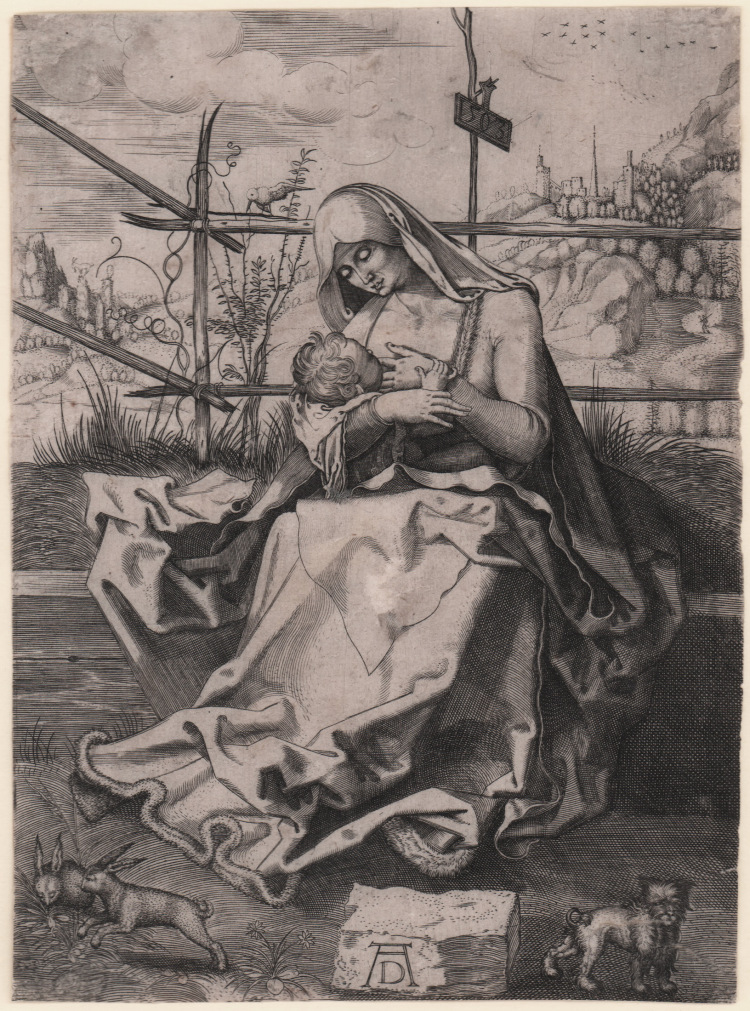
Engraving, late 16th century, monogrammed with the initials AD.
A reverse copy of the famous Virgin on the Grassy Bank, an engraving by Albrecht Dürer executed in 1503. This is the first state of two, before the publisher's address 'Per. Ouerrat excu.'.
In the Maternity of the Virgin on the Grassy Bank, Albrecht Dürer entrusts the engraving with a vision of intimate sacredness, where the tenderness of the maternal gesture merges with a silent and participating nature. The Virgin, gathered in a composed and natural balance, does not dominate the landscape but integrates harmoniously with it, as if creation itself held the mystery of the Incarnation. The naturalistic elements, depicted with extraordinary precision, are not mere backdrops: the grass, the ground, and the modulations of light create a scene of perfect proportion, in which every sign is necessary and nothing is superfluous. The composition reveals a rare balance, the fruit of an absolute control of space and line.
Albrecht Dürer's attention to detail, humanity, and wisdom in depicting the Virgins are well known, as is his recognition of revolutionizing Christian iconography toward a more earthly approach, one that was therefore understandable to believers. This is evident in the way he imbued his Madonnas, in particular, with a maternal spirit and appearance. This evolution was encouraged by two cultural traits inherent to him. On the one hand, his convictions regarding the Lutheran Reformation led him to a more concrete approach to religious iconography. On the other, his profound knowledge of anatomy, the elements, and natural phenomena aided him in the construction of his subjects. His extraordinary manual dexterity, furthermore, allowed him to masterfully implement his reflections.
Peter Overadt (active in Cologne from 1596 to c. 1632) was an important German publisher, cartographer, and engraver. He was part of the second generation of the Cologne school of cartography founded by Frans Hogenberg. After 1600, he focused his printing and publishing house primarily on the production of Catholic sacred and devotional images, including depictions of saints and scenes from the Passion. Peter Overadt's workshop in Cologne (located under the name "Sechszehen Häusern") transformed from a cartographic hub to an important center for the production and distribution of Catholic religious prints, closely linked to the Counter-Reformation.
A magnificent work, rich in tone, printed on contemporary laid paper, trimmed to the plate, slightly thinned on the verso, minor defects, overall in good condition.
Bibliografia
Meder 1932, Dürer Katalog n. 31, copia; Bartsch, Le Peintre graveur VII.54.34, C5; Heller 568.
Pieter OVERADT (attivo a Colonia 1596 - 1632)
|
Peter Overadt is one of the many lesser-known figures of the second generation of the Cologne school of map making, which had been founded about 1570 by Frans Hogenberg. Overadt is noteworthy as the first continental publisher (aside from Jodocus I Hondius, who was at that time active in London) to have decorated printed topographical maps with marginal historical-political images. During the first phase of his business (1592-1600), he issued eight maps, with a three-sheet map of "Germania" as the pinnacle of his production. After 1600, Overadt's firm was primarily engaged in the publication of religious prints with a Catholic orientation. Topographical productions from this later period are three large town views and the re-issue of a map of the Rhine area, printed from a re-worked copper plate of 1594 by Theodoor de Bry.
|