
| Reference: | S52996 |
| Author | Nicolò BETTONI |
| Year: | 1809 ca. |
| Zone: | United States |
| Printed: | Brescia |
| Measures: | 490 x 350 mm |
| Reference: | S52996 |
| Author | Nicolò BETTONI |
| Year: | 1809 ca. |
| Zone: | United States |
| Printed: | Brescia |
| Measures: | 490 x 350 mm |
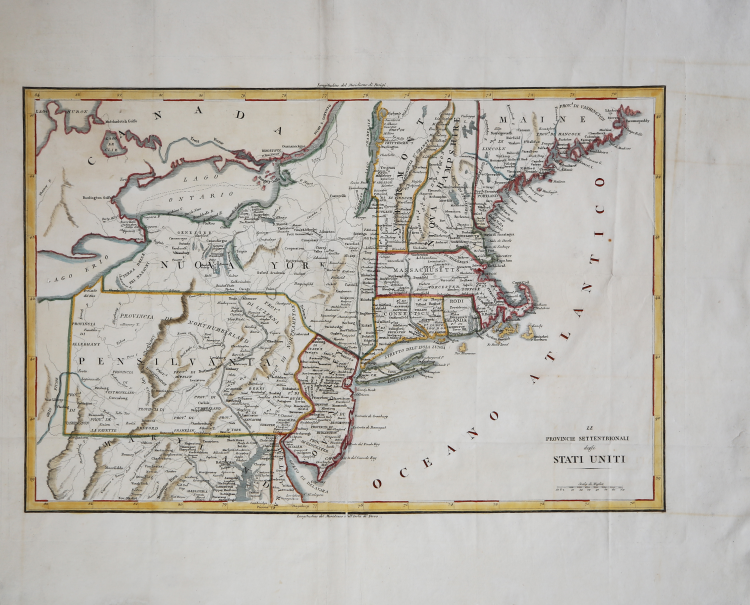
Scarce early 19th Century Italian Map of the Northeastern part of the United States, from Maine to Lake Erie, Maryland & Washington DC. The counties in Pennsylvania and New Jersey are named, and there is substantial other detail throughout, including early roads.
From Carlo Botta’s Storia della guerra dell'indipendenza degli Stati Uniti di America. Edizione eseguita sopra quella del 1819 di questa stessa tipografia approvata e corretta dall'autore., first published in 1809 by Nicolò Bettoni.
Copperplate with fine later hand colour, good condition.
Nicolò BETTONI (Portogruaro, 24 aprile 1770 – Parigi, 19 novembre 1842)
|
Son of Giampietro Bettoni and Angela Zanon, daughter of the wealthy textile industrialist and economics writer Antonio Zanon, he studied at the Seminary of Portogruaro, where he certainly had as a companion Girolamo Ortis, whose tragic end inspired Ugo Foscolo in his Last Letters of Jacopo Ortis. In 1810, he married Maddalena Bellegrandi from Brescia.
In 1787, he attended the Faculty of Law at the University of Padua for just one year.
From 1788, he held various administrative positions. In 1797, following the fall of the Republic of Venice, he was appointed administrator of the province of Udine but resigned after the Treaty of Campoformido. He was called to Brescia in 1800 to serve as Secretary General of the Prefecture of Mella and in 1803 as Inspector of the Departmental Printing Office of Mella.
Having developed a passion for typography following a meeting with Giovanni Bodoni, in 1806 he purchased the "Tipografa Dipartimentale del Mella" (Brescia), where, among other works, the first edition of I Sepolcri by Ugo Foscolo (Bettoni's brother, a Freemason), and the first edition of Iliad by Vincenzo Monti, were printed. His printing house also published "Il redattore del Mella," the official newspaper of the Napoleonic department in Brescia.
In 1808, he opened a second printing house in Padua, under the name "Nicolò Zanon Bettoni," with Latinist Giuseppe Codognato appointed to manage it. The printing house, sold in 1819, continued operating under the name "Tipografa della Minerva."
He opened a third printing house in Alvisopoli in 1810, entrusting its management to his brother Giovanni. Three years later, in 1813, the "Alvisopoli" printing house was sold and moved to Venice, where it gained fame under the direction of Bartolomeo Gamba.
In 1812, "Il redattore del Mella" ceased publication. The printing house began publishing the "Giornale del Dipartimento del Mella," which, in February 1816, changed its name to the "Giornale della Provincia bresciana" in response to the changing political situation.
In 1819, a fourth printing house opened in Milan, near the Teatro alla Scala. Austrian Emperor Francis I, visiting the house in 1825, endorsed a loan of 4,000 florins, which the publisher invested in opening a fifth printing house in Portogruaro, the "N. Bettoni e Figli." When the loan repayment deadline expired, Bettoni began to experience financial problems.
In 1832, after the collapse of the Milan printing press, the printing presses in Brescia and Portogruaro followed. In May, Bettoni decided to move to Florence, where he intended to create the Pantheon of Nations, a series of portraits of illustrious men, but the project failed due to the severity of the Grand Duchy's censorship. In September, he left for Paris, stowing away on the French ship Sully.
In Paris, he resumed the Pantheon of Nations project, the first four installments of which were published in 1835.
After years of misadventures and disappointments, persecuted by creditors, he died in Paris on November 19, 1842.
The Municipal Library of Portogruaro is named after him.
|
Nicolò BETTONI (Portogruaro, 24 aprile 1770 – Parigi, 19 novembre 1842)
|
Son of Giampietro Bettoni and Angela Zanon, daughter of the wealthy textile industrialist and economics writer Antonio Zanon, he studied at the Seminary of Portogruaro, where he certainly had as a companion Girolamo Ortis, whose tragic end inspired Ugo Foscolo in his Last Letters of Jacopo Ortis. In 1810, he married Maddalena Bellegrandi from Brescia.
In 1787, he attended the Faculty of Law at the University of Padua for just one year.
From 1788, he held various administrative positions. In 1797, following the fall of the Republic of Venice, he was appointed administrator of the province of Udine but resigned after the Treaty of Campoformido. He was called to Brescia in 1800 to serve as Secretary General of the Prefecture of Mella and in 1803 as Inspector of the Departmental Printing Office of Mella.
Having developed a passion for typography following a meeting with Giovanni Bodoni, in 1806 he purchased the "Tipografa Dipartimentale del Mella" (Brescia), where, among other works, the first edition of I Sepolcri by Ugo Foscolo (Bettoni's brother, a Freemason), and the first edition of Iliad by Vincenzo Monti, were printed. His printing house also published "Il redattore del Mella," the official newspaper of the Napoleonic department in Brescia.
In 1808, he opened a second printing house in Padua, under the name "Nicolò Zanon Bettoni," with Latinist Giuseppe Codognato appointed to manage it. The printing house, sold in 1819, continued operating under the name "Tipografa della Minerva."
He opened a third printing house in Alvisopoli in 1810, entrusting its management to his brother Giovanni. Three years later, in 1813, the "Alvisopoli" printing house was sold and moved to Venice, where it gained fame under the direction of Bartolomeo Gamba.
In 1812, "Il redattore del Mella" ceased publication. The printing house began publishing the "Giornale del Dipartimento del Mella," which, in February 1816, changed its name to the "Giornale della Provincia bresciana" in response to the changing political situation.
In 1819, a fourth printing house opened in Milan, near the Teatro alla Scala. Austrian Emperor Francis I, visiting the house in 1825, endorsed a loan of 4,000 florins, which the publisher invested in opening a fifth printing house in Portogruaro, the "N. Bettoni e Figli." When the loan repayment deadline expired, Bettoni began to experience financial problems.
In 1832, after the collapse of the Milan printing press, the printing presses in Brescia and Portogruaro followed. In May, Bettoni decided to move to Florence, where he intended to create the Pantheon of Nations, a series of portraits of illustrious men, but the project failed due to the severity of the Grand Duchy's censorship. In September, he left for Paris, stowing away on the French ship Sully.
In Paris, he resumed the Pantheon of Nations project, the first four installments of which were published in 1835.
After years of misadventures and disappointments, persecuted by creditors, he died in Paris on November 19, 1842.
The Municipal Library of Portogruaro is named after him.
|