
| Reference: | CO-023 |
| Author | Pietro BERTELLI |
| Year: | 1598 ca. |
| Zone: | Caprarola |
| Printed: | Venice |
| Measures: | 355 x 245 mm |
| Reference: | CO-023 |
| Author | Pietro BERTELLI |
| Year: | 1598 ca. |
| Zone: | Caprarola |
| Printed: | Venice |
| Measures: | 355 x 245 mm |
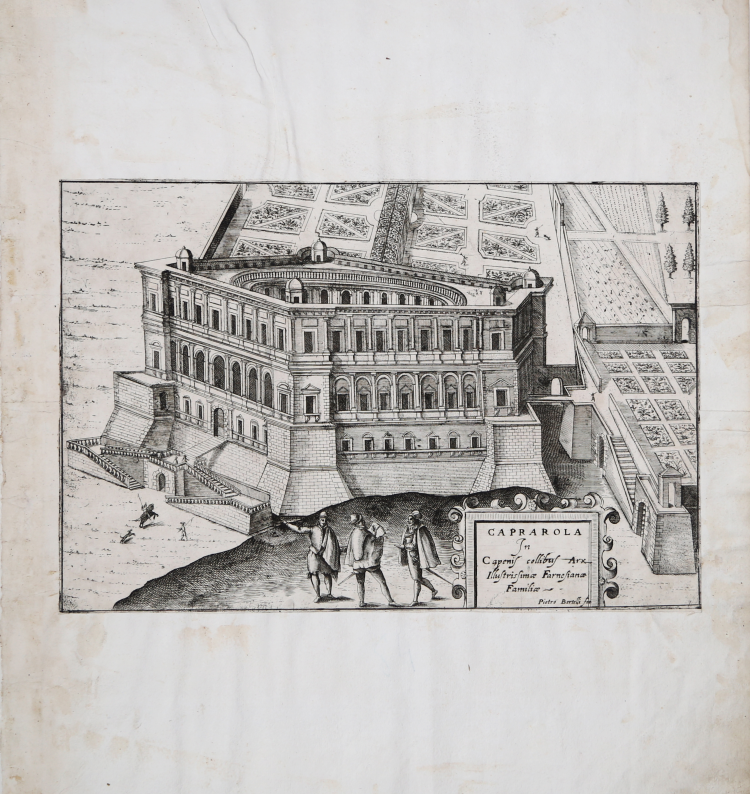
In the lower right, in a frame, is engraved the title: CAPRAROLA In Capenis collibus Arx Illustrissimae Farnesianae Familiae. Pietro Bertelli for.
Perspective view of the Farnese Palace in Caprarola, undated, signed by Pietro Bertelli, one of the last exponents of typography. The palace was one of several stately homes built by the Farnese in their domains. The project for a fortified residence was initially entrusted to Antonio Sangallo by Cardinal Alessandro Farnese the Elder. Work began in 1530, but was suspended in 1546 due to Sangallo's death. They resumed in 1559, entrusted to Giacomo Barozzi da Vignola, who radically modified the original project: the building, while retaining the pentagonal plan of the original fortification, was transformed into an imposing Renaissance palace, completed only in 1575, two years after Vignola's death. The palace was portrayed in the engraving that appears in the fifth volume (Cologne, 1598) of Georg Braun and Fransz Hogenberg's Civitates Orbis Terrarum. This plate signed by Pietro Bertelli is quite similar to the plate included in the Civitates Orbis Terrarum, although it focuses more on the palace and neglects the adjacent gardens. In place of the two figures, here there are three in the foreground, well outlined in the style of Pietro Bertelli's first major work, the Diversarum nationum habitus (Padua 1589-91).
The dating is difficult, as we do not know whether Bertelli's work precedes or derives from Hogenberg's plate; it can certainly be said that it was not made at the time of the end of work on the palace, the date of which (1575) does not coincide with the period of activity of Pietro, son of Ferrando Bertelli, who was born about 1571. His most important topographical work, the Theatrum urbium italicarum collectore Petro Bertellio patavino (Padua 1599) does not include a view of the Farnese palace in Caprarola.
Pietro Bertelli (c. 1571 - 1621) was a publisher, engraver and printer, son of Ferrando Bertelli, who worked in Padua, in the Libreria all'insegna dell'Angelo, Venice and Vicenza. As an engraver, in 1589 he collaborated on some plates in the work Diversarum nationum habitus... consisting of 106 prints, published in collaboration with Alciato Alciati. For Vite degli imperatori de' Turchi con le loro effigie intaglio in rame per i tipi di Giorgio Greco, published in Vicenza in 1599, Bertelli engraved fifteen portraits. In the same year came out the Theatrum Urbium Italicarum, a series of 59 plates with views and plans accompanied by Latin descriptions, executed by several engravers, later reprinted, enlarged, also with the Italian title Teatro delle città d'Italia, for the types of Domenico Amadio. Upon his death, the business continued with his son Francesco, also a printer, engraver and publisher. His typographic mark was a standing angel with outstretched wings, his right forearm pointing upward with his index finger to heaven and a lily in his left hand. The Teatro delle città d'Italia was reprinted several times and implemented by Francesco over the next century.
The print is of incredible rarity; only 2 institutional examples are known [Milan, Raccolta Bertarelli and Wolfenbuttel, Herzog August Bibliothek].
Etching and engraving, impressed on contemporary laid paper, trimmed to the borderline and applied to contemporary paper, in perfect condition.
Bibliografia
S. Bifolco/F. Ronca, Cartografia e topografia italiana del XVI secolo, p. 2135, tav. 1084; Arrigoni Bertarelli (1939): n. 4980.
Pietro BERTELLI (Padova 1571 - 1621)
|
Bertelli family represents the largest group of publishers, engravers, cartographers and merchants of prints of the sixteenth century. Ferrando Bertelli was the most productive, active between 1570, the 1560th, but maps of the last quarter of the century are known by the names of Andrea, Donato, Lucca, Nicholas and Peter. This was mainly active in Padua, where he led a workshop in letterpress and engravings. The earliest records show the asset at the date of 1589 as an engraver of several plates for an edition entitled Diversarum nationum habitus which was published in collaboration with Alciato Alciati. Pietro Bertelli had a library in Padua "the banner of the Angel". At his death the business was inherited by his son Francis. Perhaps son Ferrando Bertelli. He was active mainly in Padua, where he led a workshop in letterpress and engravings. The earliest records show the asset at the date of 1589 as an engraver of several plates for an edition entitled Diversarum nationum habitus which was published in collaboration with Alciato Alciati. Pietro Bertelli had a library in Padua "the banner of the Angel". At his death the business was inherited by his son Francis. Bibliography: Valerio, Cartographers Veneti, p. 149.
|
Pietro BERTELLI (Padova 1571 - 1621)
|
Bertelli family represents the largest group of publishers, engravers, cartographers and merchants of prints of the sixteenth century. Ferrando Bertelli was the most productive, active between 1570, the 1560th, but maps of the last quarter of the century are known by the names of Andrea, Donato, Lucca, Nicholas and Peter. This was mainly active in Padua, where he led a workshop in letterpress and engravings. The earliest records show the asset at the date of 1589 as an engraver of several plates for an edition entitled Diversarum nationum habitus which was published in collaboration with Alciato Alciati. Pietro Bertelli had a library in Padua "the banner of the Angel". At his death the business was inherited by his son Francis. Perhaps son Ferrando Bertelli. He was active mainly in Padua, where he led a workshop in letterpress and engravings. The earliest records show the asset at the date of 1589 as an engraver of several plates for an edition entitled Diversarum nationum habitus which was published in collaboration with Alciato Alciati. Pietro Bertelli had a library in Padua "the banner of the Angel". At his death the business was inherited by his son Francis. Bibliography: Valerio, Cartographers Veneti, p. 149.
|