
- New


| Reference: | S53091 |
| Author | Harmensz van Rijn detto REMBRANDT |
| Year: | 1632 |
| Measures: | 82 x 110 mm |
| Reference: | S53091 |
| Author | Harmensz van Rijn detto REMBRANDT |
| Year: | 1632 |
| Measures: | 82 x 110 mm |
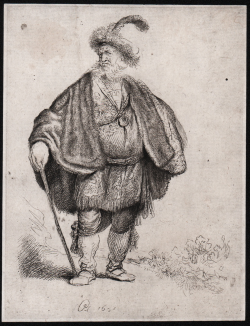
The Persian, a stout bearded man magnificently dressed in a fringed tunic, boots, fur-trimmed cloak and plumed fur beret, whole-length in frontal view leaning with his right hand on a stick, his left hand resting on his hip, his right foot advanced and looking away to left.
Etching, 1632, signed and dated at lower center RHL 1632.
Example of the second state (of three) according to The New Hollstein, with the left outline of the cane strengthened with two lines that touch the right index finger. Only state according White & Boon.
Already in the 18th century this print was known as ‘het Persiaantje’ (the little Persian), because the man’s clothing was perceived as having Oriental features. However, it is not genuine Iranian costume. Although Rembrandt lavished attention on rendering the fabrics, it remains an imaginary, pieced together outfit. This is actually a tronie, but then a full-length one. He stands confidently, leaning on a cane, with his gaze directed away from the viewer, adding a sense of thoughtfulness or contemplation. The figure wears a large, fur-lined cloak that drapes heavily over his shoulders, providing a sense of volume and texture that Rembrandt has captured with meticulous etching techniques. On his head sits a plumed hat, which, along with the various layers and richly ornamented fabrics of his garb, reinforces the exotic perception of the subject’s origin. The detailing on the man’s clothing is indicative of Rembrandt’s keen interest in the play of light and shadow, creating a sense of depth and form.
A fine impression, on laid paper without watermark, thin margins, a light water stain at the upper left, otherwise very good condition.
Bibliografia
The New Hollstein: Dutch and Flemish etchings, engravings and woodcuts 1450-1700 (110. II); Hind, A Catalogue of Rembrandt's Etchings; chronologically arranged and completely illustrated (93); White & Boon, Rembrandt's Etchings: An Illustrated Critical Catalogue (152).
Harmensz van Rijn detto REMBRANDT (Leida 1606 - Amsterdam 1669)
|
Born in Leiden, Holland in 1606, Rembrandt studied with Jacob Isaacsz van Swanenburgh (1571-1638) and Pieter Lastman (1583-1633). By 1626 he was an independent painter, working in Leiden alongside Jan Lievens (1607-74), another pupil of Lastman.
In 1631 Rembrandt moved to Amsterdam where he painted portraits of wealthy merchants. Three years later, he married his first wife, Saskia, and by the end of the 1630s he had moved into a substantial house (now the Rembrandt House Museum). In 1642, the year Rembrandt completed The Nightwatch (Rijksmuseum, Amsterdam), Saskia died.
By 1649, Hendrikje Stoffels had become his housekeeper and partner. Both Saskia and Hendrikje Stoffels posed for many paintings and sketches, often appearing as Susannah, Diana, Flora, Artemisa and other classical or Biblical figures. Rembrandt, however, was plagued by financial troubles and in 1656 his assets were made over to the courts, and many were sold. With his wife and son in financial control, Rembrandt continued to paint. Hendrikje died in 1663, his son Titus in 1668 and Rembrandt himself in 1669.
In his drawings, etchings and paintings, Rembrandt treated every subject: histories, landscapes, portraits, self-portraits, everyday scenes or sketches from nature. Rembrandt's biographer, Cornelis de Bie, praised his paintings, 'which enlighten every mind', and his etchings which are 'the very soul of life that lives therein'.
|
Harmensz van Rijn detto REMBRANDT (Leida 1606 - Amsterdam 1669)
|
Born in Leiden, Holland in 1606, Rembrandt studied with Jacob Isaacsz van Swanenburgh (1571-1638) and Pieter Lastman (1583-1633). By 1626 he was an independent painter, working in Leiden alongside Jan Lievens (1607-74), another pupil of Lastman.
In 1631 Rembrandt moved to Amsterdam where he painted portraits of wealthy merchants. Three years later, he married his first wife, Saskia, and by the end of the 1630s he had moved into a substantial house (now the Rembrandt House Museum). In 1642, the year Rembrandt completed The Nightwatch (Rijksmuseum, Amsterdam), Saskia died.
By 1649, Hendrikje Stoffels had become his housekeeper and partner. Both Saskia and Hendrikje Stoffels posed for many paintings and sketches, often appearing as Susannah, Diana, Flora, Artemisa and other classical or Biblical figures. Rembrandt, however, was plagued by financial troubles and in 1656 his assets were made over to the courts, and many were sold. With his wife and son in financial control, Rembrandt continued to paint. Hendrikje died in 1663, his son Titus in 1668 and Rembrandt himself in 1669.
In his drawings, etchings and paintings, Rembrandt treated every subject: histories, landscapes, portraits, self-portraits, everyday scenes or sketches from nature. Rembrandt's biographer, Cornelis de Bie, praised his paintings, 'which enlighten every mind', and his etchings which are 'the very soul of life that lives therein'.
|