- New
| Reference: | S53090 |
| Author | Harmensz van Rijn detto REMBRANDT |
| Year: | 1648 |
| Measures: | 130 x 75 mm |
| Reference: | S53090 |
| Author | Harmensz van Rijn detto REMBRANDT |
| Year: | 1648 |
| Measures: | 130 x 75 mm |
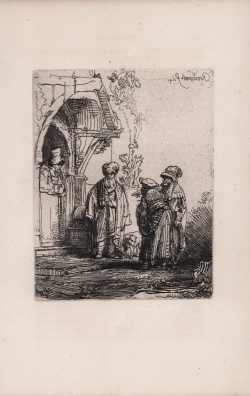
Etching, 1648, signed and dated at the upper side Rembrandt f. 1648.
At left, the man with a cane bends so closely towards the man with whom he is conversing that you wonder if he has a hearing problem. The clothing of all the figures suggests that they are Jews who have gathered in a synagogue. What exactly Rembrandt represents here remains unclear. Perhaps the seated figure is Judas, filled with remorse for betraying Jesus.
Example of the fifht state of nine described in The New Hollstein (n. 242 V/IX), second of three according White & Boon.
A fine impression, on contemporary laid paper without watermark, small margins, very good condition.
Bibliografia
The New Hollstein: Dutch and Flemish etchings, engravings and woodcuts 1450-1700 (242.V/IX); Hind, A Catalogue of Rembrandt's Etchings; chronologically arranged and completely illustrated (234); White & Boon, Rembrandt's Etchings: An Illustrated Critical Catalogue (126 II/III).
Harmensz van Rijn detto REMBRANDT (Leida 1606 - Amsterdam 1669)
|
Born in Leiden, Holland in 1606, Rembrandt studied with Jacob Isaacsz van Swanenburgh (1571-1638) and Pieter Lastman (1583-1633). By 1626 he was an independent painter, working in Leiden alongside Jan Lievens (1607-74), another pupil of Lastman.
In 1631 Rembrandt moved to Amsterdam where he painted portraits of wealthy merchants. Three years later, he married his first wife, Saskia, and by the end of the 1630s he had moved into a substantial house (now the Rembrandt House Museum). In 1642, the year Rembrandt completed The Nightwatch (Rijksmuseum, Amsterdam), Saskia died.
By 1649, Hendrikje Stoffels had become his housekeeper and partner. Both Saskia and Hendrikje Stoffels posed for many paintings and sketches, often appearing as Susannah, Diana, Flora, Artemisa and other classical or Biblical figures. Rembrandt, however, was plagued by financial troubles and in 1656 his assets were made over to the courts, and many were sold. With his wife and son in financial control, Rembrandt continued to paint. Hendrikje died in 1663, his son Titus in 1668 and Rembrandt himself in 1669.
In his drawings, etchings and paintings, Rembrandt treated every subject: histories, landscapes, portraits, self-portraits, everyday scenes or sketches from nature. Rembrandt's biographer, Cornelis de Bie, praised his paintings, 'which enlighten every mind', and his etchings which are 'the very soul of life that lives therein'.
|
Harmensz van Rijn detto REMBRANDT (Leida 1606 - Amsterdam 1669)
|
Born in Leiden, Holland in 1606, Rembrandt studied with Jacob Isaacsz van Swanenburgh (1571-1638) and Pieter Lastman (1583-1633). By 1626 he was an independent painter, working in Leiden alongside Jan Lievens (1607-74), another pupil of Lastman.
In 1631 Rembrandt moved to Amsterdam where he painted portraits of wealthy merchants. Three years later, he married his first wife, Saskia, and by the end of the 1630s he had moved into a substantial house (now the Rembrandt House Museum). In 1642, the year Rembrandt completed The Nightwatch (Rijksmuseum, Amsterdam), Saskia died.
By 1649, Hendrikje Stoffels had become his housekeeper and partner. Both Saskia and Hendrikje Stoffels posed for many paintings and sketches, often appearing as Susannah, Diana, Flora, Artemisa and other classical or Biblical figures. Rembrandt, however, was plagued by financial troubles and in 1656 his assets were made over to the courts, and many were sold. With his wife and son in financial control, Rembrandt continued to paint. Hendrikje died in 1663, his son Titus in 1668 and Rembrandt himself in 1669.
In his drawings, etchings and paintings, Rembrandt treated every subject: histories, landscapes, portraits, self-portraits, everyday scenes or sketches from nature. Rembrandt's biographer, Cornelis de Bie, praised his paintings, 'which enlighten every mind', and his etchings which are 'the very soul of life that lives therein'.
|