
| Reference: | A53188 |
| Author | Harmensz van Rijn detto REMBRANDT |
| Year: | 1639 |
| Measures: | 200 x 245 mm |
| Reference: | A53188 |
| Author | Harmensz van Rijn detto REMBRANDT |
| Year: | 1639 |
| Measures: | 200 x 245 mm |
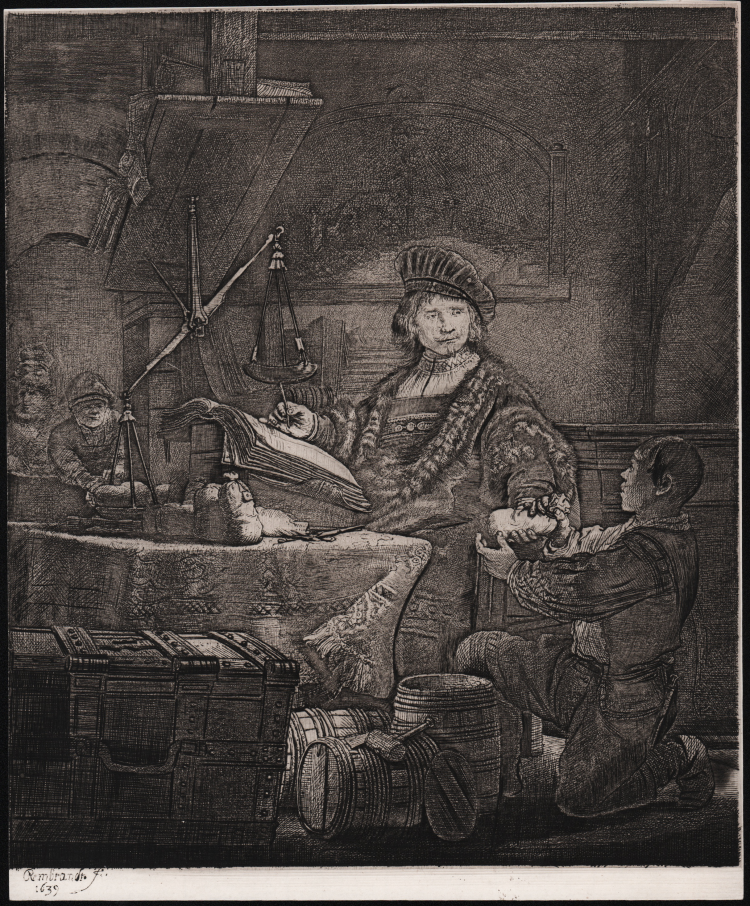
Portrait of Jan Uytenbogaert, 'The Goldweigher'; a well-dressed man sitting in a fur-trimmed cloak and soft beret at a table, writing in a ledger while handing a small bag to a youth who kneels beside him, with chests and barrels in left foreground, a scale hanging from a hanging-shelf above the table which is littered with bags and coins; with a picture of Moses and the brazen serpent on the wall behind and a man and woman waiting at a counter in left background.
Etching with drypoint, 1639, signed and dated at lower left Rembrandt f. 1639.
Example of the third state, reworked by William Baillie.
Jan Uytenbogaert (1608–1680) was Holland’s Receiver-General, or chief tax collector. Rembrandt may have met him in Leiden in the early 1630s, when Uytenbogaert was studying law and Rembrandt was studying painting. In Amsterdam, they both enjoyed collecting prints.
Rembrandt may have etched this print as a token of gratitude to Uytenbogaert for his intervention on the artist’s behalf. In 1639, the year of this print, Rembrandt sought to purchase a house in Amsterdam but lacked the necessary down payment, as he was still waiting to receive compensation for the paintings he had completed for Frederick Henry, Prince of Orange. Uytenbogaert’s overture on the artist’s behalf was successful, and Rembrandt’s purchase of the house followed soon after.
In this portrait, the artist depicts Uytenbogaert exercising his professional duties. He sits at a carpet-covered table topped with gold-weighing scales and bags of gold, and records payments in a ledger. A kneeling servant accepts one of the bags. To the left, a couple carrying bags of gold are about to enter. Light and dark passages animate the space, with drypoint used to describe the velvety character of his fur coat and hat. One wonders if Rembrandt consulted with Uytenbogaert before composing this conceptually and technically ambitious etching. The profusion of anecdotal detail recalls Northern graphic traditions of a century earlier, reflecting the collecting tastes of both men.
This print of the tax collector Jan Uytenbogaert marks one of Rembrandt van Rijn’s first uses of drypoint, not as a corrective tool but as a supplement to an etching. Here the technique accentuates the velvety quality of the sitter’s rich fur garment.
A good impression, printed on laid paper without watermark, trimmed to the platemark, in good condition.
Bibliografia
The New Hollstein: Dutch and Flemish etchings, engravings and woodcuts 1450-1700 (172. III); Hind, A Catalogue of Rembrandt's Etchings; chronologically arranged and completely illustrated (167); White & Boon, Rembrandt's Etchings: An Illustrated Critical Catalogue (281 II).
Harmensz van Rijn detto REMBRANDT (Leida 1606 - Amsterdam 1669)
|
Born in Leiden, Holland in 1606, Rembrandt studied with Jacob Isaacsz van Swanenburgh (1571-1638) and Pieter Lastman (1583-1633). By 1626 he was an independent painter, working in Leiden alongside Jan Lievens (1607-74), another pupil of Lastman.
In 1631 Rembrandt moved to Amsterdam where he painted portraits of wealthy merchants. Three years later, he married his first wife, Saskia, and by the end of the 1630s he had moved into a substantial house (now the Rembrandt House Museum). In 1642, the year Rembrandt completed The Nightwatch (Rijksmuseum, Amsterdam), Saskia died.
By 1649, Hendrikje Stoffels had become his housekeeper and partner. Both Saskia and Hendrikje Stoffels posed for many paintings and sketches, often appearing as Susannah, Diana, Flora, Artemisa and other classical or Biblical figures. Rembrandt, however, was plagued by financial troubles and in 1656 his assets were made over to the courts, and many were sold. With his wife and son in financial control, Rembrandt continued to paint. Hendrikje died in 1663, his son Titus in 1668 and Rembrandt himself in 1669.
In his drawings, etchings and paintings, Rembrandt treated every subject: histories, landscapes, portraits, self-portraits, everyday scenes or sketches from nature. Rembrandt's biographer, Cornelis de Bie, praised his paintings, 'which enlighten every mind', and his etchings which are 'the very soul of life that lives therein'.
|
Harmensz van Rijn detto REMBRANDT (Leida 1606 - Amsterdam 1669)
|
Born in Leiden, Holland in 1606, Rembrandt studied with Jacob Isaacsz van Swanenburgh (1571-1638) and Pieter Lastman (1583-1633). By 1626 he was an independent painter, working in Leiden alongside Jan Lievens (1607-74), another pupil of Lastman.
In 1631 Rembrandt moved to Amsterdam where he painted portraits of wealthy merchants. Three years later, he married his first wife, Saskia, and by the end of the 1630s he had moved into a substantial house (now the Rembrandt House Museum). In 1642, the year Rembrandt completed The Nightwatch (Rijksmuseum, Amsterdam), Saskia died.
By 1649, Hendrikje Stoffels had become his housekeeper and partner. Both Saskia and Hendrikje Stoffels posed for many paintings and sketches, often appearing as Susannah, Diana, Flora, Artemisa and other classical or Biblical figures. Rembrandt, however, was plagued by financial troubles and in 1656 his assets were made over to the courts, and many were sold. With his wife and son in financial control, Rembrandt continued to paint. Hendrikje died in 1663, his son Titus in 1668 and Rembrandt himself in 1669.
In his drawings, etchings and paintings, Rembrandt treated every subject: histories, landscapes, portraits, self-portraits, everyday scenes or sketches from nature. Rembrandt's biographer, Cornelis de Bie, praised his paintings, 'which enlighten every mind', and his etchings which are 'the very soul of life that lives therein'.
|