
| Reference: | S16979 |
| Author | Francesco Faraone AQUILA |
| Year: | 1724 |
| Measures: | 350 x 560 mm |
| Reference: | S16979 |
| Author | Francesco Faraone AQUILA |
| Year: | 1724 |
| Measures: | 350 x 560 mm |
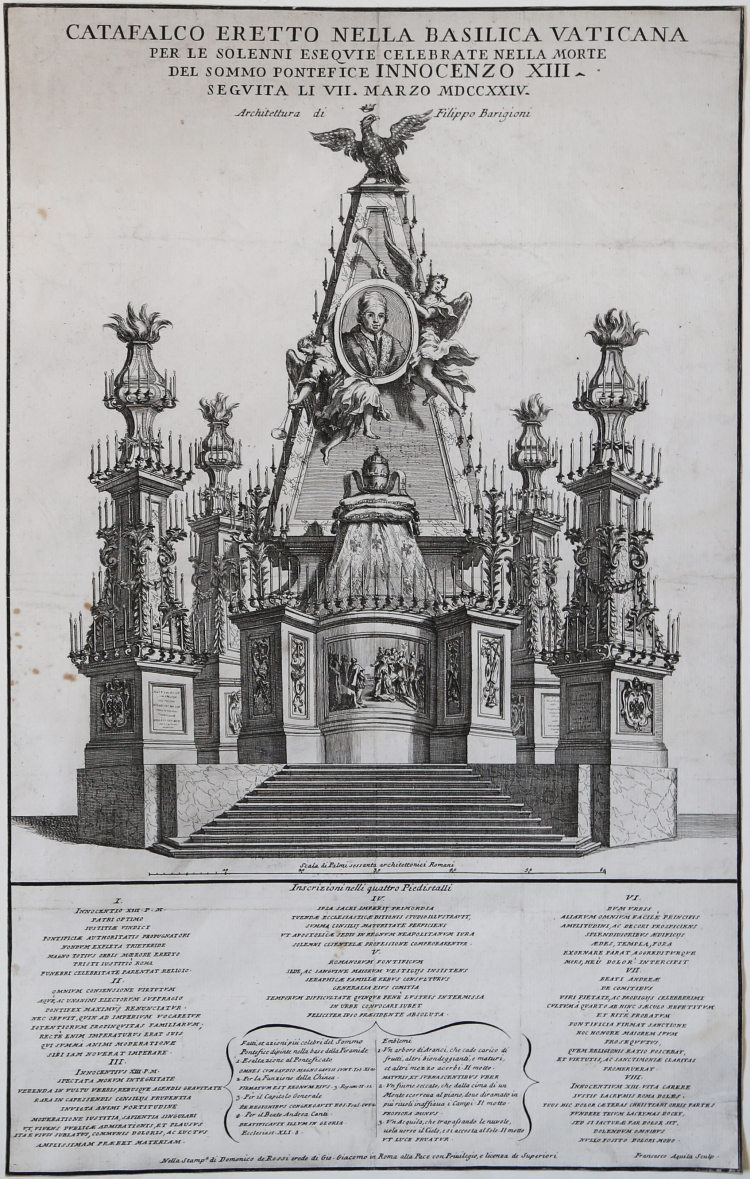
CATAFALCO ERETTO NELLA BASILICA VATICANA PER LE SOLENNI ESEQUIE CELEBRATE NELLA MORTE DEL SOMMO PONTEFICE CLEMENTE XI, SEGUITA LI XIX MARZO MDCCXXI. Architettura di Filippo Barigioni.
Etching, 1724, signed on the plate lower right "Francesco Aquila Sculp."
It depicts the catafalque erected in the Vatican for the funeral of Pope Innocent XIII.
Francesco Faraone Aquila (or dell'Aquila) (Palermo, 1676 – Rome, 1740) was an Italian engraver who followed in the footsteps of his brother or nephew Pietro. He moved to Rome in 1690, where Pietro had already been known for decades for his work as an engraver for the capital's major engraving workshops. Pietro, a priest, opened the doors of Roman ecclesiastical patronage to him. Pope Clement XI commissioned what remained his greatest achievement, the engraving of the bas-reliefs on the Column of Antoninus Pius. Following the antiquarian taste that was gaining traction during the 18th century, Francesco Aquila engraved various works from the Roman classical era: statues, vases, and triumphal arches, thus meeting the demand, especially from foreign visitors, mostly German and English. His portraits of his contemporaries, both painters and clerics, were also very famous.
A good impression, printed on contemporary laid paper, trimmed at the margins, with traces of paper creases visible on the verso, otherwise in good condition. Very rare.
Francesco Faraone AQUILA (Palermo 1676 circa – Roma 1740 circa)
|
Francesco Faraone Aquila (or dell'Aquila) (Palermo, 1676 – Rome, 1740) was an Italian engraver who followed in the footsteps of his brother Pietro. Other sources suggest that Francesco was not Pietro Aquila's brother but rather his nephew, and chronological data may indeed confirm this second hypothesis, given that Pietro was of the previous generation and died in 1692. Little is known about his life. We know that in 1690 he moved to Rome, where his brother had already been known for decades for his work as an engraver for the capital's major engraving workshops. Pietro, who was a priest, opened the doors of Roman ecclesiastical patronage for him. Pope Clement XI commissioned him to carry out what would become his greatest achievement: the engraving of the bas-reliefs of the Column of Antoninus Pius and its pedestal. This work remains invaluable today, as the reliefs are subject to deterioration due to atmospheric agents and the loss of the column in a fire in 1759, of which only the base remains, preserved in the Vatican Museums. In 1713, Domenico de Rossi published Raccolta di vasi diversi formati da illvstri artefici antichi e di varie targhe soprapposte alle Fabbriche più insigni di Roma..". The plates of which were designed and engraved by Pharaoh Aquila. Another very important work by Francesco Aquila was the engraving of Correggio's fresco in the dome of Parma Cathedral and that of Raphael's Vatican apartments. But Gori Gandellini, in his book Notizie storici degli intagliatori (Historical News of the Engravers), leaves us a long list of engravings of paintings and frescoes, both Renaissance and Baroque, by Aquila, including those by Carlo Maratta, Francesco Albani, Lanfranco, Ciro Ferri, Pietro da Cortona, Pier Leone Ghezzi, and countless others. Following the antiquarian taste that was gaining traction during the eighteenth century, Francesco Aquila engraved various works from the Roman classical era: statues, vases, triumphal arches, thus meeting the demand, especially from foreign visitors, mostly German and English. His portraits of his contemporaries, both painters and clergy, were also very famous.
|
Francesco Faraone AQUILA (Palermo 1676 circa – Roma 1740 circa)
|
Francesco Faraone Aquila (or dell'Aquila) (Palermo, 1676 – Rome, 1740) was an Italian engraver who followed in the footsteps of his brother Pietro. Other sources suggest that Francesco was not Pietro Aquila's brother but rather his nephew, and chronological data may indeed confirm this second hypothesis, given that Pietro was of the previous generation and died in 1692. Little is known about his life. We know that in 1690 he moved to Rome, where his brother had already been known for decades for his work as an engraver for the capital's major engraving workshops. Pietro, who was a priest, opened the doors of Roman ecclesiastical patronage for him. Pope Clement XI commissioned him to carry out what would become his greatest achievement: the engraving of the bas-reliefs of the Column of Antoninus Pius and its pedestal. This work remains invaluable today, as the reliefs are subject to deterioration due to atmospheric agents and the loss of the column in a fire in 1759, of which only the base remains, preserved in the Vatican Museums. In 1713, Domenico de Rossi published Raccolta di vasi diversi formati da illvstri artefici antichi e di varie targhe soprapposte alle Fabbriche più insigni di Roma..". The plates of which were designed and engraved by Pharaoh Aquila. Another very important work by Francesco Aquila was the engraving of Correggio's fresco in the dome of Parma Cathedral and that of Raphael's Vatican apartments. But Gori Gandellini, in his book Notizie storici degli intagliatori (Historical News of the Engravers), leaves us a long list of engravings of paintings and frescoes, both Renaissance and Baroque, by Aquila, including those by Carlo Maratta, Francesco Albani, Lanfranco, Ciro Ferri, Pietro da Cortona, Pier Leone Ghezzi, and countless others. Following the antiquarian taste that was gaining traction during the eighteenth century, Francesco Aquila engraved various works from the Roman classical era: statues, vases, triumphal arches, thus meeting the demand, especially from foreign visitors, mostly German and English. His portraits of his contemporaries, both painters and clergy, were also very famous.
|