

| Reference: | S46996 |
| Author | Renè BOYVIN |
| Year: | 1566 |
| Measures: | 120 x 175 mm |
| Reference: | S46996 |
| Author | Renè BOYVIN |
| Year: | 1566 |
| Measures: | 120 x 175 mm |
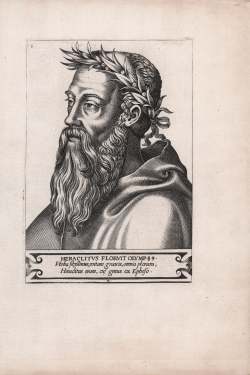
Engraving, 1566, signed on the plate at the bottom with the artist's monogram.
Part of a series of twelve portraits of Greek and Roman philosophers, titled 'Illustrium philosophorum et poetarum effigies', published in 1566 by P. de Roville in Paris.
René Boyvin's engravings were soon spread by other engravers. Boyvin’s prints were copied (twelve plates) also in Italy by Girolamo Olgiati, Illustrium philosophorum et sapientium effigies ab eorum numismatibus extractae (Venice: Girolamo Olgiati, editions ca 1567/1568-1583).
René Boyvin was born at Angers about 1520, and settled in Paris about 1545, joining the workshop of the printmaker Pierre Milan. He was closely involved in Protestant circles, became the portrait engraver for leading reformers, and in 1569 was imprisoned in Paris for his religious beliefs.
A fine impression, printed on contemporary laid paper, with margins, very good condition. Rare.
Bibliografia
Robert-Dumesnil, Le peintre-graveur français (Paris 1850), VIII, pp.54-57 nos. 91-102 ; Jacques Levron, René Boyvin, graveur angevin du XVIe siècle: avec le catalogue de son oeuvre et la reproduction de 114 estampes (Paris 1941), pp.68-69 nos. 58-69; IFF 16e siècle 2; LeBlanc nn. 215-226.
Renè BOYVIN (Angers 1525 ca. - Roma 1580 ca.)
|
French engraver, etcher and designer. Vasari, in his Vita of Marcantonio Raimondi, mentions that ‘after the death of Rosso [Fiorentino], we saw the arrival from France of all the engravings of his works’. He attributed this upsurge of engraved reproductions ‘to the copperplate engraver René’, that is René Boyvin. He came to Paris c. 1545 from Angers, where he was an associate of the mint. In Paris he might have been in contact with Antonio Fantuzzi, and he is known to have renewed a contract of service with the engraver Pierre Milan in 1549. In 1553 he completed two plates that Milan had failed to finish for the music publisher Guillaume Morlaye (c. 1510–after 1558); one of these was the Nymph of Fontainebleau. He later opened his own workshop, and it is known that Lorenzo Penni, the son of Luca, was working for him in October 1557. Boyvin survived for many years despite the Calvinist beliefs for which he was imprisoned in January 1569. He seems to have published nothing under his own name between 1569 and 1574. His last dated work is from 1580, but it appears that he was still alive well into the 17th century.
|
Renè BOYVIN (Angers 1525 ca. - Roma 1580 ca.)
|
French engraver, etcher and designer. Vasari, in his Vita of Marcantonio Raimondi, mentions that ‘after the death of Rosso [Fiorentino], we saw the arrival from France of all the engravings of his works’. He attributed this upsurge of engraved reproductions ‘to the copperplate engraver René’, that is René Boyvin. He came to Paris c. 1545 from Angers, where he was an associate of the mint. In Paris he might have been in contact with Antonio Fantuzzi, and he is known to have renewed a contract of service with the engraver Pierre Milan in 1549. In 1553 he completed two plates that Milan had failed to finish for the music publisher Guillaume Morlaye (c. 1510–after 1558); one of these was the Nymph of Fontainebleau. He later opened his own workshop, and it is known that Lorenzo Penni, the son of Luca, was working for him in October 1557. Boyvin survived for many years despite the Calvinist beliefs for which he was imprisoned in January 1569. He seems to have published nothing under his own name between 1569 and 1574. His last dated work is from 1580, but it appears that he was still alive well into the 17th century.
|