
| Reference: | S49978 |
| Author | Giovanni Paolo Bianchi |
| Year: | 1636 ca. |
| Zone: | Oleggio |
| Printed: | Milan |
| Measures: | 340 x 240 mm |
| Reference: | S49978 |
| Author | Giovanni Paolo Bianchi |
| Year: | 1636 ca. |
| Zone: | Oleggio |
| Printed: | Milan |
| Measures: | 340 x 240 mm |
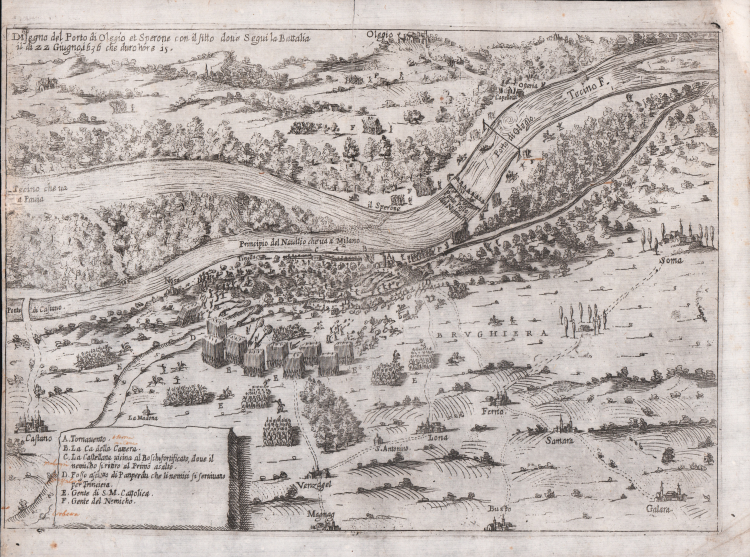
A high oblique etched view of the Battle of Tornavento, fought on 22 June 1636 between the French, commanded by Charles de Créquy, Duc de Lesdiguières (1578-1638) and Victor Amadeaus, Duke of Savoy (8 May 1587-7 October 1637) and the Spanish, commanded by the Marquis of Leganés (1580-1655) resulting in a French-Savoyard victory. Franco-Spanish War (1635-1659). Oriented with west to top.
The 'Sperone' which is mentioned in the title is now represented by a building in the tiny administrative area of Alzaia del Naviglio, a small settlement just a few metres to the south. It is on the east bank of the River Ticino. The river, which today marks the boundary between Piedmont on the west, and Lombardy on the east, has changed course over the centuries since this print was made. It is unclear what the symbol, which links 'il Sperone' with the island represents. It may be a ford. A pontoon bridge to the right of this feature is followed, a little further upstream, by a representation of a ferry which is prevented from being drawn in to the adjacent whirlpool by being attached by a rope to an overhead line which is anchored by a post on each bank of the river.
For stylistic reasons, we attribute the plate to the printing house of Giovanni Paolo Bianchi. The work is extremely rare. In addition to the copy in the Royal Collection, one is included in the Doria Atlas.
Bibliografia
McDonald (2019): p. 713, n. 3001; Sotheby’s (2005): pp. 165-196, e pp. 302-323, n. 174.
Giovanni Paolo Bianchi (Milano 1590 - 1654 circa)
|
Giovanni Paolo Bianchi was born in Milan around 1590 and worked here as an engraver, draughtsman and, perhaps, painter. He was also a cartographic engraver and publisher "all'insegna della Balla"; active in 1617 and again in 1654.
Bianchi appears to have been enrolled in 1620 as an engraver at the Accademia di Belle Arti at the Ambrosiana in Milan. He then worked, almost exclusively, for the best-known Milanese printers and publishers, especially for G. B. Bidelli, the Malatesta, the Ponzio: accurate and diligent are his engravings with burin, although the engraving mark is often uncertain (Le Blanc, in his Manuel de l'amateur d'estampes, I [Paris 1854, p. 333], lists twenty-four), taken from drawings by D. Fiasella, B. Castelli, A. Lanzani, D. Piola, Frà Molina, G. C. Storer, A. Tempesta, and also, especially for thesis heads, from his own invention. He signed "Bianchi G. P. fece," "Blanc.", "Blancus" "Io. Pau. Blancus," etc., often followed by the indication "Mediolanensis" or "in Milano." The dedications of his prints testify to the vast circle of interests and relationships he had with the society of his time.
Among the headings for "theses" (see the fonds of the Civica Raccolta delle stampe Bertarelli, Milan, and the Bibl. Civica di Bergamo) are those for Francesco della Somaglia, discussed at the Brera college (1644), and for Angelo Francesco Porro in the church of SS. Cosma e Damiano (Feb. 1654); among the publications for degrees those for Giberto Borromeo (s.d.) and for Giacomo Francesco Attendolo Bolognini (1642). (cf. Fabia Borroni - Dizionario Biografico degli Italiani - Volume 10 (1968))
|
Giovanni Paolo Bianchi (Milano 1590 - 1654 circa)
|
Giovanni Paolo Bianchi was born in Milan around 1590 and worked here as an engraver, draughtsman and, perhaps, painter. He was also a cartographic engraver and publisher "all'insegna della Balla"; active in 1617 and again in 1654.
Bianchi appears to have been enrolled in 1620 as an engraver at the Accademia di Belle Arti at the Ambrosiana in Milan. He then worked, almost exclusively, for the best-known Milanese printers and publishers, especially for G. B. Bidelli, the Malatesta, the Ponzio: accurate and diligent are his engravings with burin, although the engraving mark is often uncertain (Le Blanc, in his Manuel de l'amateur d'estampes, I [Paris 1854, p. 333], lists twenty-four), taken from drawings by D. Fiasella, B. Castelli, A. Lanzani, D. Piola, Frà Molina, G. C. Storer, A. Tempesta, and also, especially for thesis heads, from his own invention. He signed "Bianchi G. P. fece," "Blanc.", "Blancus" "Io. Pau. Blancus," etc., often followed by the indication "Mediolanensis" or "in Milano." The dedications of his prints testify to the vast circle of interests and relationships he had with the society of his time.
Among the headings for "theses" (see the fonds of the Civica Raccolta delle stampe Bertarelli, Milan, and the Bibl. Civica di Bergamo) are those for Francesco della Somaglia, discussed at the Brera college (1644), and for Angelo Francesco Porro in the church of SS. Cosma e Damiano (Feb. 1654); among the publications for degrees those for Giberto Borromeo (s.d.) and for Giacomo Francesco Attendolo Bolognini (1642). (cf. Fabia Borroni - Dizionario Biografico degli Italiani - Volume 10 (1968))
|