

| Reference: | A53495 |
| Author | Mario GIOFFREDO |
| Year: | 1768 |
| Printed: | Naples |
| Measures: | 300 x 450 mm |
| Reference: | A53495 |
| Author | Mario GIOFFREDO |
| Year: | 1768 |
| Printed: | Naples |
| Measures: | 300 x 450 mm |
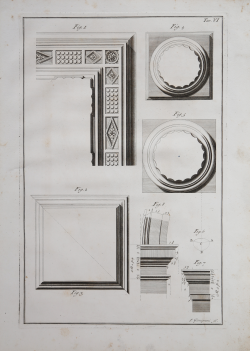
Large plate depicting the architectural orders, the work of Mario Gioffedo who published it in the rare treatise Dell’Architettura di Mario Geoffredo Architetto Napoletano, published in Naples in 1768.
Mario Gioffredo, also known as the Neapolitan Vitruvius, was an architect, engineer, engraver, and topographer. An innovative architect in the graphic representation of projects, he had a largely humanistic education and attended Solimena's workshop, learning drawing techniques. He frequented the studio of Martino Buonocore and also read the classical theoretical treatises of Vitruvius and Renaissance architects, such as Palladio. He began to travel, learning about antiquities and other subjects, and designed buildings in many cities of the Kingdom of Naples, including Campania, Abruzzo, and Calabria, as well as in Naples. He was among the first to discover the antiquities of Herculaneum, Pompeii, and Stabiae, and especially Paestum, where he rediscovered, among other things, the Basilica dedicated to Hera and the temples dedicated to Neptune and Athena. This occurred in 1746. Motivated by archaeological discoveries, he turned toward eighteenth-century classicism, whose architecture anticipated the neoclassical models of the following century. Gioffredo was also involved in the design of festive machines, in this activity the architect distanced himself from his classicist architecture to use in this case, as he believed, a more lively and popular style: the Rococo.
Etching, printed on contemporary laid paper, light foxing, otherwise good condition.
Mario GIOFFREDO (Napoli 1718 - 1785)
|
Mario Gioffredo, also known as the Neapolitan Vitruvius, was an architect, engineer, engraver, and topographer. An innovative architect in the graphic representation of projects, he had a largely humanistic education and attended Solimena's workshop, learning drawing techniques. He frequented the studio of Martino Buonocore and also read the classical theoretical treatises of Vitruvius and Renaissance architects, such as Palladio. He began to travel, learning about antiquities and other subjects, and designed buildings in many cities of the Kingdom of Naples, including Campania, Abruzzo, and Calabria, as well as in Naples. He was among the first to discover the antiquities of Herculaneum, Pompeii, and Stabiae, and especially Paestum, where he rediscovered, among other things, the Basilica dedicated to Hera and the temples dedicated to Neptune and Athena. This occurred in 1746. Motivated by archaeological discoveries, he turned toward eighteenth-century classicism, whose architecture anticipated the neoclassical models of the following century. Gioffredo was also involved in the design of festive machines, in this activity the architect distanced himself from his classicist architecture to use in this case, as he believed, a more lively and popular style: the Rococo.
|
Mario GIOFFREDO (Napoli 1718 - 1785)
|
Mario Gioffredo, also known as the Neapolitan Vitruvius, was an architect, engineer, engraver, and topographer. An innovative architect in the graphic representation of projects, he had a largely humanistic education and attended Solimena's workshop, learning drawing techniques. He frequented the studio of Martino Buonocore and also read the classical theoretical treatises of Vitruvius and Renaissance architects, such as Palladio. He began to travel, learning about antiquities and other subjects, and designed buildings in many cities of the Kingdom of Naples, including Campania, Abruzzo, and Calabria, as well as in Naples. He was among the first to discover the antiquities of Herculaneum, Pompeii, and Stabiae, and especially Paestum, where he rediscovered, among other things, the Basilica dedicated to Hera and the temples dedicated to Neptune and Athena. This occurred in 1746. Motivated by archaeological discoveries, he turned toward eighteenth-century classicism, whose architecture anticipated the neoclassical models of the following century. Gioffredo was also involved in the design of festive machines, in this activity the architect distanced himself from his classicist architecture to use in this case, as he believed, a more lively and popular style: the Rococo.
|