
| Reference: | S30435 |
| Author | Jacques CALLOT |
| Year: | 1633 |
| Measures: | 115 x 57 mm |
| Reference: | S30435 |
| Author | Jacques CALLOT |
| Year: | 1633 |
| Measures: | 115 x 57 mm |
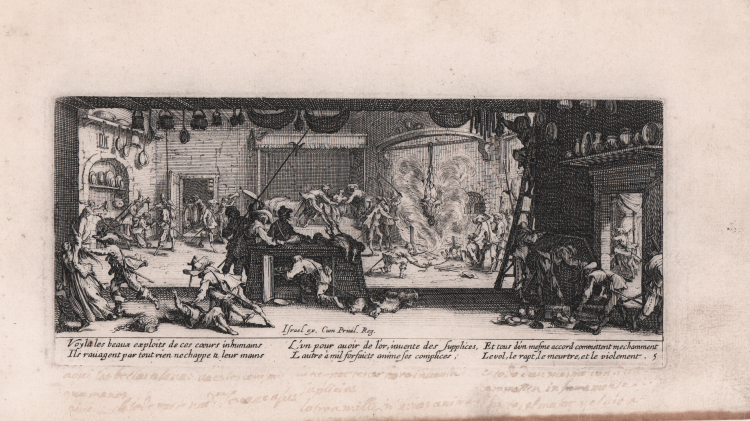
Etching, 1633, from the Large Miseries of War.
Second state, dated 1633 (in the title page) and with the plate numbered.
A very good impression, printed on contemporary laid paper, with “hunting horn” watermark (Lieure 47), with margins, very good condition.
Callot etched two series of prints illustrating the miseries of the war. The first, in a smaller format and therefore called the Small Miseries of War, consist of six prints, which Callot etched ca. 1632. The Small Miseries are usually treated as a preliminary sketches for the more famous Large Miseries.
Les Grandes Misères et Malheurs de la Guerre, issued in 1633, during the course of the pan-European conflict known as the Thirty Years War, with a royal privilege from Louis XIII. The series consist of 18 etchings, included the title pahe.
The size of the etched images is quite small, 113-115 x 51-57 mm; this would compel a viewer to examine them in close physical proximity, so as to be able to see each print clearly. Their wide, shallow rectangular shape creates an elongation of the pictorial field that promotes a scanning mode of viewing. Moreover, the text below the image, also oriented horizontally, enforces this directional viewing as the eye moves across the printed sheet from left to right. The broad, full landscape pictured in each image draws attention to the general actions of a large number of people as opposed to a few detailed figures. The landscapes and the people within them bear no obvious markers of national specificity or identity. In fact, the lack of these kinds of referents allows the print series to examine the nature of warfare in general, without recourse to the sorts of polemic questions normally taken up by propagandistic images from the period
Except the titlepage, each plate is accompanied by six lines of verse, in the form of three rhyming couplets, attribued to Michel de Marolles, Abbé de Villeloin. It seems reasonable since the Abbé was a prolific poet and print collector, who owned, in fact, some 1648 prints by Callot.
The series begins with three plates depicting war in the narrow sense of the word: the title page, which shows the emblems of war, the “Enlisting of the Troops”, and “The Battle”.
The next five print, 4-8, show show crimes committed by soldiers: the pillage of an inn, of an house, of a cloister, of a village, and attack on travelers.
The next print, numbered 9, illustrates the capture of the soldier-marauders.
It is followed by five prints, 10-14, showing the punishments of these soldiers: by strappado, hanging, firing squad, pyre, and wheel.
Three prints, 15-17, illustrating misfortunes of soldiers come next: sick and wounded refuge, dying on the road, and a vengeful attack by peasants.
The last print, 18, showing the distribution of awards to soldiers.
Callot’s prints are characterized by clear daylight, wide-angle perspective, meticulous drawing, and figures who display little emotion.
In the first half of the 17th century, Jacques Callot renewed the language of graphic art by developing and enhancing the potential of etching. Born in Nancy in 1592, he completed his artistic training in Italy, staying in Rome between 1608 and 1611, were he learned to engrave with a burin and established his first contacts with the engraver community. His patron, between 1612 and 1620, was Cosimo II de' Medici, at whose court he earned great renown both as an engraver of refined skill and as a judge of taste and intelligence. The years of his Florentine sojourn were filled with works that cemented his fame. After Cosimo II's death in 1621, Callot returned to Nancy, where he received new illustrious patrons, including the Duke of Lorraine and the Infanta of Spain. His fame was finally cemented with the commission, received through Richelieu, to engrave The Siege of La Rochelle and the Île de Ré for the King of France, Louis XIII. In 1630, he began collaborating with the publisher Israel Henriet in Paris, who edited many of his works. For his inexhaustible inventiveness in subject matter, his technical expertise, and his attention to detail and the minuscule, Callot's work stands as a decisive benchmark for the entire development of European engraving.
|
Diane Wolfthal, The Art Bulletin , Vol. 59, N. 2 (Jun., 1977), pp. 222-233; Lieure, 1339-1356.
|
Jacques CALLOT (Nancy 1592 - 1635)
|
He was a baroque graphics artist, draftsman and printmaker from the Duchy of Lorraine (an independant state on the North-Eastern border with France). He made etchings that chronicled the people and the life of his period (soldiers, clowns, drunkards, wanderers, beggars, and various outcasts). These images of people are often contrasted by spectacular landscapes (see, for instance, "The Temptation of St. Anthony"). His skill in shading and his use of different tones were remarkable for the period and he is often compared to Albrecht Dürer.
|
|
Diane Wolfthal, The Art Bulletin , Vol. 59, N. 2 (Jun., 1977), pp. 222-233; Lieure, 1339-1356.
|
Jacques CALLOT (Nancy 1592 - 1635)
|
He was a baroque graphics artist, draftsman and printmaker from the Duchy of Lorraine (an independant state on the North-Eastern border with France). He made etchings that chronicled the people and the life of his period (soldiers, clowns, drunkards, wanderers, beggars, and various outcasts). These images of people are often contrasted by spectacular landscapes (see, for instance, "The Temptation of St. Anthony"). His skill in shading and his use of different tones were remarkable for the period and he is often compared to Albrecht Dürer.
|