
| Reference: | A53342 |
| Author | François Tortebat |
| Year: | 1667 |
| Measures: | 190 x 270 mm |
| Reference: | A53342 |
| Author | François Tortebat |
| Year: | 1667 |
| Measures: | 190 x 270 mm |
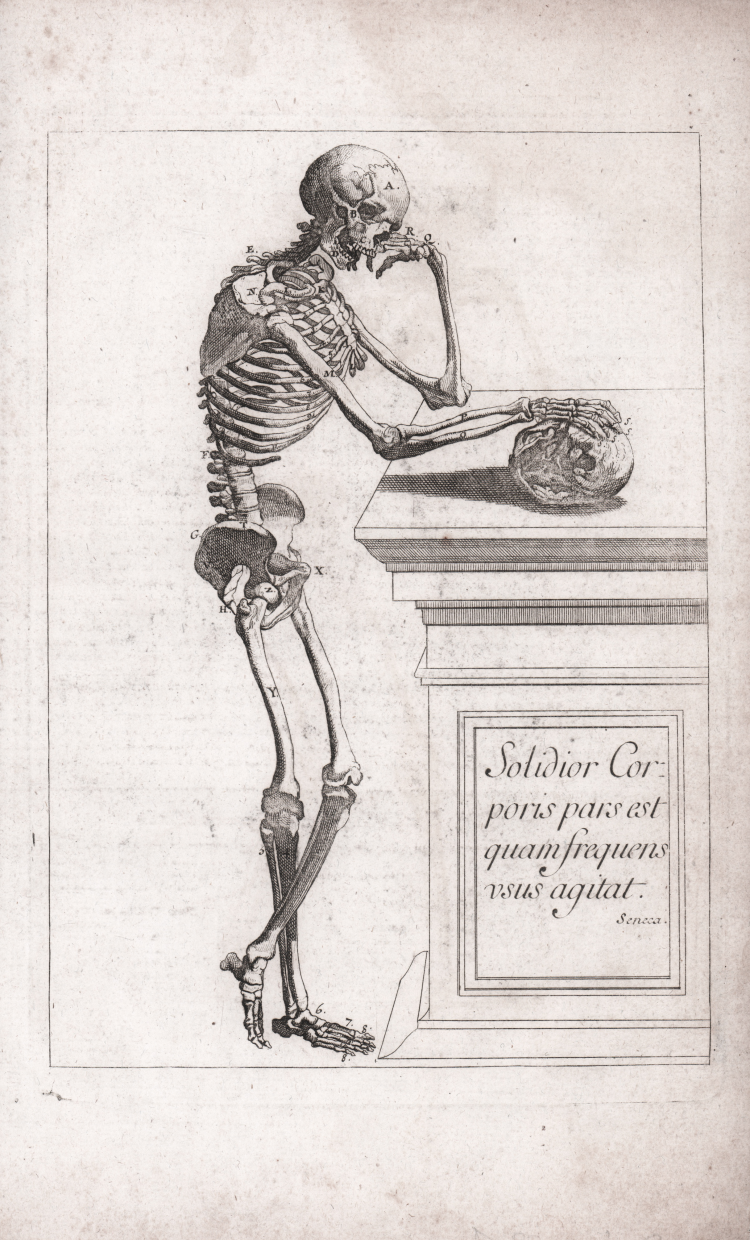
Memento Mori derived from the model introduced by Andreas Vesalius in his De humani corporis fabrica, published in 1543. The figure depicts a skeleton in a melancholic pose, leaning against a tomb while meditating on death, an image that blends scientific precision and high artistic value.
The inscription on the gravestone reads, "Solidior Corporis pars est quam frequens vsus agitat" (The most solid part of the body is that which frequent use makes active) by Lucius Seneca.
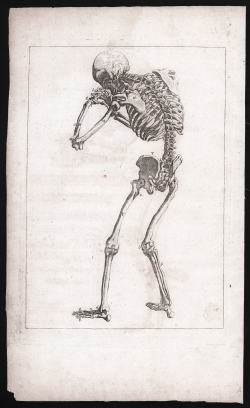
This engraving was created to illustrate the Abregé d'anatomie accomodé aux arts de peinture et de sculpture, ouvrage tres-utile, et tres-necessaire à tous ceux qui font profession du dessein. Mis en lumière par Francois Tortebat. A rare treatise on anatomy intended for artists, first published in 1667 and considered the finest reproduction ever made of the plates of Vesalius, the founder of modern anatomy. This work is the result of a collaboration between Roger de Piles (1635-1709) and the engraver François Tortebat (1621-1690).
Etching, with margins, in excellent condition.
François Tortebat Parigi, 1616 circa – 1690
|
François Tortebat was a French painter and engraver. Tortebat was the son of Louis Tortebat and Marguerite de Nameur, aunt of the historical painter Louis de Nameur. He studied in the studio of Simon Vouet around 1631. On November 9, 1643, he married his master's eldest daughter, Françoise, with whom he had twenty-nine children. Among them was Jean Tortebat, admitted as a painter to the Académie Royale de Peinture et de Sculpture on October 3, 1699. Tortebat stayed in Rome between 1635 and 1640, where he made large copies of Raphael's tapestry cartoons at the request of Cardinal Antonio Barberini. Upon his return to France, he joined Vouet's studio. After Simon Vouet's death in 1649, Tortebat collaborated with another of Vouet's son-in-laws, Michel Dorigny, and obtained the right to reproduce his works through engraving. He designed the stage sets for Louis XIV's return to Paris with his new wife, Maria Theresa of Spain, in 1660. On March 31, 1663, François Tortebat became a member of the Académie Royale and presented a posthumous portrait of Vouet as an induction work. Tortebat also published a series of engravings based on Carracci paintings housed in the Palazzo Magnani in Bologna. He produced the engravings for Roger de Piles's book Abrégé d'anatomie accommodé aux arts de peinture et de sculpture, published in 1668. He died in Paris on June 4, 1690.
|
François Tortebat Parigi, 1616 circa – 1690
|
François Tortebat was a French painter and engraver. Tortebat was the son of Louis Tortebat and Marguerite de Nameur, aunt of the historical painter Louis de Nameur. He studied in the studio of Simon Vouet around 1631. On November 9, 1643, he married his master's eldest daughter, Françoise, with whom he had twenty-nine children. Among them was Jean Tortebat, admitted as a painter to the Académie Royale de Peinture et de Sculpture on October 3, 1699. Tortebat stayed in Rome between 1635 and 1640, where he made large copies of Raphael's tapestry cartoons at the request of Cardinal Antonio Barberini. Upon his return to France, he joined Vouet's studio. After Simon Vouet's death in 1649, Tortebat collaborated with another of Vouet's son-in-laws, Michel Dorigny, and obtained the right to reproduce his works through engraving. He designed the stage sets for Louis XIV's return to Paris with his new wife, Maria Theresa of Spain, in 1660. On March 31, 1663, François Tortebat became a member of the Académie Royale and presented a posthumous portrait of Vouet as an induction work. Tortebat also published a series of engravings based on Carracci paintings housed in the Palazzo Magnani in Bologna. He produced the engravings for Roger de Piles's book Abrégé d'anatomie accommodé aux arts de peinture et de sculpture, published in 1668. He died in Paris on June 4, 1690.
|