

| Reference: | S6745 |
| Author | MAESTRO I.F. |
| Year: | 1542 |
| Measures: | 395 x 250 mm |
| Reference: | S6745 |
| Author | MAESTRO I.F. |
| Year: | 1542 |
| Measures: | 395 x 250 mm |
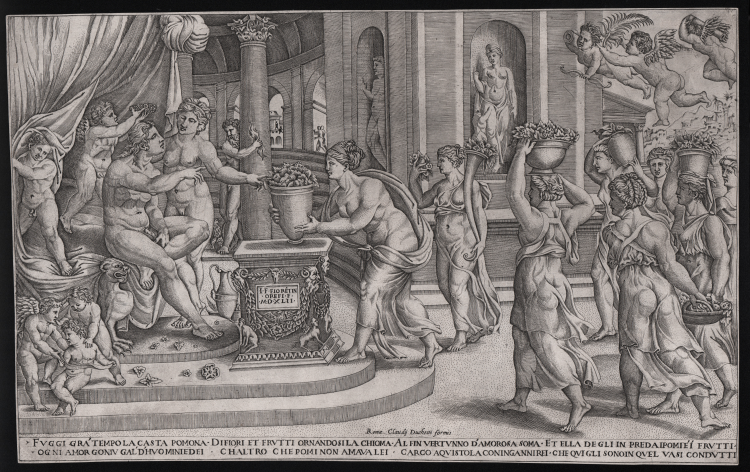
Engraving 1542, dated and monogrammed on plate at centre.
Example in the second state of two, with the address of the editor Claudio Duchet.
Beautiful proof, on laid paper, "Shield with letter M and star" watermark (Briquet 8390-91-92), trimmed at the platemark, in very good condition. The artist known by the initials "I.F." is unidentified, although he has often been mistaken for Giovanni Francia.
The print, which probably reproduces a Raphael school drawing that is now lost, is presented in the same orientation as the fresco once visible in the Casino Bevilacqua, also known by the titles The Offerings to Vertumnus and Pomona, The Awakening of Alexander and Roxane, or The Feast of Flora or Venus and Adonis.
According to Passavant's description, who observed the fresco before it was removed from the Casino, this subject was the centerpiece of the vaulted ceiling of the room decorated with The Marriage of Alexander and Roxane. He attributes the paintings to Perin del Vaga. More recently, however, Hunter has attributed them to the circle of Girolamo Siciolante.
The marriage of Vertumnus and Pomona is a Roman myth from Ovid's Metamorphoses, where Vertumnus, the god of changing seasons, wins the reclusive garden goddess Pomona by disguising himself as an old woman to teach her the virtues of love and marriage, finally revealing his true form, causing her to fall for him, leading to their union as a symbol of fertility and harmonious seasons in art and literature.
This print, datable to the year 1542, is the only known graphic work by this interesting artist. Very rare.
|
Passavant, 1889, II, p. 270; J.B. Hunter, The Life and Work of Girolamo Siciolante da Sermoneta, pp. 30 e 140-146; Bartsch XV, pp. 502-3, 1; TIB, 31, p. 368; Massari, Tra Mito e Allegoria, p. 114, 35 II.
|
|
Florentine goldsmith active in the first half of the sixteenth century.
|
|
Passavant, 1889, II, p. 270; J.B. Hunter, The Life and Work of Girolamo Siciolante da Sermoneta, pp. 30 e 140-146; Bartsch XV, pp. 502-3, 1; TIB, 31, p. 368; Massari, Tra Mito e Allegoria, p. 114, 35 II.
|
|
Florentine goldsmith active in the first half of the sixteenth century.
|