

| Reference: | S51396 |
| Author | Andrew Bell |
| Year: | 1810 ca. |
| Zone: | Etna |
| Printed: | Edinburgh |
| Measures: | 170 x 230 mm |
| Reference: | S51396 |
| Author | Andrew Bell |
| Year: | 1810 ca. |
| Zone: | Etna |
| Printed: | Edinburgh |
| Measures: | 170 x 230 mm |
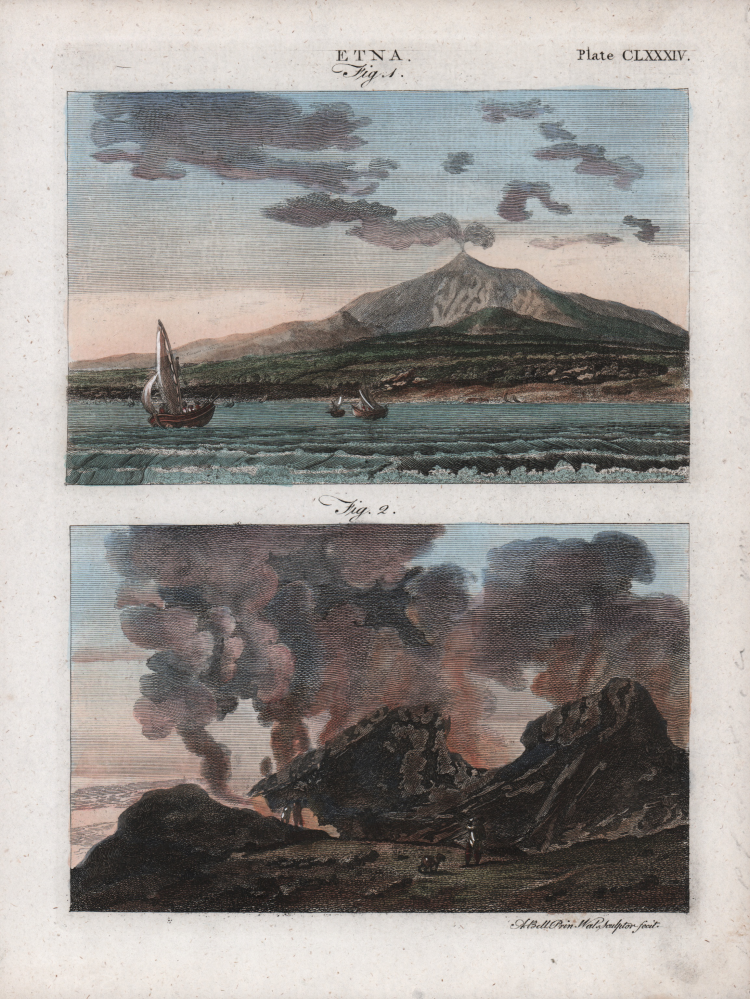
Two views in one sheet taken from Encyclopaedia Britannica Or a Dictionary of Arts, Sciences and Miscellaneous Litterature.
The Encyclopaedia Britannica (original name, in Latin, Encyclopædia Britannica) is one of the major encyclopedias in the English language; its first edition is dated 1768-71 in Edinburgh, Scotland, as Encyclopædia Britannica, or, A dictionary of Arts and Sciences, Compiled upon a New Plan.
A product of the Scottish Enlightenment, the Britannica was originally published in Edinburgh in the second half of the 18th century. The first Britannica came from the minds of Colin Macfarquhar, a bookseller and printer, and Andrew Bell, an engraver, who published the work under the pseudonym Society of Gentlemen. They conceived Britannica as a conservative reaction to Denis Diderot's French Encyclopédie (published 1751-1766).
Etching, printed on contemporary laid paper and finely hand coloured, in very good condition.
|
Andrew Bell was a Scottish engraver and printer, who co-founded Encyclopædia Britannica with Colin Macfarquhar. Bell produced almost all of the copperplate engravings for the 1st-4th editions of the Britannica: 160 for the 1st, 340 for the 2nd, 542 for the 3rd, and 531 for the 4th.
|
|
Andrew Bell was a Scottish engraver and printer, who co-founded Encyclopædia Britannica with Colin Macfarquhar. Bell produced almost all of the copperplate engravings for the 1st-4th editions of the Britannica: 160 for the 1st, 340 for the 2nd, 542 for the 3rd, and 531 for the 4th.
|