
- New
| Reference: | S52052 |
| Author | Anonimo |
| Year: | 1580 ca. |
| Measures: | 70 x 105 mm |
| Reference: | S52052 |
| Author | Anonimo |
| Year: | 1580 ca. |
| Measures: | 70 x 105 mm |
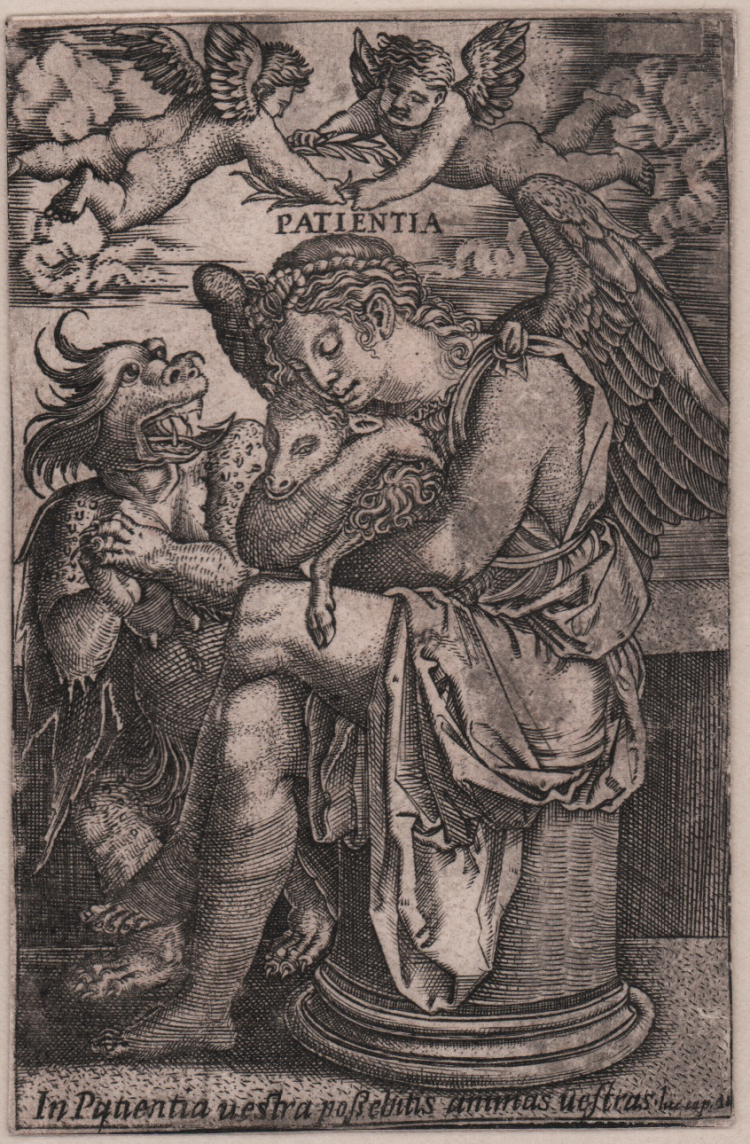
Allegory of Patience depicted with a winged female figure in antique dress and seated with her eyes closed on the base of a column, her legs crossed and holding a sheep in her lap. On the left, we find a demonic creature with a disfigured face looking at the two putti hovering in the clouds and holding a laurel wreath on the head of the female figure.
Reverse copy after Sebald Beham (Pauli 141).
Engraving, second half of the XVI Century, unsigned. Lettered 'PATIENTIA' above the figure and lettered in lower edge: “In Patientia vestra possidebitis animas vestras”. This quotation from the Gospel of Luke (21:19) indicates that patience is the key to self-control, intellectual control, and control of the will. It also means that spiritual salvation can be achieved through patience.
The print, probably Italian in origin, is likely based on the copy of Beham's engraving made by Giovan Battista de Cavalleris in 1561 (Pauli 141b/c), which features verses from the Gospel of Luke engraved at the bottom.
The work is part of a group of independent engravings of allegorical figures that Beham designed between 1539 and 1541. They are always placed in the foreground, with few attributes surrounding them, and in this sense follow the format of the contemporary bronze plates of similar subject matter and similarly small size made by Peter Flötner of Nuremberg.
The allegory of Patience is a widespread and iconographic theme of sacred allegory, which has left recurrent evidence in the visual arts, particularly in painting and printed illustration. The iconography, from its initial contents of distinctly theological inspiration, has undergone a shift into "profane" territory, which occurred in the time frame around the middle of the 16th century, the results of which lent themselves to use in political key, in the historical climate of the Italian Renaissance courts. The personification of this virtue, as a rule, pursues a moralizing intent, moving, therefore, on a theological ground that reflects the tradition of the Gospel and patristic doctrine, following the Christian philosophy of the early centuries, elaborated by the Church Fathers and ecclesiastical writers.
A very good impression, printed on contemporary laid paper, trimmed to copperplate, in excellent condition. Very rare work, not described by Pauli.
Collection mark on verso, of Reverend James Burleigh (Lugt 1425).
Bibliografia
Cfr. Pauli 1901-11, Hans Sebald Beham: Ein Kritisches Verzeichniss seiner Kupferstiche Radirungen und Holzschnitte (141); Hollstein, German engravings, etchings and woodcuts c.1400-1700 (141.IV); Bartsch, Le Peintre graveur (VIII.168.138); Bartrum 1995, German Renaissance Prints 1490-1550 (99).
Anonimo
Anonimo